e-Governance moved onto phones once smartphones became widespread. This article covers the key case studies, platforms and success stories showing how mobile access reshaped citizen services.


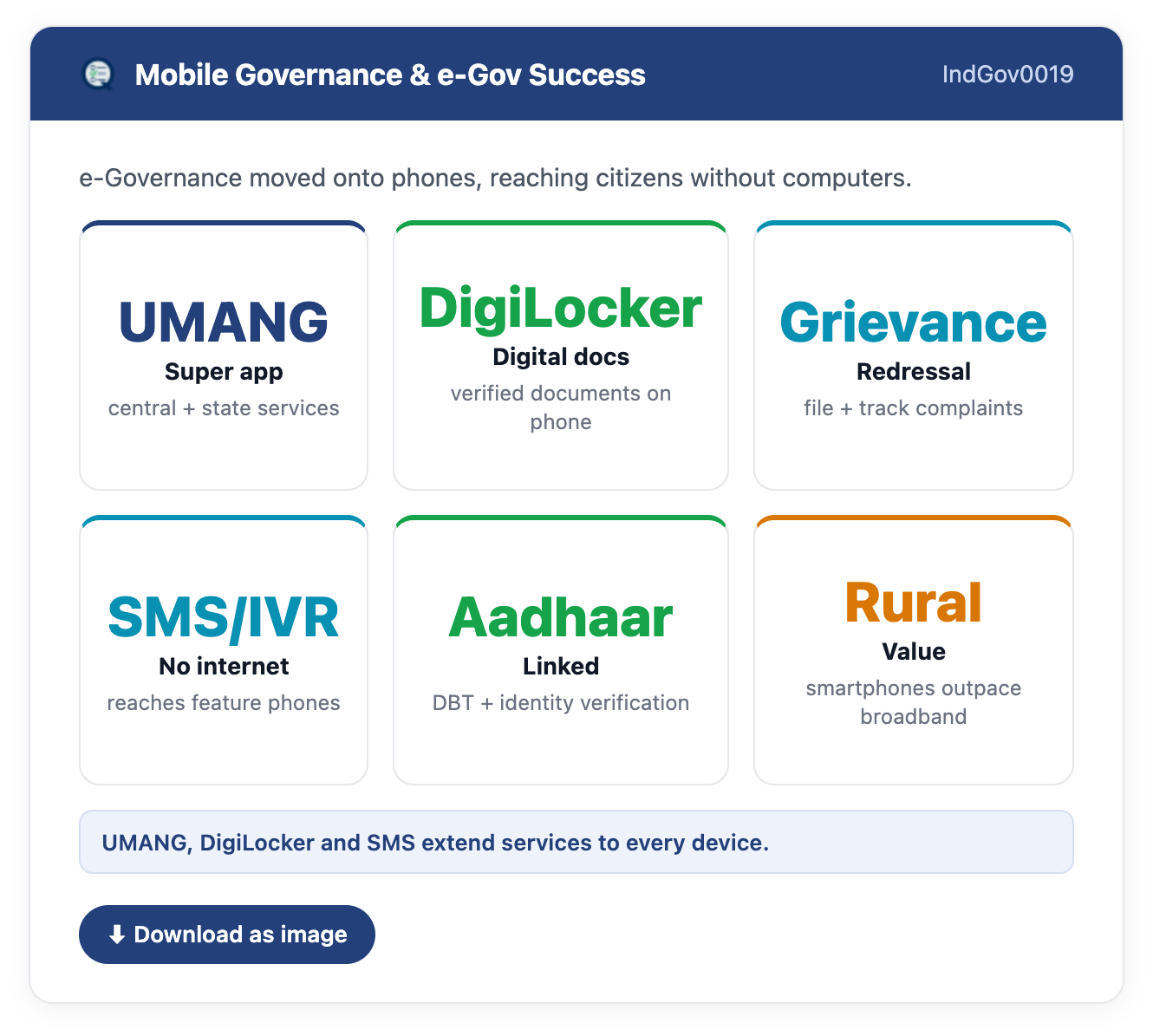
Must Know
Mobile Governance and e-Governance Success Stories
What Mobile Governance Is, and the UMANG App
- DefinitionMobile governance (m-governance) extends e-governance services to mobile phones, reaching citizens without requiring computer or broadband access. It grew once smartphones became widespread in India.
- UMANGUMANG consolidates numerous central and state services into a single mobile platform, offering thousands of services across ministries and departments so citizens don’t need a separate app per service.
DigiLocker and Mobile Grievance Redressal
- DigiLockerDigiLocker lets citizens store and share verified official documents digitally, accessible directly through mobile devices, holding documents like driving licences, insurance and certificates.
- Grievance RedressalMobile platforms let citizens file and track complaints against departments from their phones, making it easier to hold officials answerable for service delivery.
SMS/IVR Access, and India Stack & UPI
- SMS and IVRSMS and IVR extend basic e-governance to feature phones without internet, serving citizens who cannot use a smartphone or app.
- India StackIndia Stack is a set of open digital public infrastructure built around Aadhaar. The Unified Payments Interface (UPI), part of that stack, enables instant mobile payments between bank accounts, making digital payments a daily, phone-based activity for millions.
Good to Know
Sectoral Success Stories
Aadhaar-Linked Services, and mKisan
- Aadhaar-LinkedAadhaar-linked mobile services enable DBT and identity verification, avoiding in-person visits to government offices. The mAadhaar app puts the Aadhaar card and its data on a phone.
- mKisanmKisan sends farmers advisory messages on crops, weather and schemes, extending agricultural information to farmers through their own phones.
eSanjeevani Telemedicine, and Rural Reach
- eSanjeevanieSanjeevani is India’s national telemedicine service, letting patients consult doctors remotely from their phones.
- Rural ValueSmartphone penetration has outpaced fixed broadband in rural areas, letting rural users leapfrog the need for fixed-line internet entirely.
Multilingual Interfaces, and Health & Safety Apps
- MultilingualMultilingual interfaces widen access for citizens comfortable in regional languages, reducing the English- and Hindi-only barrier to digital services.
- Health and SafetyApps like Aarogya Setu and CoWIN carried health and vaccination services during the pandemic; apps and SMS also help deliver emergency and public-safety information more broadly.
Test Yourself
Loading practice…
Great to Know
Lessons and Design Choices
Match Technology to Access, and Build an Ecosystem
- LessonMobile governance succeeds by matching technology to actual device access, not to assumed infrastructure.
- EcosystemAadhaar, mobile platforms and digital documents create an ecosystem greater than any single tool. UPI, DigiLocker and UMANG work together to deliver end-to-end services, not as isolated apps.
The Digital Divide, and Data Privacy
- Digital DivideA continued digital divide means mobile governance must pair with offline alternatives, to avoid excluding citizens without smartphone access.
- Privacy and SecurityAs services move to phones, protecting personal data becomes critical. Convenience must be balanced against security and consent, not assumed as a free byproduct of going digital.
Current Affairs
📰 Current Affairs
UMANG at Three Years: 11.66 Crore Users, 798 Crore Transactions
- The NumbersOn 7 August 2026, the Ministry of Electronics and IT told the Rajya Sabha that UMANG has registered over 11.66 crore users and processed about 798 crore transactions over three years. (Source: The Tribune, citing the IT Ministry)
- ScaleAs of 31 July 2026, 2,575 services were active on UMANG, 880 from the Central Government and 1,695 from State Governments, spanning services this article’s own Must Know card already names.
- So WhatThis is the concrete, current-day proof of the “one app for government services” idea this article’s UMANG card describes, not just a design philosophy but a platform now used by more than a tenth of India’s population.
PYQ
Exam Point of View
UPSC CSP 2017: What UPI Actually Does to Mobile Wallets
- QuestionUPSC CSP 2017 asked for UPI’s most likely consequence for mobile wallets.
- AnswerThe correct answer is that mobile wallets become unnecessary for online payments, since UPI moves money directly between bank accounts rather than through a stored-wallet balance. View this question on the full UPSC CSP 2017 paper →.
- Why It FitsThis is exactly this article’s own India Stack and UPI card: UPI is not just another mobile payment app alongside wallets, it structurally replaces the need for one.
Beyond the answer
Browse all indian-polity-and-constitution topics →
📚 Keep reading
IndGov0022 — Digital IndiaIndEco0080 — Production-Linked Incentive (PLI) SchemeSciTech0003 — Science and Technology in Daily Life: Health, Connectivity and SustainabilityIndEco0006 — Service SectorIndSoc0084 — Mobile Phones and Child Socialization: A Changing Childhood❓ Practice this topic
Preamble Quiz: 5 Questions with ExplanationsPolity0391 — Article 47 of the ConstitutionPolity0390 — Article 46 of the ConstitutionPolity0389 — Article 30 of the Constitution🎲 Take a Indian Polity And Constitution Quiz
Leave a Reply