At the exact midnight hour India became free, one woman sang a song that marked the moment forever. Sucheta Kripalani’s own story runs from a 10-year-old’s quiet anger at British rule, through a dangerous peace mission, to a seat no Indian woman had held before. This lesson follows her complete arc, from resistance to government.

All India Mahila Congress: The women’s wing of the Indian National Congress, founded by Kripalani in 1940, years before the midnight session she is best remembered for.
Noakhali peace mission: Gandhi’s 1946 village-to-village walk through a district (now in Bangladesh) hit by severe religious violence, aimed at calming the killing in person.
1.How did Kripalani’s childhood shape her later anger at injustice?
1.1What did a 10-year-old overhear about Jallianwala Bagh?
A frequently-moved childhood still left room for one sharp, early lesson in injustice.
- Sucheta Kripalani grew up in a Bengali family. Her father was a doctor, and his job moved the family often, so she attended many different schools.
- At just 10 years old, she heard her father and his friends discuss the Jallianwala Bagh massacre, where British soldiers had shot at a peaceful crowd.
- The children around her were so angry that they took it out in a small, sad way, calling their own Anglo-Indian playmates names. Even as a child, Sucheta had already felt the sting of British rule.
1.2Why did even Gandhi oppose her 1936 marriage at first?
A marriage both families resisted went on to last a lifetime.
- In 1936, Sucheta married fellow freedom fighter Acharya J.B. Kripalani, a well-known Congress leader twenty years her senior. Both families objected, and even Mahatma Gandhi did not approve at first.
- Gandhi eventually changed his mind and let the marriage go ahead. It lasted the rest of their lives.
2.What happened when she sang Vande Mataram at midnight?
2.1What moment did her song mark?
One song captured the exact hour a nation became free.
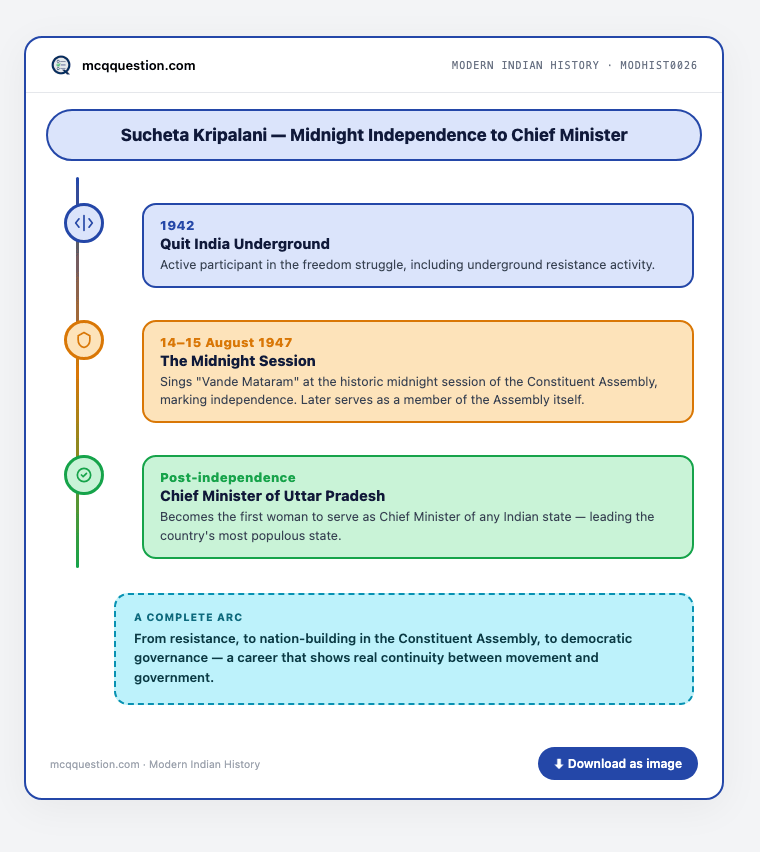
- Kripalani sang “Vande Mataram” at the historic midnight session of the Constituent Assembly, on the night of 14-15 August 1947, the exact hour India became independent.
- She had already been an active participant in the freedom struggle before that night, including underground activity during the Quit India Movement of 1942.
True or false: Sucheta Kripalani had already been active in the freedom struggle, including the underground Quit India Movement, before her midnight moment in 1947.
2.2How dangerous was the Noakhali peace mission she walked alongside Gandhi?
This was a real risk to her safety, not a ceremonial role.
- In 1946, severe religious violence broke out in Noakhali, a district now in Bangladesh. Gandhi went there in person, walking village to village to calm people and stop the killing.
- Kripalani went with him, working closely alongside Gandhi right in the middle of the violence. It was not a safe, symbolic role.
True or false: Kripalani’s role in the freedom movement was purely symbolic, with no involvement in dangerous or risky situations.
3.How did she move from resistance to nation-building?
3.1What did she do in the Constituent Assembly?
Her role shifted from the streets to the drafting table.
- Kripalani was a member of the Constituent Assembly, helping draft independent India’s own Constitution.
- Her career bridged the freedom struggle and independent India’s early democratic institutions, spanning both the movement itself and the government that followed it.
3.2What milestone did she reach as Chief Minister?
One state government post made her the first woman in India to hold it.
- After independence, Kripalani became the first woman to serve as Chief Minister of an Indian state, leading Uttar Pradesh, the country’s most populous state.
- Her path traced a complete arc: underground Quit India activity, Constituent Assembly membership, then a state’s Chief Minister, moving from resistance to nation-building to democratic governance.
- Becoming the first woman Chief Minister of any Indian state marked a genuine milestone for women’s political representation in the newly independent country, not just a symbolic honour.
4.How did she handle a 62-day strike as Chief Minister?
4.1What happened during UP’s first government employees’ strike?
A long standoff tested her resolve as the state’s leader.
- Kripalani served as UP Chief Minister from 2 October 1963 to 13 March 1967. During her term, the state faced its first-ever government employees’ strike, which dragged on for 62 long days.
- She stood firm and refused to give in to the workers’ demand for higher pay, even under heavy pressure. In the end, the strike leaders agreed to a compromise, not her.
4.2What was her life beyond the midnight session?
Her organising work began years before the moment she is best remembered for.
- Kripalani founded the All India Mahila Congress in 1940, the party’s women’s wing, well before independence.
- She stayed married to J.B. Kripalani for the rest of both their lives, the same marriage that once faced so much early opposition. She died in 1974.
True or false: Sucheta Kripalani founded the All India Mahila Congress, the party’s women’s wing, in 1940, years before independence.
4.3Why is the office she first held still being filled by women?
Her 1963 milestone still shapes who leads Indian states today.
- On 20 February 2025, Rekha Gupta was sworn in as Delhi’s Chief Minister, becoming Delhi’s fourth woman to hold the post.
- Alongside West Bengal’s Mamata Banerjee, she is one of two women currently leading an Indian state or union territory, more than 60 years after Kripalani opened this list in 1963.
5.Exam Angle: How does CDS test India’s first woman CM?
CDS (II) 2025, General Knowledge, Question 14.
This question asked who India’s first woman Chief Minister was. The answer is Sucheta Kripalani. All three other options are real, well-known women in Indian public life, which is the trap. Sarojini Naidu became a state Governor, not Chief Minister. Only Kripalani led a state government directly, as UP’s CM from 1963 to 1967.
MCQ on Sucheta Kripalani
Question 1 of 1
Question 1 of 1
Question 1 of 1
Question 1 of 1
Question 1 of 1
Question 1 of 1
Related:
Leave a Reply