Matangini Hazra was in her seventies when she led a huge Quit India procession in Bengal. Police shot her three times, but she kept walking and chanting until she died. This lesson follows her final march, the quiet decades of resistance before it, and why India still remembers her name today.

“Gandhi buri”: Bengali for “old lady Gandhi,” the affectionate nickname Hazra earned for her Gandhian devotion, including spinning her own thread and wearing khadi.
Biplabi: The underground nationalist newspaper whose account of Hazra’s final march is the source for the detail that she kept holding the flag even after the first bullet struck her arm.
1.What was the plan to capture Tamluk?
1.1What did Midnapore’s protesters plan to seize?
One district planned something far bolder than a simple protest march.
- Matangini Hazra was an elderly freedom fighter from the Tamluk region of Bengal who joined the Quit India Movement of 1942.
- People in Midnapore planned something bold: to march in and take over the local police station, the courthouse, and other government offices, all in a single day.
1.2Who led the march, and how many people joined her?
At 72, she chose to walk at the very front, flag in hand.
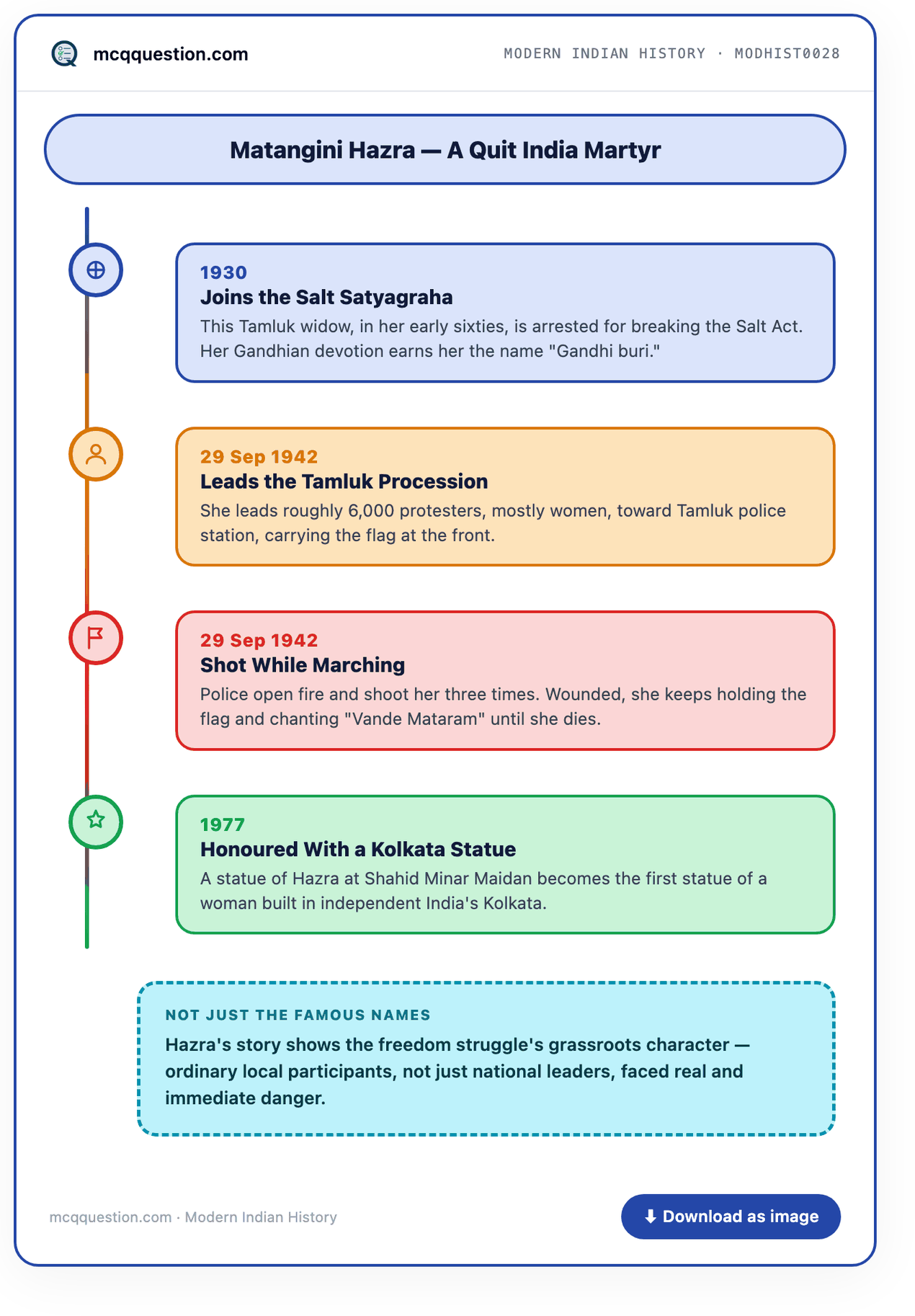
- On 29 September 1942, at 72 years old, Hazra led one such march toward the Tamluk police station. Roughly 6,000 protesters walked with her, most of them women.
- She walked right at the front of the march, holding the national tricolour flag high in her own hands.
2.What happened when police opened fire?
2.1How did she respond to the order to stop?
She answered an order to disband by walking straight toward it.
- British Indian police ordered the marchers to stop and disband. Hazra did not stop. She kept walking straight toward them, flag in hand.
- The police opened fire. One account, from the underground newspaper Biplabi, says a bullet hit her arm first, and she still did not drop the flag.
True or false: Matangini Hazra dropped the national flag as soon as police fired the first shot.
2.2What happened in her final moments?
A second bullet finally brought her down, but not her voice.
- A second bullet struck her forehead. Only then did she fall. She died chanting “Vande Mataram”, the flag still in her hand.
- She is widely remembered as the first martyr of the Quit India Movement in Midnapore, and one of the best-known martyrs of the whole movement, especially in Bengal.
3.What did her earlier life of resistance look like?
3.1How did a widow with no schooling join the freedom struggle?
Her activism began decades before the march that made her famous.
- Hazra was born around 1870 in Hogla village, near Tamluk, into a Mahishya farming family, and never received formal schooling. She was married at age twelve to Trilochan Hazra, and widowed by eighteen, with no children.
- In 1930, in her early sixties, she joined the Civil Disobedience Movement, helping make salt by hand at the Alinan salt centre in deliberate defiance of the British salt law. Police arrested her for it.
3.2Why was she nicknamed “Gandhi buri”?
One nickname captured both her devotion and the price she paid for it.
- Hazra followed Gandhian ideals closely, spinning her own thread and wearing khadi, which earned her the nickname “Gandhi buri.”
- She was also active in the local Chowkidari Tax resistance movement, serving six months in Baharampur jail for it.
- In 1933, she was injured in a police baton charge at a Congress conference in Serampore.
3.3Who was the woman behind the famous march?
Long before she was famous, she nursed the sick that others were too afraid to help.
- When smallpox broke out in her area, most people stayed away out of fear of catching it.
- Hazra went and cared for the sick herself, nursing men, women, and children through the epidemic.
- This kind of quiet service, done years before her final march, is part of why local people already trusted and respected her by 1942.
True or false: Years before her final march, Hazra personally nursed smallpox patients in her village when others stayed away.
4.How does India remember her today?
4.1What physical memorials carry her name forward?
Statues, a postage stamp, and institutions all keep her story alive.
- A statue of Hazra was erected in 1977 at Shahid Minar Maidan, Kolkata, the first statue of a woman built in independent India’s Kolkata. A second statue marks the exact spot in Tamluk where she was killed.
- In 2002, India Post issued a five-rupee commemorative postage stamp bearing her portrait, part of a series marking 60 years of the Quit India Movement.
- Hazra Road in Kolkata is named after her, along with several local schools.
- The Shahid Matangini Hazra Government College for Women opened in Tamluk in 2015, carrying her name forward.
4.2Why was she named in the President’s 2026 Independence Day address?
Eighty-four years on, her name still reaches the country’s highest level.
- On the eve of India’s 80th Independence Day, President Droupadi Murmu paid tribute to Hazra by name in her national address, alongside Assam’s Kanaklata Barua, another Quit India martyr shot dead at 17 while trying to unfurl the flag at Gohpur police station.
- Pairing her with Kanaklata Barua signals how exams increasingly test the movement’s spread across regions, not one state’s martyrs alone.
True or false: In her 2026 Independence Day address, President Droupadi Murmu named Matangini Hazra alongside Assam’s Kanaklata Barua.
5.Exam Angle: How does CDS test Matangini Hazra?
CDS (II) 2025, General Knowledge, Question 69.
This question asked which movement Matangini Hazra and Lakshman Naik sacrificed their lives in. The answer is the Quit India Movement. Lakshman Naik, a tribal leader in Odisha, was hanged in 1943 for his role in the same movement. This shows exams sometimes pair Hazra with lesser-known martyrs from other regions, testing whether you know the movement itself, not just one individual.
MCQ on Matangini Hazra
Question 1 of 1
Question 1 of 1
Question 1 of 1
Question 1 of 1
Question 1 of 1
Question 1 of 1
Question 1 of 1
Related:
Leave a Reply