The British placed a 10,000-rupee bounty on his head, the largest reward of its time. He was not a general or a nobleman. He was a Sikh ascetic who ran a religious retreat, and turned it into the base for a resistance the British could not tolerate.
 MCQ Questions
ModHist0158
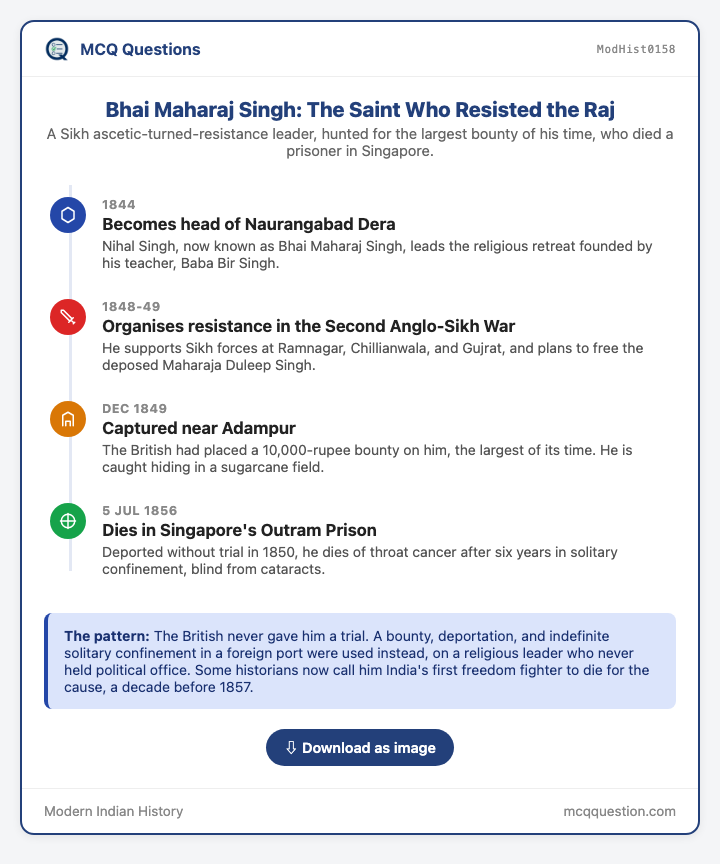
Bhai Maharaj Singh: The Saint Who Resisted the Raj
A Sikh ascetic-turned-resistance leader, hunted for the largest bounty of his time, who died a prisoner in Singapore.
1844
Becomes head of Naurangabad Dera
Nihal Singh, now known as Bhai Maharaj Singh, leads the religious retreat founded by his teacher, Baba Bir Singh.
1848-49
Organises resistance in the Second Anglo-Sikh War
He supports Sikh forces at Ramnagar, Chillianwala, and Gujrat, and plans to free the deposed Maharaja Duleep Singh.
Dec 1849
Captured near Adampur
The British had placed a 10,000-rupee bounty on him, the largest of its time. He is caught hiding in a sugarcane field.
5 Jul 1856
Dies in Singapore’s Outram Prison
Deported without trial in 1850, he dies of throat cancer after six years in solitary confinement, blind from cataracts.
The pattern: The British never gave him a trial. A bounty, deportation, and indefinite solitary confinement in a foreign port were used instead, on a religious leader who never held political office. Some historians now call him India’s first freedom fighter to die for the cause, a decade before 1857.
Modern Indian Historymcqquestion.com
Must Know
- Bhai Maharaj Singh was born Nihal Singh, in Rabbon village, Ludhiana district, Punjab, in the late 18th century.
- He trained as a Sikh ascetic and joined the dera (religious retreat) of Baba Bir Singh at Naurangabad. He became its head in 1844, after Bir Singh’s death.
- After the First Anglo-Sikh War (1845-46) weakened Sikh sovereignty, he turned the dera into a base for organising resistance to British control of Punjab.
- During the Second Anglo-Sikh War (1848-49), he supported Sikh forces at the battles of Ramnagar, Chillianwala, and Gujrat. He also planned to free the deposed Maharaja Duleep Singh.
- The British placed a 10,000-rupee bounty on him, the largest reward offered for any individual at the time. He was captured near Adampur on 29 December 1849.
- He was deported without trial to Singapore in 1850 and imprisoned at Outram Prison, where he died of throat cancer on 5 July 1856.
Good to Know
- His resistance responded directly to the decline of the Sikh Empire after Ranjit Singh’s death. See ModHist0074 — The Sikh Empire of Ranjit Singh.
- His campaign fits within the wider Company military effort against Sikh power in Punjab. See ModHist0055 — The East India Company’s Wars: Mysore, Maratha and Sikh Campaigns.
- By the time he died in 1856, he had spent over six years in solitary confinement and had gone blind from untreated cataracts.
- A memorial at Gurdwara Silat Road in Singapore, where his remains were cremated, was designated a heritage site in 1999. A statue was unveiled in his home village, Rabbon Uchi, in 2021.
- He and Ram Singh, who later founded the Namdhari (Kuka) movement, were both disciples of Baba Bir Singh and travelled Punjab together raising awareness of Sikh sovereignty. See ModHist0149 — Baba Ram Singh and the Kuka Movement.
Test Yourself

Great to Know
- A religious ascetic organising a military-style resistance shows how Sikh institutional structures could double as resistance networks. His dera provided both legitimacy and an organising base the British couldn’t easily dismiss.
- Deporting him to Singapore rather than trying or executing him in Punjab reveals a specific British strategy. Removing an influential regional figure entirely from the country neutralised him without creating a local martyr’s grave.
- His case anticipates a pattern the British would repeat for other resistance leaders. No public trial, indefinite detention far from home, and a death recorded but not widely publicised at the time.
Beyond the answer
Browse all modern-indian-history topics →
📚 Keep reading
Governors-General and Viceroys of India (1773-1947)Lord Dalhousie: The Doctrine of Lapse, Railways and AnnexationLord Wellesley: The Subsidiary Alliance and the Conquest of IndiaMedHist0079 — Banda Singh Bahadur: The Ascetic Who Toppled a Mughal GovernorLord Canning: The First Viceroy of India❓ Practice this topic
The Rakhmabai case of 1884 revolved around which issue?Why did the early nationalists oppose the Council Act of 1892?The Durand Line, drawn in 1893, is the border betweenThe Age of Consent Act of 1891, passed under Lord Lansdowne,🎲 Take a Modern Indian History Quiz
Leave a Reply