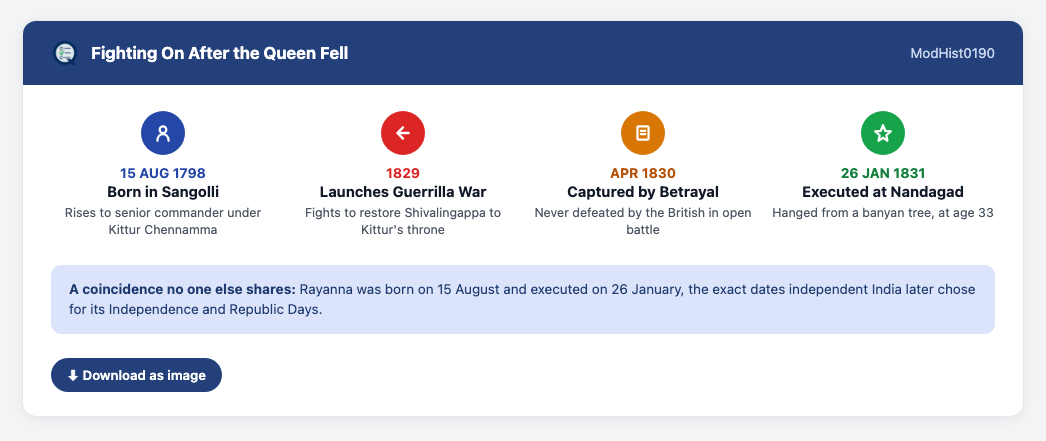
Sangolli Rayanna refused to accept his queen’s defeat. He kept fighting for years after Kittur Chennamma’s own capture, as a guerrilla the British could never quite pin down. His birth and martyrdom dates carry a coincidence no other Indian freedom fighter shares.


The Guerrilla Campaign Need to Know
- Sangolli Rayanna was born on 15 August, in a Kuruba-dhangar family in Sangolli, Belagavi district. Sources differ on the exact year, giving either 1796 or 1798.
- He served as a senior commander for Kittur Chennamma. He was arrested during her 1824 rebellion against the British, then released.
- Chennamma herself died in British captivity on 21 February 1829, at Bailhongal Fort.
- From 1829, Rayanna led his own guerrilla insurgency. He aimed to install Shivalingappa, Chennamma’s adopted son, as Kittur’s rightful ruler.
- His forces burned East India Company offices, ambushed troops, and raided treasuries, while constantly staying on the move. A Siddi warrior, Gajaveera, assisted the campaign.
Capture and Legacy Good to Know
- British troops could not defeat him in open battle. He was captured in April 1830, alongside Shivalingappa, after his own uncle Lakshmana betrayed him to British soldiers while he was bathing.
- He was tried and executed by hanging from a banyan tree near Nandagad, on 26 January 1831.
- He is widely cited as the only Indian freedom fighter whose birth date (15 August) and martyrdom date (26 January) coincide with Independence Day and Republic Day.
- He is considered a pioneer of guerrilla warfare in India, a strategy of hit-and-run tactics that avoided pitched battles entirely.
Test Yourself

Legacy in Modern Karnataka Great to Know
- The honorific Krantiveera (“revolutionary hero”) is commonly prefixed to his name. Bengaluru’s City Railway Station was renamed “Krantiveera Sangolli Rayanna Station” in his honour.
- The Karnataka government officially observes both his birth anniversary and martyrdom day, at state and district level.
- His story has been told in two Kannada films, both titled Kranthiveera Sangolli Rayanna, released in 1967 and 2012.
- Rayanna’s resistance is inseparable from Kittur Chennamma’s own story, decades before the 1857 Revolt. See ModHist0141 — Kittur Chennamma: Resistance 33 Years Before 1857.
- Like Chennamma’s rebellion, Rayanna’s campaign grew from a specific grievance against the Doctrine of Lapse, the same policy that later triggered Nana Sahib‘s revolt in 1857.
Beyond the answer
Browse all modern-indian-history topics →
📚 Keep reading
ModHist0141 — Kittur Chennamma: Resistance 33 Years Before 1857Governors-General and Viceroys of India (1773-1947)Lord Wellesley: The Subsidiary Alliance and the Conquest of IndiaLord Dalhousie: The Doctrine of Lapse, Railways and AnnexationLord Canning: The First Viceroy of India❓ Practice this topic
On 21 October 1965, Shastri coined the slogan 'Jai Jawan, Jai Kisan' at a public gathering near Allahabad. What was that village called?Lal Bahadur Shastri resigned as Railways Minister after a second train accident in November 1956. Where did that accident happen?Bengal National College and Bengal Technical Institute eventually merged to form which university, formally set up on 24 December 1955?At its December 1906 Calcutta session under Dadabhai Naoroji, the Indian National Congress passed four resolutions. Which one of these was NOT among them?🎲 Take a Modern Indian History Quiz
Leave a Reply