Maveeran Alagumuthu Kone fought British-backed forces a full century before the Revolt of 1857. Some historians call him India’s earliest anti-British freedom fighter. His resistance ended in a stark, dramatic execution, one still remembered in local tradition.


Timeline
- 11 July 1728 (sources vary; some give 1710): Born in Kattalankulam, in present-day Thoothukudi district, Tamil Nadu.
- 1750: Becomes chieftain of Kattalankulam. He acts as defender and ally of the neighbouring Ettayapuram chieftaincy, refusing to submit to East India Company authority.
- 1755: His forces, allied with Travancore’s army, defeat Colonel Heron’s forces in battle.
- 1750-1759: Wages sustained war against Presidency armies across the region.
- 1759: Defeated by British forces, combined with those of Maruthanayagam, later known as Yusuf Khan.
- Late 1759: Executed, according to tradition by cannon. Sources genuinely disagree on the exact date and location.
- 26 December 2015: The Government of India releases a commemorative postage stamp in his honour.
A Chieftain Defies the Company Need to Know
- Maveeran Alagumuthu Kone was chieftain of Kattalankulam, in present-day Thoothukudi district, Tamil Nadu. He acted as defender and ally of the neighbouring Ettayapuram chieftaincy, and refused to submit to East India Company authority.
- He waged war against Presidency armies from 1750 to 1759. He is sometimes called India’s earliest anti-British freedom fighter, though the surviving documentation for his life is thin.
- In 1755, his forces, allied with Travancore’s army, defeated Colonel Heron’s forces in battle. This engagement is well documented independently, tied to the wider conflict between the Nawab of Arcot and South Indian poligars.
- He was finally defeated in 1759. British forces combined with those of Maruthanayagam to defeat him, and Maruthanayagam later took the name Yusuf Khan.
- Traditional accounts describe his execution as death by cannon, though the precise date and place are disputed across sources. The Government of India honoured him with a commemorative postage stamp on 26 December 2015.
Test Yourself

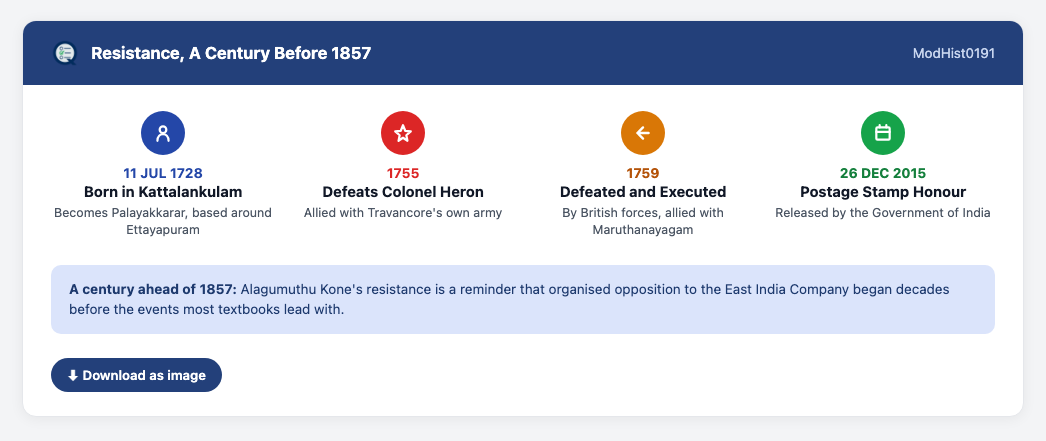
A Century Ahead of 1857 Great to Know
- His struggle predates the Revolt of 1857 by roughly a century. It was part of a wider pattern of local resistance to Company expansion, across the 1750s in South India.
- Some accounts describe him standing before the cannon that killed him. This detail is still remembered in local tradition around Kattalankulam and Thoothukudi.
- His story overlaps with Maruthanayagam, who defeated him in 1759. Maruthanayagam later rebelled against the British himself, under the name Yusuf Khan.
- The Tamil Nadu government conducts an annual commemoration ceremony on his birthday, 11 July. Senior political leaders regularly pay tribute.
- Alagumuthu Kone’s 1750s campaigns unfolded during the same period as the Carnatic Wars. European trading companies fought for dominance in South India at the same time. See ModHist0078 — The Carnatic Wars: Anglo-French Rivalry.
- His defeat came at the hands of a fellow Indian commander, who later turned against the British himself. Alliances during this period rarely followed a simple “Indian versus British” divide.
Beyond the answer
Browse all modern-indian-history topics →
📚 Keep reading
Lord Dalhousie: The Doctrine of Lapse, Railways and AnnexationLord Canning: The First Viceroy of IndiaGovernors-General and Viceroys of India (1773-1947)Lord Wellesley: The Subsidiary Alliance and the Conquest of IndiaLord Lytton: The Vernacular Press Act, Arms Act and the Delhi Durbar❓ Practice this topic
Between 1946 and 1948, the Nizam of Hyderabad's own irregular militia waged a separate campaign of terror against his opponents, including the peasant movement. Who led this militia, known as the Razakars?In Parliament in 1963, Ram Manohar Lohia sharpened his critique of Congress-era poverty with a famous claim. What did he say?In which year did Ram Manohar Lohia found the Socialist Party?Ram Manohar Lohia evaded arrest for nearly two years after going underground in 1942. In which year was he finally arrested?🎲 Take a Modern Indian History Quiz
Leave a Reply