One night in February 1946, a naval rating painted “Quit India” on a wooden platform at his own base. His arrest for it set off the largest mutiny the Royal Indian Navy ever faced, and a story that stayed almost forgotten for 25 years.

 MCQ Questions
ModHist0201
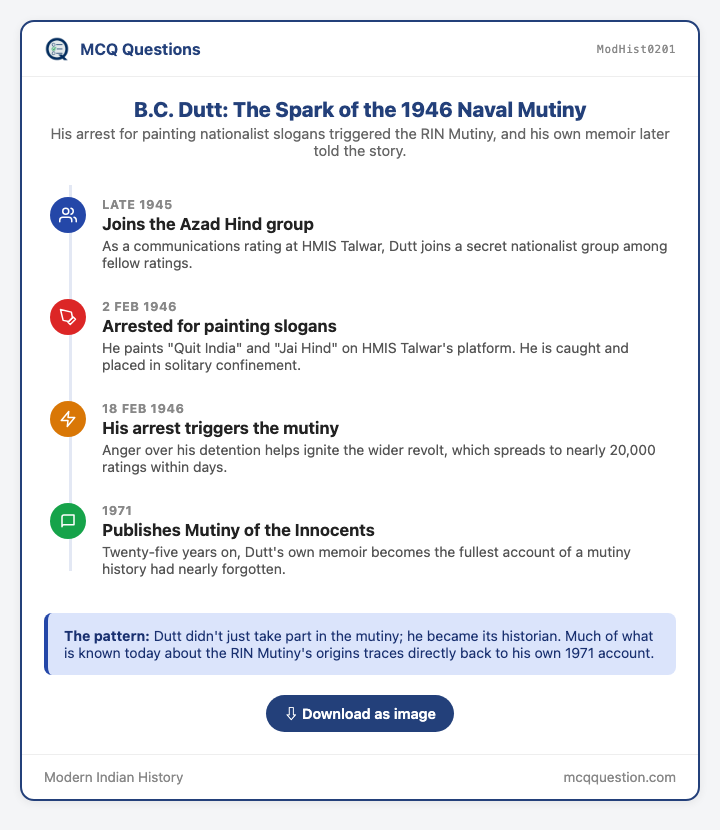
B.C. Dutt: The Spark of the 1946 Naval Mutiny
His arrest for painting nationalist slogans triggered the RIN Mutiny, and his own memoir later told the story.
Late 1945
Joins the Azad Hind group
As a communications rating at HMIS Talwar, Dutt joins a secret nationalist group among fellow ratings.
2 Feb 1946
Arrested for painting slogans
He paints “Quit India” and “Jai Hind” on HMIS Talwar’s platform. He is caught and placed in solitary confinement.
18 Feb 1946
His arrest triggers the mutiny
Anger over his detention helps ignite the wider revolt, which spreads to nearly 20,000 ratings within days.
1971
Publishes Mutiny of the Innocents
Twenty-five years on, Dutt’s own memoir becomes the fullest account of a mutiny history had nearly forgotten.
The pattern: Dutt didn’t just take part in the mutiny; he became its historian. Much of what is known today about the RIN Mutiny’s origins traces directly back to his own 1971 account.
Modern Indian Historymcqquestion.com
✊ Must Know
The Arrest That Sparked a Mutiny
- Balai Chandra Dutt, known as B.C. Dutt (1923-2009), was born near Burdwan, West Bengal. He served as a communications rating in the Royal Indian Navy, based at HMIS Talwar in Bombay.
- In late 1945, he joined Azad Hind, a secret nationalist group formed among fellow naval ratings.
- On 2 February 1946, Dutt painted “Quit India” and “Jai Hind” slogans on a platform at HMIS Talwar.
- He was caught, found with nationalist and communist literature, and placed in solitary confinement for seventeen days.
- Anger over his arrest helped trigger the wider Royal Indian Navy Mutiny. It broke out on 18 February 1946 and drew in nearly 20,000 ratings.
- He was later dismissed from the Navy after the mutiny’s suppression.
Test Yourself

🌟 Great to Know
A Story That Nearly Stayed Forgotten
- In 1971, twenty-five years after the mutiny, Dutt published “Mutiny of the Innocents,” his own memoir of the events. It remains one of the fullest firsthand accounts of the mutiny’s origins.
- A single act of graffiti, painting two nationalist slogans, escalated into the largest coordinated revolt Indian armed forces staged before independence. That gap between the trigger and its consequences is worth sitting with.
- Dutt waited twenty-five years to write his account. That gap suggests the mutiny’s own history took real time to feel tellable. It wasn’t just personal readiness; the wider public needed time too.
- Being remembered mainly through his own book, rather than official recognition, mirrors what happened to M.S. Khan and most of the mutiny’s other leaders. The mutiny’s memory survived largely through its participants’ own efforts.
📝 Previous Year Questions
Where the RIN Mutiny Fits in the Timeline
- Answer: (c) The correct chronological order is 3-2-1: Second Round Table Conference (1931), Quit India Movement launched (1942), then the RIN Mutiny (1946).
- Second Round Table Conference Ran September to December 1931, the earliest of the three events.
- Quit India Movement Launched 8 August 1942, in between the other two events.
- RIN Mutiny Began 18 February 1946, the last and most recent of the three, and the one this article covers directly.
- View this question on the full 2017 paper →
Beyond the answer
Browse all modern-indian-history topics →
📚 Keep reading
SciTech0038 — The Indian NavyModHist0195 — M.S. Khan: President of the Naval Strike CommitteeModHist0155 — The 1946 Royal Indian Navy MutinyLord Ripon: Local Self-Government and the Ilbert BillModHist0288 — Quit India Movement, 1942❓ Practice this topic
The Rakhmabai case of 1884 revolved around which issue?Why did the early nationalists oppose the Council Act of 1892?The Durand Line, drawn in 1893, is the border betweenThe Age of Consent Act of 1891, passed under Lord Lansdowne,🎲 Take a Modern Indian History Quiz
Leave a Reply