Subhas Chandra Bose took command of an army in exile. Within four months, he had declared a government. This article covers that government, its women’s regiment, and the trial that followed.


Timeline
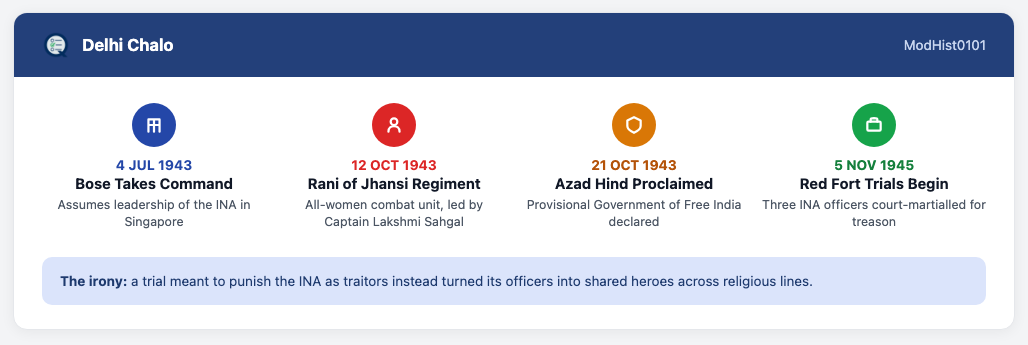
- 4 July 1943: Bose reaches Singapore and takes command of the Indian National Army. He renames it Azad Hind Fauj the next day.
- 12 October 1943: The Rani of Jhansi Regiment is formed, an all-women combat unit led by Captain Lakshmi Sahgal.
- 21 October 1943: Bose proclaims the Provisional Government of Free India, known as Azad Hind, at Cathay Cinema Hall.
- 5 November 1945: The Red Fort Trials begin. Three INA officers face court-martial for waging war against the King-Emperor.
Command and the Provisional Government Need to Know
- Subhas Chandra Bose took command of the Indian National Army (INA) in Singapore on 4 July 1943, renaming it Azad Hind Fauj.
- On 21 October 1943, he proclaimed the Provisional Government of Free India, known as Azad Hind. Nine Axis-aligned states recognised it, including Japan, Germany, and Italy.
- The Rani of Jhansi Regiment, formed on 12 October 1943, was an all-women combat unit. Captain Lakshmi Sahgal commanded it.
- The Red Fort Trials (November 1945 to May 1946) court-martialled three INA officers: Shah Nawaz Khan, Prem Sahgal, and Gurbaksh Singh Dhillon. One was Muslim, one Hindu, one Sikh.
Related Articles and Parakram Diwas Good to Know
- The INA’s own military campaign, including the fighting at Imphal and Kohima, is covered in ModHist0022 — The INA’s Military Campaign: Imphal and Kohima.
- Bose’s earlier escape from India to reach Axis support is covered in ModHist0023 — Netaji’s Escape: From Calcutta to Kabul to Berlin.
- Congress leaders including Bhulabhai Desai, Jawaharlal Nehru, and Tej Bahadur Sapru defended the accused INA officers at the Red Fort Trials.
- The Government of India observes 23 January, Bose’s birth anniversary, as Parakram Diwas. It marked his 129th birth anniversary in January 2026. (Source)
Test Yourself


Death and the Red Fort Trials’ Fallout Great to Know
- Bose reportedly died on 18 August 1945, in a plane crash in Taipei. Some historians still dispute the circumstances, making it one of modern India’s most persistent unresolved questions.
- The Red Fort Trials backfired on the British. They were meant to show imperial authority. Instead, they united Hindu, Muslim, and Sikh opinion behind the accused — a unity the official freedom movement had struggled to build on its own.
- Massive public agitation followed the trials, including protests and riots across India through 1945-46. Historians widely see this as a major factor pushing Britain toward a faster exit.
- Azad Hind was recognised by nine foreign states. This gave the Indian independence movement something it had never had before — a government, however wartime and provisional, acknowledged abroad.
Beyond the answer
Browse all modern-indian-history topics →
📚 Keep reading
ModHist0100 — Subhas Chandra Bose and the Forward Bloc, 1939ModHist0109 — Chandrashekhar Azad: The Vow of AzadSciTech0089 — Bose InstituteSciTech0050 — Jagadish Chandra Bose: Radio Pioneer and Plant PhysiologistModHist0174 — Habib ur Rahman: The Last Witness to Netaji❓ Practice this topic
Who among the following was/were associated with the introduction of the Ryotwari Settlement in India during the British rule? 1. Lord Cornwallis 2. Alexander Read 3. Thomas MunroStatement I: The Permanent Settlement was rarely extended to any region beyond Bengal. Statement II: After 1810, the agricultural prices declined, affecting adversely the income of the Bengal Zamindars.Consider the following statements about the Bengal countryside at the time of the Permanent Settlement: 1. The zamindars' troops were disbanded. 2. Within the villages, the power of jotedars was more effective than that of zamindars. 3. The East India Company made a rule that the property of women would not be taken over. 4. Adhiyars were sharecroppers on the land owned by bargadars.What was the consequence of the Permanent Settlement on rural society in Bengal?🎲 Take a Modern Indian History Quiz
Leave a Reply