The Indian National Army did not just exist on paper. It fought real battles against British forces, on Indian soil, as part of a push toward Delhi. This lesson follows that campaign, from the INA’s troubled birth to the brutal battles that broke it.
U-Go offensive: General Renya Mutaguchi’s 1944 plan to push through Manipur and Nagaland into British India, with INA soldiers marching alongside his Japanese troops.
Subhas Brigade / Gandhi Brigade: The two INA combat units that led the push into India. Both were named after prominent nationalist figures, tying the army’s identity to the freedom movement.
1.How was the INA born, and why did it collapse once already?
1.1How did Japan turn prisoners of war into an army?
Defeat, not victory, created the opening Japan needed.
- In February 1942, Singapore fell to Japan, and around 45,000 Indian soldiers fighting for the British were taken prisoner.
- Japanese intelligence officer Major Fujiwara Iwaichi saw an opportunity in these prisoners, and began talking to them about fighting for India’s freedom instead.
- An army officer among the prisoners, Mohan Singh, organised thousands of them into the first Indian National Army, with Japanese help. Rash Behari Bose gave it political backing.
1.2Why did Mohan Singh dissolve it, and who brought it back?
The first INA ended almost as fast as it began, over a basic question of trust.
- Mohan Singh grew suspicious that Japan only wanted to use Indian soldiers for its own purposes. In December 1942, he dissolved the force and sent the men back to prison camps.
- The INA came back to life in July 1943, when Subhas Chandra Bose arrived and took command. He rebuilt it into the army that would later march on Imphal.
2.What was Mutaguchi’s two-battle plan, and what happened at Moirang?
2.1What did the U-Go plan actually call for?
One Japanese general wanted to open the road to Delhi in a single stroke.
- In 1944, Japanese general Renya Mutaguchi planned to smash through Manipur and Nagaland, march into India, and knock the British out of the war.
- Two INA units marched with him: the Subhas Brigade, led by Shah Nawaz Khan, and the Gandhi Brigade, led by Inayat Kiyani. Winning both Imphal and Kohima would open the road to Delhi.

2.2What happened when the flag went up at Moirang?
For a few short weeks, the campaign actually seemed to be working.
- On 14 April 1944, INA officer Colonel Shaukat Malik led his men into the small Manipur town of Moirang.
- Malik raised the Indian tricolour, with its springing tiger, on Indian soil. It was the first time a flag of a free India had ever flown over Indian ground.
True or false: Colonel Shaukat Malik raised the Indian tricolour at Moirang on 14 April 1944. It was the first time a flag of a free India flew on Indian soil.
3.Why did Mutaguchi’s cattle gamble fail, and how brutal was Kohima?
3.1What went wrong with the food supply?
The whole invasion plan had one huge weak spot: feeding the army.
- Mutaguchi did not carry enough supplies for a long fight, so he sent thousands of cattle along with his army to eat as he marched.
- Many animals starved or wandered off before reaching the soldiers. By May 1944, both Japanese divisions were going hungry, while British planes flew thousands of supply flights for their own troops.

3.2What was the Battle of the Tennis Court?
The fighting at Kohima centred on one strange, small spot.
- Japanese and British soldiers dug trenches on opposite sides of a tennis court next to the local Deputy Commissioner’s house. They were close enough to throw grenades straight across it.
- About 2,500 British and Indian defenders held out on Garrison Hill. Help broke through after two weeks; survivors were so thin they were described as “aged, bloodstained scarecrows.”
True or false: General Mutaguchi’s cattle-supply plan worked well, keeping his army fed throughout the campaign.
4.Why does this defeat still count as a turning point?
4.1Why did a Japanese general defy his own orders?
Facing starvation, one commander chose his men’s survival over obedience.
- Kohima’s Japanese commander, General Kotoku Sato, had lost faith in the plan as his men starved.
- On 25 May 1944, he pulled his troops back and retreated, defying direct orders from his own superiors. That was a decision almost unheard of in the Japanese army at the time.
True or false: General Sato retreated from Kohima against his own superiors’ direct orders, likely saving many of his men’s lives.
4.2What do the numbers and the aftermath show?
The scale of loss earned this campaign a grim nickname, and the defeat still moved a nation.
- At Imphal, Japan suffered 54,879 casualties, over 13,000 of them deaths, mostly from hunger and sickness rather than combat. At Kohima, at least 5,764 Japanese and 4,064 British and Indian troops became casualties.
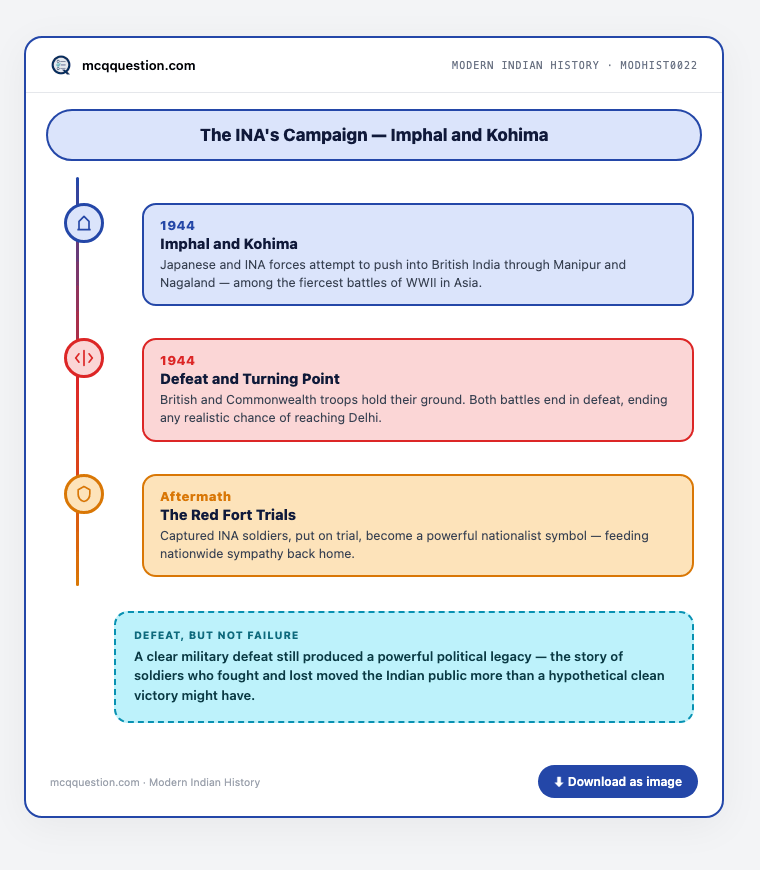
- Historians call it the “Stalingrad of the East.” Both battles ended in defeat for the Japanese-INA side, ending any realistic chance of reaching Delhi.
- Captured INA soldiers, later put on trial, became a powerful nationalist symbol back home. The loss on the battlefield fed directly into the sympathy seen during the Red Fort Trials.
5.Exam Angle: How does CDS test Bose’s INA rebuild?
CDS (I) 2023, General Knowledge, Question 31.
This question asked whether Bose recruited soldiers from Indian POWs in Japanese camps. It also asked whether he separately introduced a women’s unit named after the Rani of Jhansi. Both statements were correct. Bose rebuilt the INA’s ranks largely from Indian POWs already held by Japan. He also set up the all-women Rani of Jhansi Regiment on 12 October 1943.
MCQ on the INA’s Imphal-Kohima Campaign
Question 1 of 1
Question 1 of 1
Question 1 of 1
Question 1 of 1
Question 1 of 1
Question 1 of 1
Question 1 of 1
Question 1 of 1
Related:
Leave a Reply