Hasrat Mohani gave India its most famous revolutionary slogan years before anyone else made it famous. He moved through Congress, the Muslim League, and the Communist Party in one lifetime. He was also a devout Muslim who wrote love poetry to Krishna.


Timeline
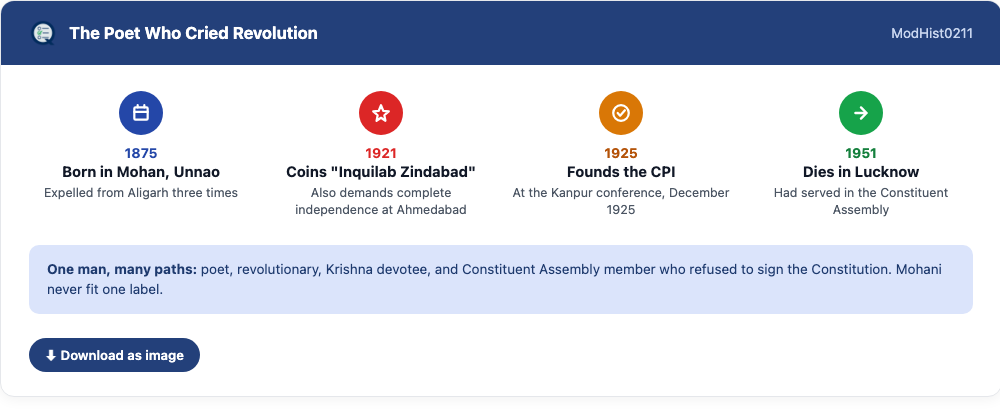
- 1 January 1875: Born Syed Fazl-ul-Hasan, in Mohan, Unnao district.
- 1903: Completes his B.A. at Aligarh’s Muhammadan Anglo-Oriental College, after being expelled three times for criticising the British government. Founds the Urdu magazine Urdu-e-Mualla the same year.
- 1903 onward: First jailed, for years, related to his political writing.
- 1920: Active in the Khilafat Movement, moving a non-cooperation resolution at the Delhi Khilafat Conference.
- 1921: Coins the slogan “Inquilab Zindabad.” At Congress’s Ahmedabad session, demands complete independence, years ahead of the mainstream.
- December 1925: Helps organise the founding conference of the Communist Party of India, at Kanpur.
- 1936: Attends the founding conference of the Progressive Writers’ Association.
- Post-1947: Serves in India’s Constituent Assembly, but does not sign the final Constitution.
- 13 May 1951: Dies in Lucknow.
Must Know Need to Know
- Hasrat Mohani coined the slogan “Inquilab Zindabad” in 1921, years before Bhagat Singh‘s group made it famous.
- At the 1921 Ahmedabad Congress session, he demanded complete independence. Congress only made this its official goal years later, at Lahore in 1929.
- He was among the founders of the Communist Party of India, and helped organise its first all-India conference at Kanpur in 1925.
- Despite being a devout Muslim, he wrote verses of deep love for Krishna, and often travelled to Mathura to celebrate Janmashtami.
- He served in independent India’s Constituent Assembly, but never signed the final Constitution, over his own reservations.
Good to Know Good to Know
- Born Syed Fazl-ul-Hasan, he took the pen name “Hasrat” for his Urdu poetry, which blended classical and modernist styles.
- He was expelled from Aligarh’s Muhammadan Anglo-Oriental College three times, for openly criticising British government policy.
- He founded the Urdu magazine Urdu-e-Mualla in 1903, blending literary and political content, and it became a repeated target of sedition charges against him.
- During the Khilafat Movement, he moved a non-cooperation resolution at the 1920 Delhi Khilafat Conference.
- Over his career, he moved through the Indian National Congress, the Muslim League, the Communist Party, and the Majlis-i-Ahrar. He always kept the same goal: total freedom.
- He was jailed multiple times, including for an article in Urdu-e-Mualla criticising British policy in Egypt.
- He chose to stay in India after Partition, rather than migrate to Pakistan, representing Indian Muslims in the Constituent Assembly.
Test Yourself

Great to Know Great to Know
- Mohani’s own 1921 push for complete independence is a useful counterpoint when studying the Purna Swaraj resolution’s 1929 date. The idea was already alive within Congress years earlier, championed by figures outside its mainstream leadership.
- He moved through the same Khilafat and Non-Cooperation era as the Ali Brothers, though his politics later diverged sharply from theirs. See ModHist0062 — Khilafat and Non-Cooperation Movements and ModHist0210 — The Ali Brothers.
- His Krishna devotion, alongside his Islamic faith, makes him an unusual figure for syllabus purposes. It is useful for questions that test whether students confuse religious identity with political ideology.
Beyond the answer
Browse all modern-indian-history topics →
📚 Keep reading
Lord Dufferin: The Founding of the Indian National CongressModHist0210 — The Ali BrothersModHist0062 — Khilafat and Non-Cooperation MovementsModHist0351 — The Founding of the Hind Mazdoor SabhaGovernors-General and Viceroys of India (1773-1947)❓ Practice this topic
Ajit Singh's son, Jayant Chaudhary, now leads the Rashtriya Lok Dal as part of which alliance's government, one that publicly favours keeping UP united?Uttarakhand, Jharkhand, and Chhattisgarh, often cited by Harit Pradesh's supporters as evidence smaller states can work, were all created in which year?Under India's Constitution, why did the UP Legislative Assembly's 2011 resolution to split the state never take effect?In 1997, Ajit Singh set up which organisation to build public support for a separate western-UP state?🎲 Take a Modern Indian History Quiz
Leave a Reply