Begum Aizaz Rasul was the only Muslim woman member of India’s Constituent Assembly. She used her position to argue strongly against separate electorates for religious minorities.

 mcqquestion.com
A Voice Against Separate ElectoratesNeed to Know
- Begum Aizaz Rasul, born Qudsia Begum, was born on 2 April 1909, in Lahore, Punjab.
- In 1929, she married Nawab Aizaz Rasul, a taluqdar of Sandila, in present-day Uttar Pradesh.
- In 1937, she was elected to the United Provinces Legislative Assembly, from a non-reserved seat.
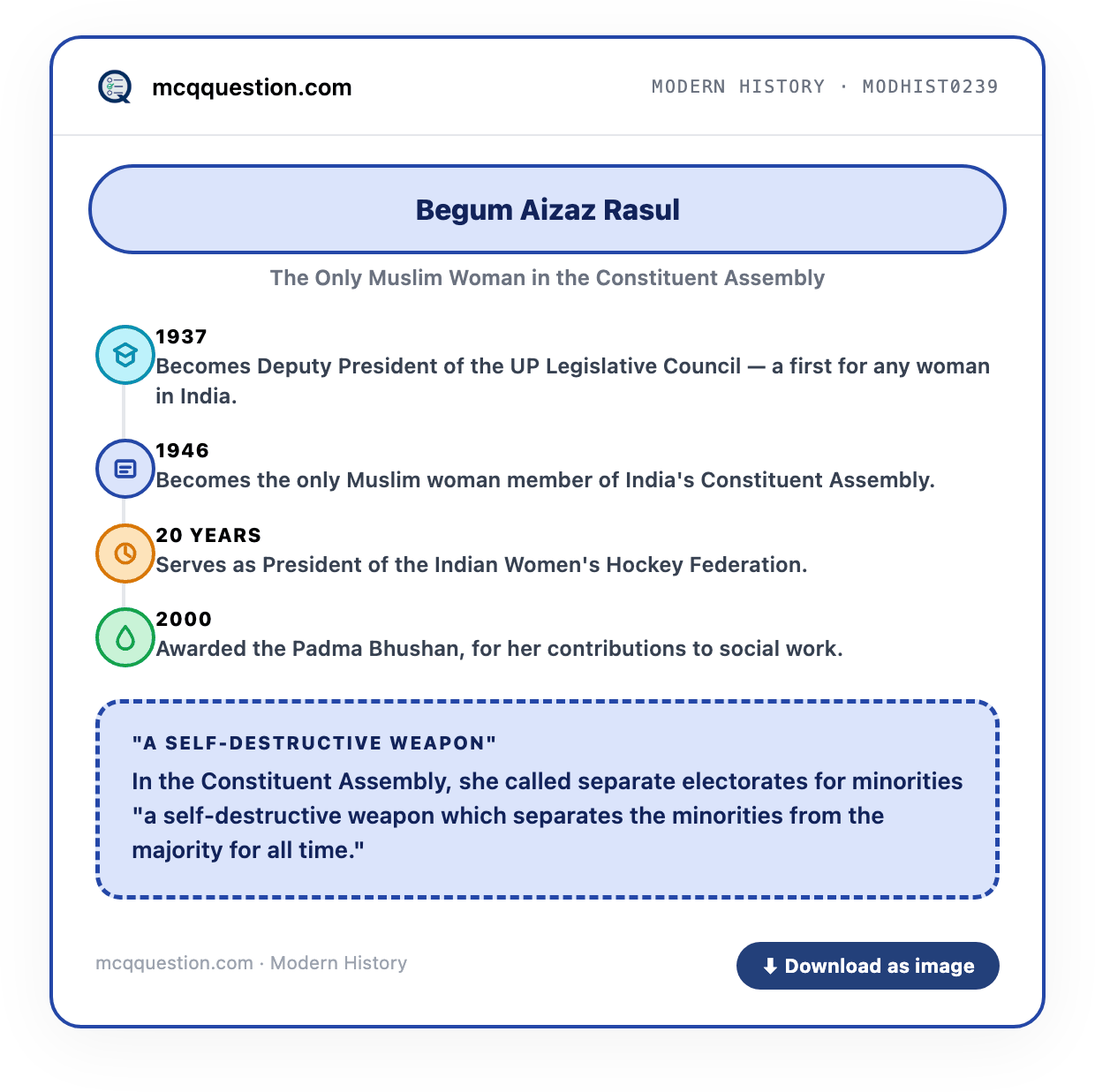
- She became Deputy President of the Legislative Council in 1937, serving until 1940. She was the first woman in India, and the first Muslim woman anywhere in the world, to hold such a position.
- She was elected to India’s Constituent Assembly in 1946, and was its only Muslim woman member.
- After Muslim League leader Chaudhry Khaliquzzaman left for Pakistan, she succeeded him as the League’s leader in the Assembly, serving as Deputy Leader of the Muslim League delegation and Deputy Leader of the Opposition.
- She served on the Assembly’s Minority Rights Drafting Subcommittee.
- She strongly opposed separate electorates for religious minorities. She called them “a self-destructive weapon which separates the minorities from the majority for all time.”
- When the Muslim League in India dissolved, in 1950, she joined the Congress party.
A Long Public CareerGood to Know
- She was elected to the Rajya Sabha, from 1952 to 1954.
- She later served in the Uttar Pradesh Legislative Assembly, from 1969 to 1989. This included a term as Minister for Social Welfare and Minorities, from 1969 to 1971.
- Outside politics, she served as President of the Indian Women’s Hockey Federation for 20 years. She also led the Asian Women’s Hockey Federation.
- India’s Women’s Hockey Cup, the Begum Rasul Trophy, is named in her honour.
Test Yourself

Beyond PoliticsGreat to Know
- She wrote an autobiography, “From Purdah to Parliament: A Muslim Woman in Indian Politics.”
- She represented India abroad too. She joined a Prime Minister’s Goodwill Delegation to Japan in 1953, and a Parliamentary Delegation to Turkey in 1955.
- She was awarded the Padma Bhushan, in 2000, for her contributions to social work.
- She died on 1 August 2001, in Lucknow, at age 92.
Beyond the answer
Browse all modern-indian-history topics →
📚 Keep reading
Polity0322 — National Commission for Minorities (NCM)Polity0375 — Women in the Higher Judiciary: Representation and the Road AheadModHist0016 — Rajiv Gandhi and the Shah Bano ControversyModHist0234 — Dakshayani VelayudhanPolity0032 — Constitutional Posts: President, Governor and Special Officers❓ Practice this topic
Junagadh, Hyderabad, and Kashmir were the three major contested princely-state accessions right after independence. Which method specifically resolved Junagadh's dispute?The anti-Sikh violence that followed Indira Gandhi's assassination remained the subject of what, for decades afterward?Who became Prime Minister immediately after Indira Gandhi's assassination on 31 October 1984?Which Sikh religious structure inside the Golden Temple complex suffered major damage during Operation Blue Star?🎲 Take a Modern Indian History Quiz
Leave a Reply