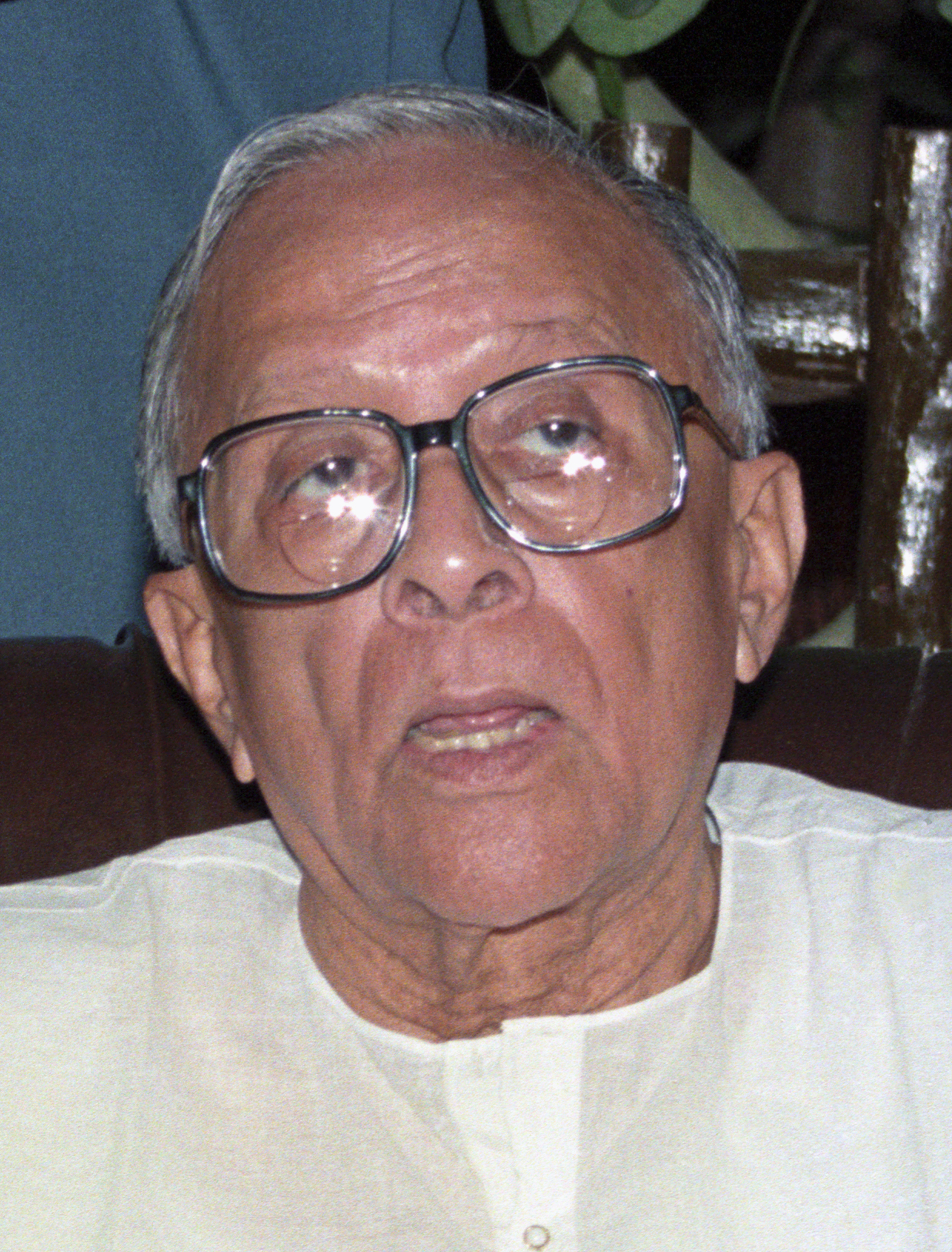
He trained as a barrister in London, then spent his career building a Marxist movement instead. Jyoti Basu governed West Bengal for 23 unbroken years, the longest Chief Minister’s tenure India had ever seen at the time. In 1996, his own party stopped him from becoming Prime Minister.
 MCQ Questions
ModHist0254
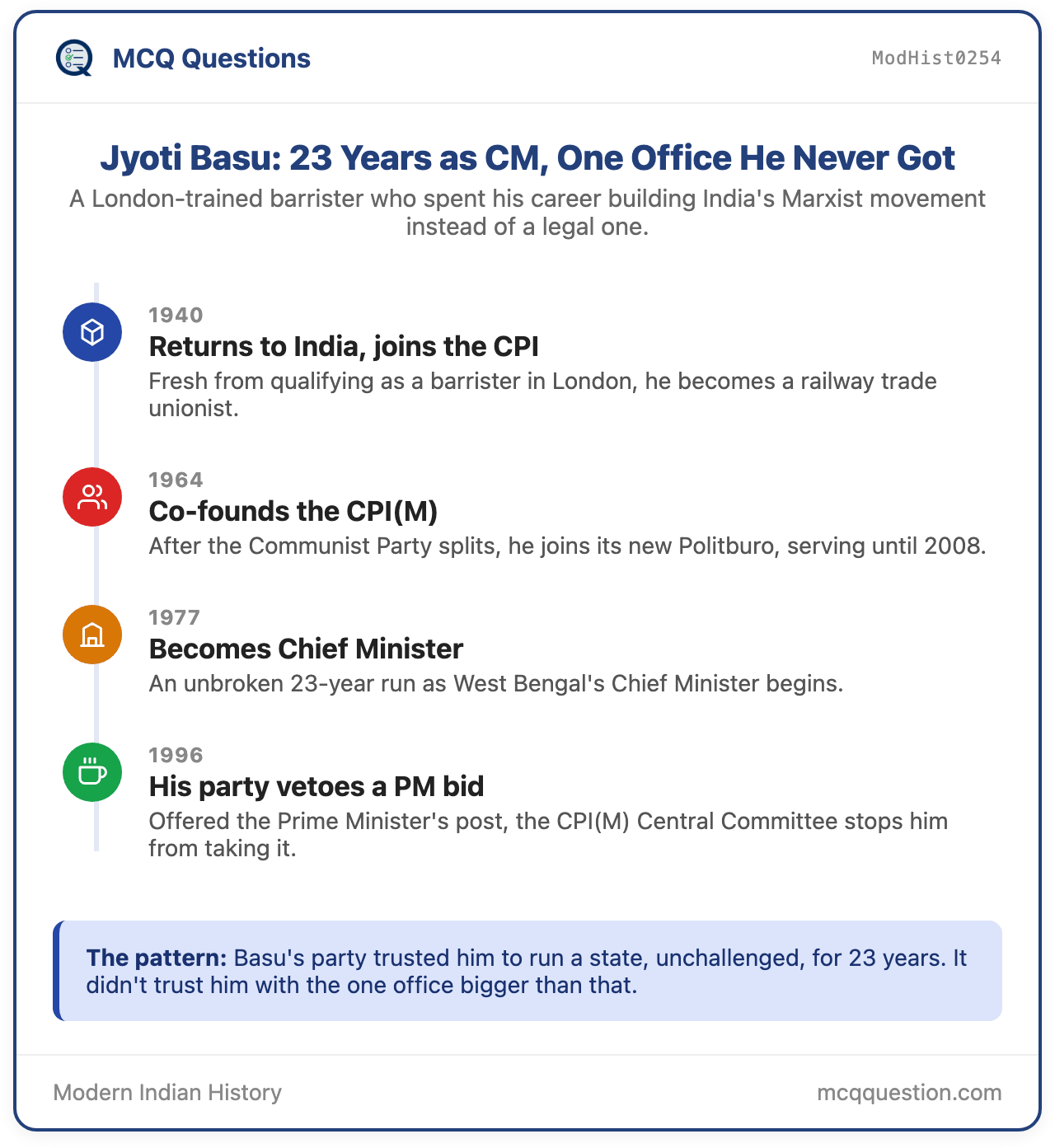
Jyoti Basu: 23 Years as CM, One Office He Never Got
A London-trained barrister who spent his career building India’s Marxist movement instead of a legal one.
1940
Returns to India, joins the CPI
Fresh from qualifying as a barrister in London, he becomes a railway trade unionist.
1964
Co-founds the CPI(M)
After the Communist Party splits, he joins its new Politburo, serving until 2008.
1977
Becomes Chief Minister
An unbroken 23-year run as West Bengal’s Chief Minister begins.
1996
His party vetoes a PM bid
Offered the Prime Minister’s post, the CPI(M) Central Committee stops him from taking it.
The pattern: Basu’s party trusted him to run a state, unchallenged, for 23 years. It didn’t trust him with the one office bigger than that.
Modern Indian Historymcqquestion.com
Barrister to Longest-Serving CMNeed to Know
- Jyoti Basu was born Jyotirindra Basu, on 8 July 1914, in Calcutta.
- He trained as a barrister in London, at the Middle Temple, qualifying in January 1940.
- He returned to India in 1940, and joined the Communist Party of India (CPI) the same year.
- After the CPI split in 1964, he became a founding member of the Communist Party of India (Marxist), or CPI(M). He served on its Politburo from 1964 to 2008.
- He was Chief Minister of West Bengal from 21 June 1977 to 5 November 2000, a continuous 23-year tenure. It was the longest by any Indian Chief Minister at the time. Pawan Chamling of Sikkim later broke this record.
- He died on 17 January 2010, in Kolkata, at age 95.
Governing West BengalGood to Know
- Before becoming Chief Minister, Basu served twice as Deputy Chief Minister of West Bengal, in 1967 and again from 1969 to 1970. Both times, he served under Chief Minister Ajoy Mukherjee.
- He was Leader of the Opposition in the West Bengal Legislative Assembly, from 1957 to 1967.
- His government launched Operation Barga, a land reform that registered over 1.5 million sharecroppers and secured their tenancy rights on more than 11 lakh acres of land.
- His government also built a strong panchayati raj system of village-level self-governance, years before it became a nationwide requirement under the 73rd constitutional amendment.
- In London, he attended lectures by the political theorist Harold Laski, at the London School of Economics. He also became a founding member of the London Majlis, an Indian students’ political group.
- Over his career, he was elected to the West Bengal Legislative Assembly 11 times.
Test Yourself

The Prime Minister That Never WasGreat to Know
- After the 1996 general election, the United Front coalition wanted Basu to become Prime Minister. The CPI(M)’s own Central Committee vetoed the idea, and he stepped aside for H.D. Deve Gowda instead.
- Basu later called his party’s veto a “historic blunder.” He said he still believed that, since such a chance does not come twice in history.
- His 23-year run as Chief Minister meant one leader governed a major Indian state for over two decades. That level of political continuity was almost unmatched in Indian democracy at the time.
- He trained as a barrister in England, in the same era as several other early Indian nationalist leaders based in London. Yet he spent his career building a Marxist movement, not a legal career.
Beyond the answer
Browse all modern-indian-history topics →
📚 Keep reading
ModHist0310 — Chittaranjan Das (Deshbandhu): The Barrister Who Founded the Swaraj PartyPolity0144 — 2026 State Assembly Elections: West Bengal, Tamil Nadu, KeralaLord Curzon: The Partition of Bengal and the Swadeshi MovementModHist0315 — A.K. Fazlul Haq (Sher-e-Bangla): The Man Who Moved the Lahore ResolutionGovernors-General and Viceroys of India (1773-1947)❓ Practice this topic
The anti-Sikh violence that followed Indira Gandhi's assassination remained the subject of what, for decades afterward?Who became Prime Minister immediately after Indira Gandhi's assassination on 31 October 1984?Which Sikh religious structure inside the Golden Temple complex suffered major damage during Operation Blue Star?Who commanded the assault on the Golden Temple complex during Operation Blue Star in June 1984?🎲 Take a Modern Indian History Quiz
Leave a Reply