K. Kamaraj
He dropped out of school at age 12 and never went back. Yet as Chief Minister, he built one of India’s most ambitious education systems, and helped found IIT Madras. His own people called him “Padikkatha Methai” — the uneducated genius.
Kingmaker of Indian politics
A coconut-seller’s son who left school at 12, Kamaraj rose through repeated jail terms to lead Tamil Nadu’s Congress without ever holding national office.
Kumaraswami Kamaraj led the Congress party in Tamil Nadu. He lived from 15 July 1903 to 2 October 1975.
He is widely called the “Kingmaker” of Indian politics. He earned this title without ever holding national office.
He was born in Virudhunagar into a trading family. His father, Kumaraswamy Nadar, sold coconuts for a living.
His father died within a year of his school enrolment. Kamaraj dropped out in the sixth grade, aged around 12.
He apprenticed at his uncle’s cloth shop after leaving school. He also worked briefly at a timber shop in Thiruvananthapuram.
Tamils still call him “Padikkatha Methai,” the uneducated genius. The name stuck even after his rise to power.
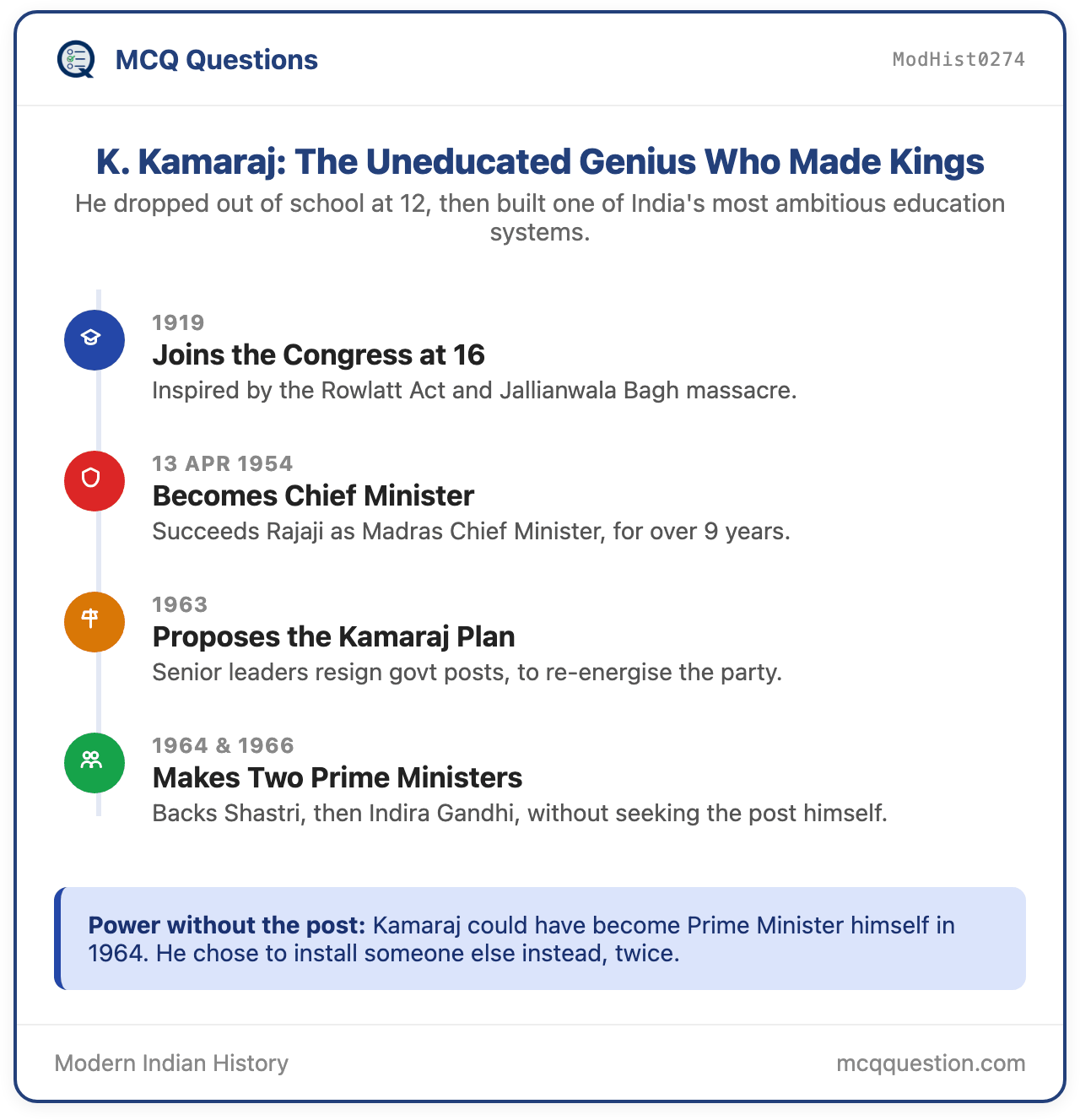
He joined the Indian National Congress in 1919, aged 16. The Jallianwala Bagh massacre shaped his decision to join.
The British jailed him six times between 1930 and 1945. His prison time totalled more than 3,000 days.
Source: standard record of Kamaraj’s birth, early life, and freedom-movement imprisonment.
Pause and decide · 1 of 10
Kamaraj dropped out of school around age 12, after his father’s death, and never returned to formal education. True or false?
True. He was jailed six times by the British between 1930 and 1945, spending more than 3,000 days in prison over his life.


The Kamaraj Plan of 1963
After a string of election losses, Kamaraj proposed that senior Congress leaders, including himself, quit their government posts to rebuild the party.
Congress lost three Lok Sabha by-elections in May 1963. This defeat pushed Kamaraj to propose a bold plan.
He suggested senior leaders quit their government posts. They would work instead to rebuild the party at the grassroots.
He resigned as Chief Minister on 2 October 1963. He deliberately chose Gandhi Jayanti to announce the move.
Six Union Ministers followed his example and resigned. Six Chief Ministers, including Kamaraj himself, also stepped down.
Lal Bahadur Shastri and Morarji Desai were among the ministers who resigned. Jagjivan Ram and Biju Patnaik also gave up their posts.
Kamaraj became Congress President about a week later, on 9 October 1963. He held the post through 1967.
The plan later helped settle who succeeded Nehru. It positioned Kamaraj as the party’s chief power broker.
Source: standard record of the 1963 Kamaraj Plan and its resignations.
Pause and decide · 2 of 10
The Kamaraj Plan involved six Union Ministers and six Chief Ministers, including Kamaraj himself, resigning their government posts. True or false?
True. He resigned as Chief Minister on 2 October 1963, deliberately choosing Gandhi Jayanti to announce the move.
Transforming education in Madras State
Kamaraj reversed his predecessor’s education scheme and built schools within reach of every village, nearly doubling the state’s literacy rate.
He scrapped Rajaji’s hereditary education scheme. That earlier policy had tied schooling to a family’s traditional trade.
He ensured no village was left without a primary school. No panchayat was left without a high school either.
New schools kept rural children within three kilometres of home. This rule sharply cut school dropout rates.
He introduced free and compulsory education up to age 14. This was a landmark reform for Madras State.
He launched the midday meal scheme at Ettayapuram. It fed about 20 lakh primary school students, for 200 days a year.
Literacy in Madras State nearly doubled during his term. It rose from 18.33% in 1951 to 36.39% in 1961.
He helped found IIT Madras in 1959. It remains one of India’s most respected engineering institutes.
Source: standard record of Kamaraj’s education reforms as Chief Minister.
Pause and decide · 3 of 10
Kamaraj’s free and compulsory education reform in Madras State applied only up to class eleven, not to a specific age. True or false?
False. The reform made education free and compulsory up to age 14, reversing Rajaji’s earlier hereditary-trade-based education scheme.
Public sector legacy and personal austerity
A deliberately small cabinet oversaw major new industry under Kamaraj, while he personally lived and died with almost nothing.
He kept his cabinet deliberately small as Chief Minister. It never had more than eight ministers.
He helped set up the Integral Coach Factory in Chennai. The Heavy Vehicles Factory at Avadi followed soon after.
Neyveli Lignite Corporation was another major project under him. It tapped Tamil Nadu’s lignite reserves for power generation.
He lost his own assembly seat in the 1967 elections. Congress suffered a wider defeat across Tamil Nadu that year.
He returned to Parliament through a Nagercoil by-election. This win came in January 1969.
He remained unmarried his entire life. He devoted himself fully to public work instead.
He died owning barely ₹130 in cash. His only other possessions were a few clothes and some books.
Source: standard record of Kamaraj’s industrial projects and personal austerity.
Pause and decide · 4 of 10
Kamaraj lost his own assembly seat in the 1967 elections, then returned to Parliament through a Nagercoil by-election in January 1969. True or false?
True. He died owning barely ₹130 in cash, alongside a few clothes and some books, reflecting his lifelong personal austerity.
Kingmaker without a crown
Kamaraj installed two Prime Ministers without ever seeking the post himself, before later splitting from Indira Gandhi’s Congress.
After Nehru’s death, Kamaraj helped install Lal Bahadur Shastri as Prime Minister. He never sought the post for himself.
After Shastri’s sudden death, he backed Indira Gandhi instead. He again declined to claim the top job.
Growing friction with Indira Gandhi split the Congress in 1969. Kamaraj led the breakaway Congress (Organisation) faction until his death.
He explained his choice not to seek the top job simply. “I am needed more in Madras than in Delhi,” he reportedly said.
Admirers also called him “Kalvi Thanthai,” father of education. Some called him “Black Gandhi,” for his simple khadi dress.
India awarded him the Bharat Ratna in 1976, posthumously. Madurai Kamaraj University and a Chennai airport terminal now bear his name.
See ModHist0270 — C. Rajagopalachari, whom Kamaraj succeeded as Madras Chief Minister, and ModHist0273 — J. Jayalalithaa, a later Tamil Nadu Chief Minister who built on the welfare-state tradition Kamaraj began.
Source: standard record of Kamaraj’s role in the 1964 and 1966 Prime Ministerial successions and the 1969 Congress split.
Pause and decide · 5 of 10
Kamaraj helped install both Lal Bahadur Shastri in 1964 and Indira Gandhi in 1966 as Prime Minister, without seeking the post for himself either time. True or false?
True. Growing friction with Indira Gandhi later split the Congress in 1969, and Kamaraj led the breakaway Congress (Organisation) faction until his death.
Exam Angle: What to Expect
No Previous Year Question in this site’s index has directly tested this yet.
Expect a question matching leaders to their party posts. Kamaraj served as Congress President from 1963 to 1967.
The Kamaraj Plan is a common standalone term for prelims. Questions often ask its year, or who proposed it.
Kamarajar Port, near Chennai, is also named after him. Do not confuse a port-infrastructure question with his political biography.
Source: standard analysis of likely exam angles on K. Kamaraj.
Pause and decide · 6 of 10
Kamaraj served as Congress President for over a decade, from the early 1960s until his death in 1975. True or false?
False. He held the Congress President post only from 1963 to 1967 — a much shorter span than his overall political career.
Pause and decide · 7 of 10
Kamarajar Port near Chennai is named after Kamaraj, distinct from his political biography and Chief Ministerial record. True or false?
True. Exam questions sometimes try to trap students by mixing up this infrastructure trivia with his actual political and education-reform record.
Pause and decide · 8 of 10
Kamaraj was jailed six separate times by the British between 1930 and 1945, well before his rise to Chief Minister in 1954. True or false?
True. He was sworn in as Chief Minister of Madras on 13 April 1954, succeeding C. Rajagopalachari, and served for over nine years.
Pause and decide · 9 of 10
Kamaraj’s midday meal scheme, launched at Ettayapuram, fed only a small pilot group of a few thousand students. True or false?
False. The scheme fed about 20 lakh primary school students, for 200 days a year, a large-scale programme rather than a small pilot.
Pause and decide · 10 of 10
Kamaraj’s cabinet as Chief Minister never had more than eight ministers, reflecting his preference for a compact administration. True or false?
True. Under this small cabinet, major projects like the Integral Coach Factory, the Avadi Heavy Vehicles Factory, and Neyveli Lignite Corporation still went ahead.
Check your understanding
Answer the ten checks above. You will see each explanation after choosing.
Primary sources
- Standard record of K. Kamaraj’s life, Chief Ministership, education reforms, and role in national Congress politics.
Practice what you learned
Question 1 of 1
Leave a Reply