Rukhmabai
An 11-year-old bride grew up to choose prison over her husband’s house. Her defiance helped reshape India’s marriage law, and she became one of India’s first practising women doctors.
The marriage and the court case
Married as a child under an unusual arrangement, Rukhmabai later refused to join her husband’s household, triggering a landmark lawsuit.
Rukhmabai (1864-1955) was an Indian physician and women’s-rights figure from a Marathi family in Bombay.
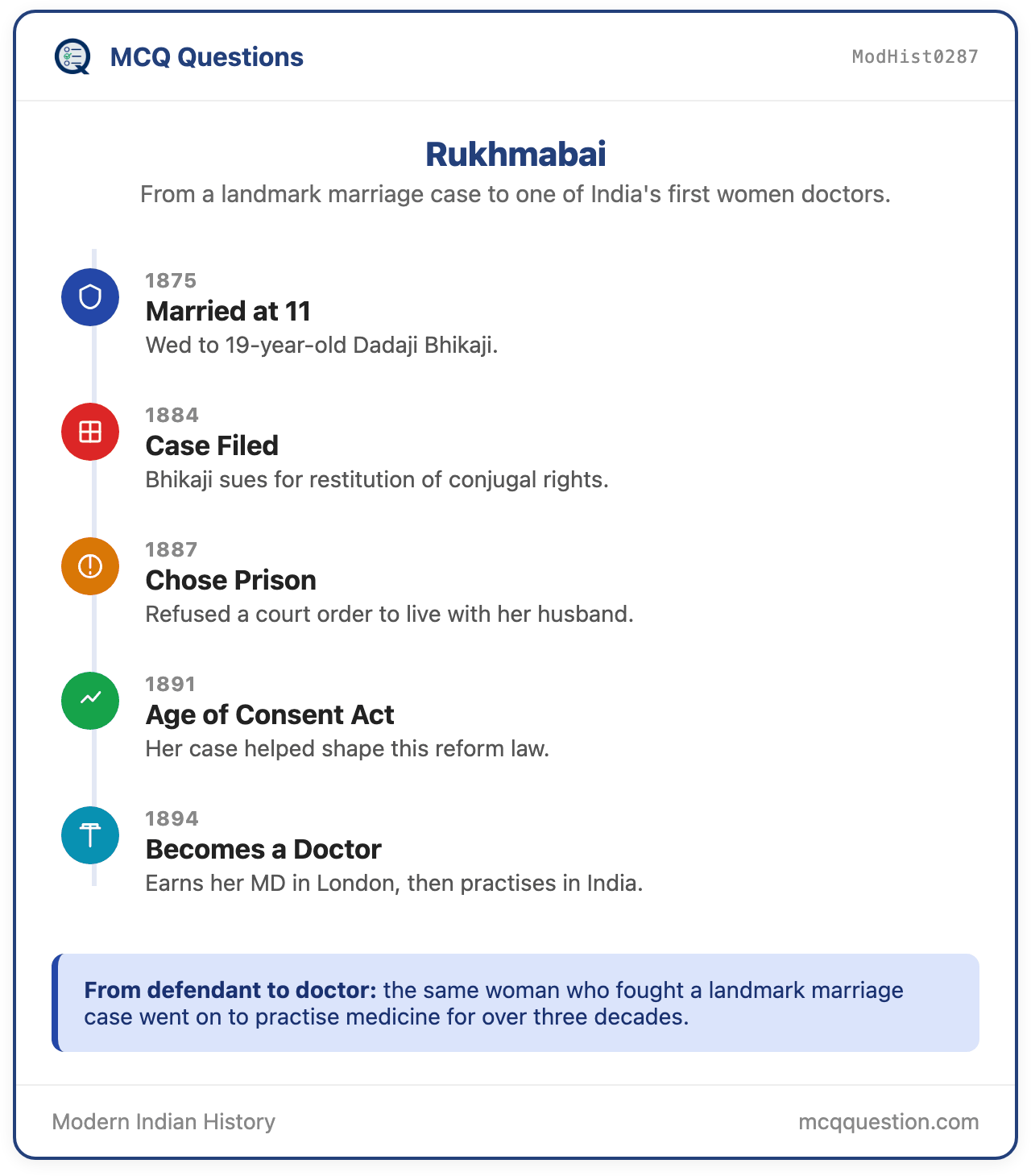
She was married at age 11, around 1875, to 19-year-old Dadaji Bhikaji.
Bhikaji was to live with her family and finish his education, rather than take her away at once.
As an adult, Rukhmabai refused to join her husband’s household.
In 1884, Bhikaji sued for “restitution of conjugal rights,” a court order forcing her to live with him.
In 1885, Justice Robert Hill Pinhey ruled in her favour. He found no basis to compel a woman married in “helpless infancy.”
On appeal and retrial, Justice Farran ruled against her on 4 March 1887. He ordered her to comply or face six months’ imprisonment.
Rukhmabai publicly said she would rather go to prison than obey. Her stand triggered intense debate in India and Britain.
Source: standard record of Rukhmabai’s marriage and the 1884-87 court case.
Pause and decide · 1 of 10
Rukhmabai’s husband initially agreed to live with her family and finish his education, rather than take her away right after their childhood marriage. True or false?
True. As an adult, she still refused to join his household, leading to his 1884 lawsuit for “restitution of conjugal rights.”


Public debate and the 1891 reform
Rukhmabai’s case settled quietly out of court, but the public debate it sparked helped drive a national reform law.
In July 1888, the case was settled outside court. Bhikaji accepted ₹2,000 and gave up his claim, ending the marriage.
Parsi journalist Behramji Malabari used the case to campaign hard against child marriage.
Journalist William Thomas Stead covered the case in London’s Pall Mall Gazette, widening the debate abroad.
The public debate her case generated was a major influence on the Age of Consent Act, 1891.
This law raised the age of consent for sexual intercourse from 10 to 12, across British India.
Source: standard record of the 1888 settlement and the 1891 Age of Consent Act.
Pause and decide · 2 of 10
Rukhmabai’s court case ended with a formal judicial ruling that dissolved her marriage. True or false?
False. The case was actually settled outside court in July 1888, when Bhikaji accepted ₹2,000 and gave up his claim — not through a formal court ruling.
From defendant to medical student
Rukhmabai wrote anonymously, appealed to the Queen, and then sailed to England to train as a doctor after her case had already made her famous.
During the case, Rukhmabai anonymously wrote newspaper pieces under the pen name “A Hindu Lady.” Her authorship was revealed only later.
In 1887, she appealed directly to Queen Victoria, asking for a minimum legal marriage age.
No verified evidence confirms the Queen personally intervened in the case, despite a popular claim to that effect.
Supporters, including physician Edith Pechey and the Rukhmabai Defence Committee, helped fund her medical education.
In 1889, she sailed to England to study medicine, after the case had already made her a public figure.
She trained at the London School of Medicine for Women and the Royal Free Hospital, with further clinical work in Brighton and Dublin.
She qualified in 1894, earning her Doctor of Medicine from the London School of Medicine for Women.
Source: standard record of Rukhmabai’s medical training and 1894 qualification.
Pause and decide · 3 of 10
Documentary evidence confirms that Queen Victoria personally intervened to help Rukhmabai’s legal case. True or false?
False. Rukhmabai did appeal directly to the Queen in 1887, but no verified evidence confirms any personal intervention, despite a popular claim to that effect.
A career in medicine
Rukhmabai became one of India’s earliest practising women doctors, serving for over three decades across two Indian hospitals.
Rukhmabai became the second Indian woman to both earn a medical qualification and go on to practise, after Kadambini Ganguly.
She returned to India in 1895 and became Chief Medical Officer at the Women’s Hospital in Surat.
In Surat, she also gave lectures for local women, partly funded by Edith Pechey, alongside her medical duties.
Early in her career, she also worked on plague-control efforts, for which she later received a Kaiser-i-Hind medal.
From 1918, Rukhmabai worked as Chief Medical Officer at the Zenana State Hospital in Rajkot.
In Rajkot, she also helped establish a local branch of the Red Cross Society in 1918.
She retired from medical practice in 1929, closing a career of roughly 35 years in medicine.
Source: standard record of Rukhmabai’s medical career in Surat and Rajkot.
Pause and decide · 4 of 10
Rukhmabai was the second Indian woman to earn a medical qualification and go on to practise, after Kadambini Ganguly. True or false?
True. She served as Chief Medical Officer first at Surat’s Women’s Hospital, then from 1918 at the Zenana State Hospital in Rajkot, retiring in 1929.
A legal argument ahead of its time
Rukhmabai’s legal team challenged the very basis of the law used against her, and she remained a reformer for the rest of her life.
Her legal argument reframed the whole debate around one point. “Restitution of conjugal rights” was an English common-law import, with no real basis in Hindu personal law.
Applying that English concept to a marriage entered in infancy was itself illegitimate, she argued. The real question was intelligent consent, not just physical maturity.
The 1888 settlement is sometimes described as India’s first Hindu divorce, though it was reached privately, outside any formal court ruling.
After retiring, she published a 1929 pamphlet titled “Purdah — the need for its abolition.” It argued that purdah kept young widows from fully contributing to society.
The Age of Consent Act, 1891, was not India’s last word on marriage-age reform. Nearly four decades later, a similar campaign produced the Sarda Act. See ModHist0262 — Har Bilas Sarda.
Rukhmabai never remarried, choosing to devote the rest of her life to medicine and social reform instead.
She died on 25 September 1955, aged 90. In 2017, Google marked her 153rd birthday with a Doodle, though she never actually used a surname in her own medical or legal records.
Source: standard record of Rukhmabai’s legal argument and later life.
Pause and decide · 5 of 10
Rukhmabai’s legal argument challenged “restitution of conjugal rights” as an English common-law import with no real basis in Hindu personal law. True or false?
True. Her real argument centred on whether intelligent consent, not just physical maturity, had ever genuinely been given to the marriage.
Exam Angle: What to Expect
No Previous Year Question in this site’s index has directly tested this yet.
Do not confuse the Age of Consent Act, 1891 (raised consent age to 12) with the later Sarda Act, 1929 (set a minimum marriage age).
Examiners often test who drove a reform, not just what it did. Behramji Malabari, not Rukhmabai alone, is usually credited as the chief campaigner behind the 1891 Act.
Kadambini Ganguly, not Rukhmabai, was India’s first woman to qualify and practise medicine. Rukhmabai came second, a distinction UPSC-style questions like to test.
Source: standard analysis of likely exam angles on Rukhmabai.
Pause and decide · 6 of 10
The Age of Consent Act, 1891, and the Sarda Act, 1929, addressed exactly the same legal question in the same way. True or false?
False. The 1891 Act raised the age of consent for sexual intercourse, while the 1929 Sarda Act instead set a minimum age for marriage itself — a distinct legal question.
Pause and decide · 7 of 10
Behramji Malabari, not Rukhmabai alone, is usually credited as the chief campaigner behind the 1891 Age of Consent Act. True or false?
True. Rukhmabai’s own case supplied the public debate that Malabari’s campaign then drew on to push the reform through.
Pause and decide · 8 of 10
Rukhmabai was India’s first woman to qualify and practise medicine. True or false?
False. Kadambini Ganguly holds that distinction; Rukhmabai was the second Indian woman to both earn a medical qualification and go on to practise.
Pause and decide · 9 of 10
Rukhmabai’s 1929 pamphlet on purdah argued that the practice kept young widows from fully contributing to society. True or false?
True. This came the same year she retired from a medical career spanning roughly 35 years, across hospitals in Surat and Rajkot.
Pause and decide · 10 of 10
The 1888 settlement that ended Rukhmabai’s marriage is sometimes described as India’s first Hindu divorce, though reached privately, outside a formal court ruling. True or false?
True. Her husband, Dadaji Bhikaji, accepted ₹2,000 and gave up his claim to end the marriage that July.
Check your understanding
Answer the ten checks above. You will see each explanation after choosing.
Primary sources
- Standard record of Rukhmabai’s life, court case, and medical career.
Practice what you learned
Question 1 of 1
Leave a Reply