Rani Gaidinliu
Rani Gaidinliu was 16 when the British sentenced her to life in prison. She spent 14 years behind bars, then lived another 46 years as a free woman, still leading her people. Her prison years are the part most people remember. They were a small fraction of her life.
Origins and rise to leadership
Gaidinliu took over a spiritual resistance movement at just 16, after the British executed the cousin who had led it.
Rani Gaidinliu lived from 1915 to 1993. She was a Naga spiritual and political leader from the Rongmei tribe of Manipur.
At around age 13, she joined the Heraka movement. Her cousin Haipou Jadonang led it, mixing indigenous religion with resistance to British rule.
The British executed Jadonang in 1931. Gaidinliu then took over leadership of the movement at just 16 years old.
She gave the movement a sharper political edge. She called on villagers to refuse taxes and to boycott British goods.
Pause and decide · 1 of 10
Rani Gaidinliu took over leadership of the Heraka movement at age 16, after the British executed her cousin, Haipou Jadonang. True or false?
True. She gave the movement a sharper political edge, calling on villagers to refuse taxes and boycott British goods.


Arrest and fourteen years in prison
Charged with abetment of murder, Gaidinliu spent fourteen years moving between four colonial jails before independence finally freed her.
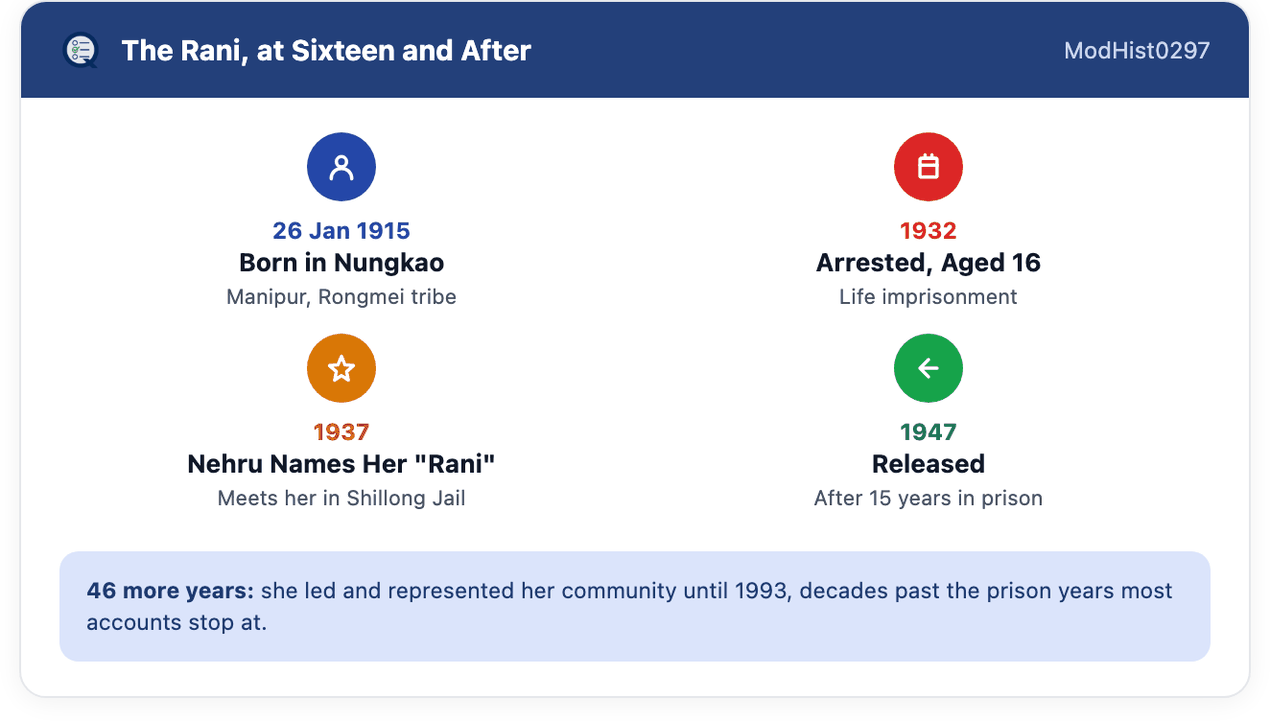
The British arrested her in 1932, at age 16. They charged her with abetment of murder linked to the resistance.
She was sentenced to life imprisonment. She was moved between four jails: Guwahati, Shillong, Aizawl, and Tura.
Jawaharlal Nehru met her at Shillong Jail in 1937. He promised to work for her release and called her “Rani,” meaning Queen.
She was released only in 1947, after independence. By then she had spent fourteen years behind bars.
Pause and decide · 2 of 10
Rani Gaidinliu was released from prison before India’s independence, as part of a separate colonial amnesty. True or false?
False. She was released only in 1947, after independence — by then she had spent fourteen years behind bars, moved between four different jails.
Life after 1947
Freedom did not end Gaidinliu’s public role; she kept leading and representing her community for another four decades, earning national honours along the way.
After her release, Gaidinliu kept leading her community for decades. She lived in Kohima from 1966 to around 1992, at the government’s request.
She met Prime Minister Nehru again in Delhi in 1953. They discussed welfare and development for the Zeliangrong people.
She received the Tamrapatra Freedom Fighter Award in 1972. She received the Padma Bhushan in 1982 and the Vivekananda Seva Award in 1983.
She returned to her home village of Longkao in 1991. She died there on 17 February 1993, at age 78.
Pause and decide · 3 of 10
Rani Gaidinliu received the Padma Bhushan in 1982, a decade after her Tamrapatra Freedom Fighter Award. True or false?
True. She also met Prime Minister Nehru again in Delhi in 1953, to discuss welfare and development for the Zeliangrong people.
Standing against the NNC insurgency
Gaidinliu opposed full secession from India, taking her own armed stand against rival Naga insurgents for six years.
Gaidinliu opposed the Naga National Council, led by A.Z. Phizo. The NNC wanted full secession from India; she did not.
She instead campaigned for a separate Zeliangrong territory, inside the Indian Union. NNC leaders saw this as a threat to their movement.
From 1960 to 1966, she went underground with an armed following. She organised roughly a thousand men to defend her position against NNC pressure.
Clashes with NNC cadres turned deadly in this period. Phizo eventually met her at Lungkao village, and the two sides reached a peace accord.
Pause and decide · 4 of 10
Rani Gaidinliu supported the Naga National Council’s demand for full secession from India. True or false?
False. She opposed full secession, instead campaigning for a separate Zeliangrong territory inside the Indian Union — a position that put her in a six-year armed standoff with NNC forces.
The Heraka faith and its symbols
Gaidinliu’s religious standing as a living goddess reinforced her political authority, while a parallel welfare body extended her practical reach.
“Heraka” means “pure” in the local language. The name described the movement’s revivalist form of indigenous Naga religion.
Within the Heraka faith, followers came to see Gaidinliu as an incarnation of the goddess Cherachamdinliu. This religious standing strengthened her political authority.
In 1934, she helped found an early tribal welfare body among the Rongmei, later known as the Kabui Samiti. It worked alongside her religious leadership.
Her story begins alongside her cousin’s. See ModHist0160 — Jadonang for the movement’s founding and the 1931 execution that first brought her to leadership.
Pause and decide · 5 of 10
Within the Heraka faith, followers came to see Rani Gaidinliu as an incarnation of the goddess Cherachamdinliu. True or false?
True. This religious standing strengthened her political authority, alongside the Kabui Samiti welfare body she helped found in 1934.
Legacy in independent India
Most accounts of Gaidinliu’s life stop at her 1947 release, overlooking the four decades of leadership and the national honours that followed.
Most accounts of her life stop at her 1947 release, as though the story ends there. It doesn’t: she led her community for another four decades.
India issued a postage stamp honouring her in 1996, followed by a commemorative coin in 2015. Both mark her role in the freedom struggle.
The Indian Coast Guard commissioned a patrol vessel named ICGS Rani Gaidinliu. It entered service on 19 October 2016, based at Krishnapatnam.
Jadonang and Gaidinliu are together remembered as founding figures of the modern Zeliangrong Naga political and religious identity, spanning Manipur, Nagaland, and Assam.
Pause and decide · 6 of 10
Most standard accounts of Rani Gaidinliu’s life fully cover her four decades of leadership after her 1947 release. True or false?
False. Most accounts stop at her 1947 release, as though the story ends there, overlooking the four more decades she spent leading her community.
Exam Angle: What to Expect
Nehru gave her the title “Rani” as an honorific in 1937. It was not a hereditary royal title, unlike Rani Lakshmibai’s.
Questions may pair her with Jadonang, her cousin and the Heraka movement’s founder. Examiners often test which leader founded a movement versus who carried it forward.
Options may mix up her Rongmei tribe with other Naga or Northeast tribal groups. Her movement is tied specifically to the Zeliangrong Nagas of Manipur, Nagaland, and Assam.
Pause and decide · 7 of 10
Rani Gaidinliu’s title was a hereditary royal title, just like Rani Lakshmibai’s. True or false?
False. Nehru gave her the title “Rani” as an honorific in 1937 — it was not a hereditary royal title, unlike Rani Lakshmibai’s.
Pause and decide · 8 of 10
Rani Gaidinliu’s movement is tied specifically to the Zeliangrong Nagas, spanning Manipur, Nagaland, and Assam. True or false?
True. Exam options sometimes mix up her specific tribal identity with other Naga or Northeast tribal groups.
Pause and decide · 9 of 10
Rani Gaidinliu was moved between four different colonial jails during her imprisonment: Guwahati, Shillong, Aizawl, and Tura. True or false?
True. It was at Shillong Jail specifically that Nehru met her in 1937 and gave her the “Rani” title.
Pause and decide · 10 of 10
Rani Gaidinliu died in 1993 in her home village of Longkao, which she had returned to only two years earlier. True or false?
True. She died on 17 February 1993, at age 78, after returning to Longkao in 1991.
Check your understanding
Answer the ten checks above. You will see each explanation after choosing.
Sources and official records
Practice what you learned
Question 1 of 1
Leave a Reply