Two Mongol commanders were marched back to Delhi and trampled by elephants in view of the city walls. This article covers nearly a century of Mongol raids the Delhi Sultanate had to repel, decade after decade.


Timeline
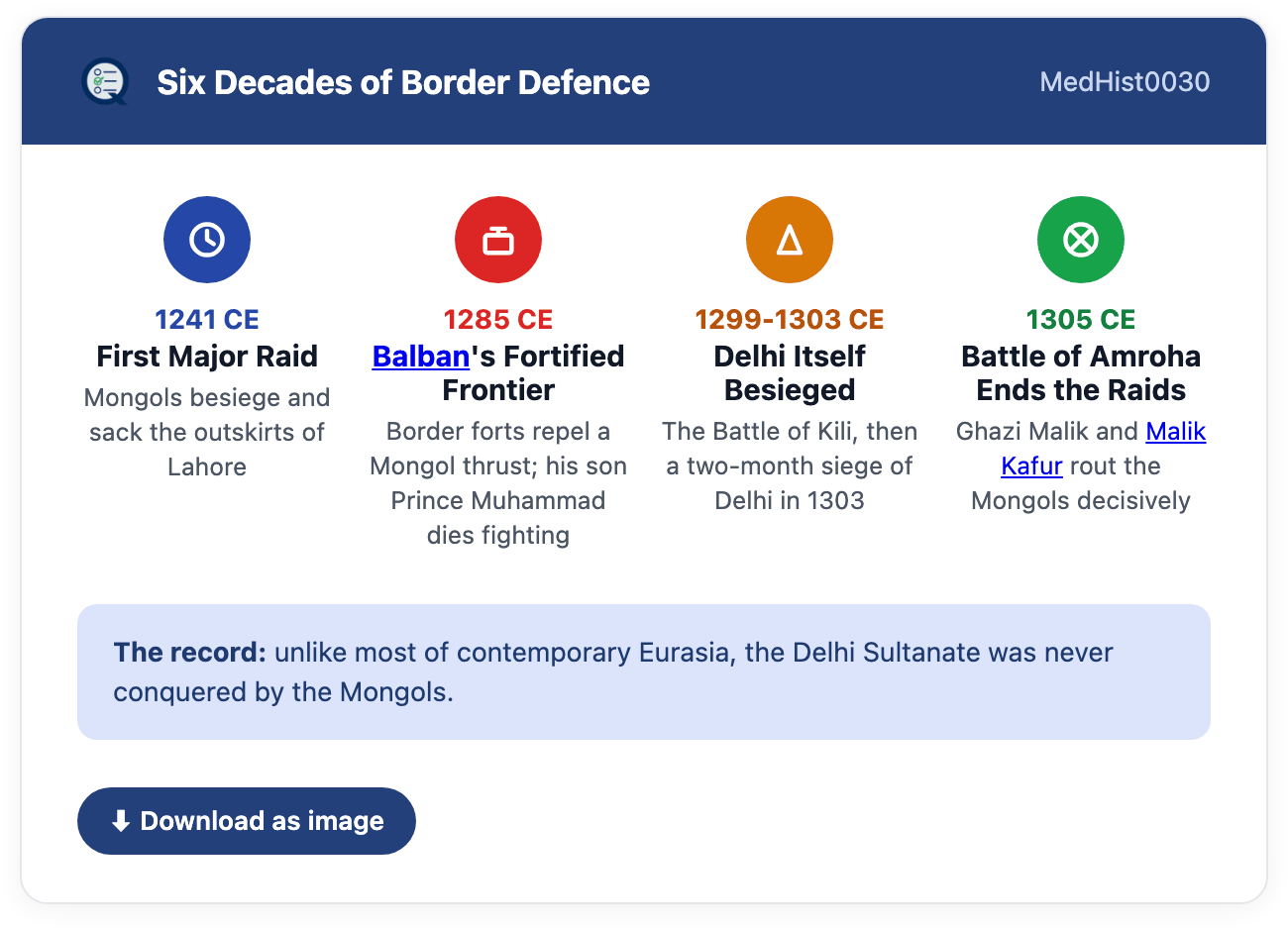
- 1241 CE: Mongols besiege Lahore, sacking its outskirts, the first major raid into Sultanate territory.
- 1285 CE: Sultan Balban’s fortified frontier repels a Mongol thrust at the Multan-Lahore border. His son, Prince Muhammad, dies in the fighting.
- 1299 CE: At the Battle of Kili, general Zafar Khan engages a Mongol detachment; his forces are ambushed but inflict heavy losses.
- 1303 CE: Mongol commander Taraghai besieges Delhi itself for over two months. Alauddin Khilji shelters in a fortified camp rather than risk open battle.
- 1305 CE: At the Battle of Amroha, generals Ghazi Malik and Malik Kafur decisively defeat a 20,000-strong Mongol force, ending major raids into Sultanate territory.
A Threat That Never Went Away Need to Know
- Mongol raids on the Delhi Sultanate began with a 1241 CE attack on Lahore and continued in waves for over six decades, across multiple reigns.
- Sultan Balban built a fortified frontier of border forts to repel Mongol incursions. His son Prince Muhammad died fighting the Mongols in 1285 CE.
- The Delhi Sultanate’s survival against the Mongols was unusual. Much of contemporary Eurasia, from China to Persia to Russia, fell to Mongol conquest during the same broad period.
- Successive Sultans treated the northwest frontier as a permanent standing priority, not an occasional emergency. Fortified border towns, large garrisons and repeated campaigns spanned multiple reigns and dynasties.
Alauddin’s Real Achievement: 1303 and Siri Fort Need to Know
- In 1303 CE, Mongol commander Taraghai invaded while two major units of the Delhi army were away. His forces besieged Delhi for over two months and ransacked its suburbs.
- Alauddin Khilji rushed back from a campaign at Chittor but had no time to prepare adequately for open battle. He sheltered instead in a well-guarded camp, at what would become Siri Fort.
- The Mongols could not breach Alauddin’s fortified camp and eventually withdrew. The experience directly shaped Alauddin’s later strategy of permanent, strongly garrisoned frontier defences.
- Siri Fort was built from this lesson. It became one of the historic “Seven Cities of Delhi,” a fortified capital built specifically in response to a real, recent military threat.

The Generals Who Ended It: Amroha, 1305 Good to Know
- At the Battle of Amroha, generals Ghazi Malik and Malik Kafur caught a Mongol force of roughly 20,000 horsemen on their way home. They inflicted a heavy defeat.
- Mongol commanders Ali Beg and Tartaq were captured, along with around 8,000 of their men. Both commanders were taken to Delhi and trampled to death by elephants, in view of the city walls.
- Ghazi Malik later founded his own dynasty, ruling as Ghiyasuddin Tughlaq. See MedHist0026 — Ghiyasuddin Tughlaq.
- Malik Kafur went on to lead major Deccan campaigns, then made his own violent bid for power after Alauddin’s death. See MedHist0089 — Malik Kafur: From Slave to Sultan-Maker for his full story.
- For Alauddin Khilji’s wider reign, see MedHist0004 — The Khilji Dynasty and Alauddin’s Reforms.
Test Yourself



Legacy Great to Know
- The same general, Ghazi Malik, who helped end the Mongol threat at Amroha later founded his own ruling dynasty. Military success against a genuine existential threat built the credibility a frontier general needed to eventually take the throne.
- The elephant executions of Ali Beg and Tartaq served a clear political purpose. A public, visible punishment in front of Delhi’s walls sent a deterrent message to any future Mongol commander weighing another raid.
- Alauddin’s fortified-camp survival in 1303 wasn’t luck. It became a template. Permanent frontier garrisons and new fortified capitals followed directly from lessons learned under real siege pressure, not abstract planning.
- Six decades of persistent, repelled invasion attempts left the Delhi Sultanate as one of the few major powers the 13th-century Mongol expansion never actually conquered.
Beyond the answer
Browse all medieval-indian-history topics →
📚 Keep reading
MedHist0004 — The Khilji Dynasty and Alauddin's ReformsMedHist0089 — Malik Kafur: From Slave to Sultan-MakerMedHist0024 — South Indian Kingdoms Destroyed by the Delhi Sultanate: Yadavas, Kakatiyas, HoysalasMedHist0026 — Ghiyasuddin TughlaqMedHist0063 — Amir Khusrau❓ Practice this topic
During which two Mughal emperors' reigns did Tavernier make his six voyages to India, between 1630 and 1668?The 115-carat rough diamond Tavernier acquired in 1666 was later cut down and sold to Louis XIV as which famous diamond?In which year did Tavernier publish “Les Six Voyages,” recording diamond prices and mining techniques from his travels?Jean-Baptiste Tavernier's book gave the first detailed European technical description of which diamond mines?🎲 Take a Medieval Indian History Quiz
Leave a Reply