A Sultan once forced nobles to kiss his feet and call him God’s shadow on Earth. Balban had once been their equal, a fellow slave-noble in the same inner circle he later crushed.
 MCQ Questions
Balban
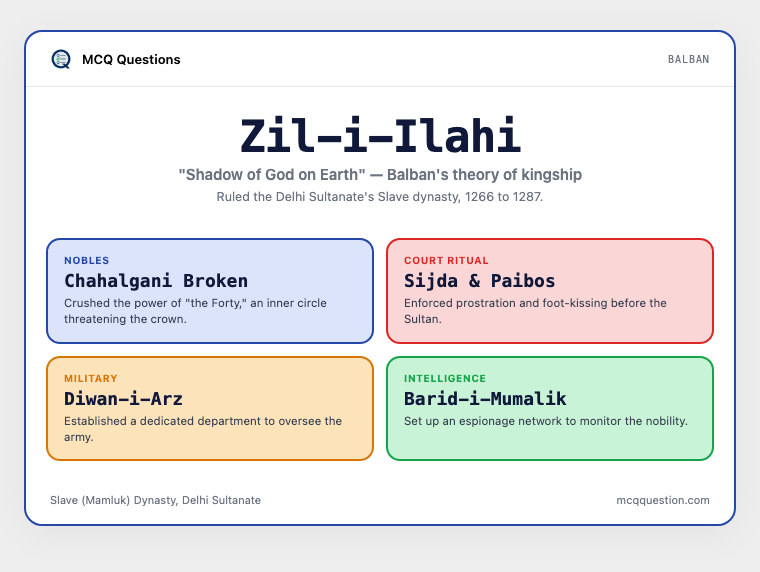
Zil-i-Ilahi
“Shadow of God on Earth” — Balban’s theory of kingship
Naib to the throne, 1246 to 1266. Sultan of the Slave dynasty, 1266 to 1287.
Nobles
Chahalgani Broken
Crushed the power of “the Forty,” the very clique he had risen through.
Court Ritual
Sijda & Paibos
Enforced prostration and foot-kissing before the Sultan.
Intelligence
Barid-i-Mumalik
Set up an espionage network to monitor the nobility.
Rise to Power: From Slave to Regent Need to Know

- Ghiyas ud din Balban was born around 1216 in Turkestan, likely into an Ilbari Turkic clan.
- Mongols captured him as a boy and sold him into slavery.
- Sultan Iltutmish bought him in Delhi in 1232, founder of the Slave, or Mamluk, dynasty.
- Balban rose through the Chahalgani, or “the Forty” — an elite corps of Turkic slave-nobles serving the Sultan.
- This same clique had opposed Razia Sultana, the dynasty’s only woman ruler, and helped depose her in 1240.
- By 1246, Sultan Nasiruddin Mahmud made Balban his Naib, or deputy ruler, with the title Ulugh Khan.
- Balban’s daughter married the Sultan, deepening his hold over the court.
- He effectively ran the government for nearly two decades before ever becoming Sultan himself.
- Nasiruddin Mahmud died in 1266 without an heir, and Balban took the throne directly.
Zil-i-Ilahi: Shadow of God on Earth Need to Know
- Once Sultan, Balban built a new theory of kingship around the Persian title Zil-i-Ilahi.
- Zil-i-Ilahi means “Shadow of God on Earth.”
- He paired it with a second title, Niyabat-i-Khudai, meaning “Vicegerent of God.”
- The idea placed the Sultan’s authority almost beyond question, sanctioned directly by God.
- This marked a sharp break from Balban’s own earlier status as one noble among equals.
- He used the ideology to demand total submission from men he had once served alongside as an equal.
Sijda and Paibos: Reinventing Court Ritual Good to Know
- To reinforce Zil-i-Ilahi in practice, Balban introduced strict new court ceremonies from Persia’s Sassanid tradition.
- Sijda required nobles and visitors to prostrate fully before the Sultan.
- Paibos required them to kiss the Sultan’s feet as a mark of submission.
- He also revived Nauroz, the Persian New Year, staging it as a show of royal grandeur.
- Balban kept a stern, formal public manner, and rarely appeared relaxed or approachable before the court.
- These rituals deliberately put distance between the Sultan and nobles he had once treated as equals.
Crushing the Forty: Blood and Iron Good to Know
- Balban had risen through the Chahalgani himself — yet he ended up dismantling that very group.
- He saw the Forty’s independent power as the single biggest threat to centralized royal authority.
- His method became known to historians as the policy of “blood and iron.”
- He began breaking the Forty’s power even during his years as Naib, before he was Sultan.
- He had his own cousin, Sher Khan, poisoned to remove a rival within the group.
- Malik Baqbaq, a provincial governor, was publicly flogged for abusing a subordinate — a warning to every noble watching.
- Haibat Khan, another noble, was executed for murder despite his high rank.
- Balban also stripped defeated or disloyal nobles of their iqtas, the land grants that funded their private armies.
- By the time his own reign was underway, the Forty had lost its power as an independent faction.
Test Yourself

Military Reforms and the Mongol Frontier Great to Know
- The Mongols were a real, serious threat along the Sultanate’s northwest frontier throughout Balban’s reign.
- He built a defensive line anchored on Multan and Lahore, using the Beas river as a forward barrier.
- Balban set up the Diwan-i-Arz, a dedicated department to organize and pay the army.
- An official called the Ariz-i-Mamalik headed this military department.
- He reorganized the army to keep it loyal, well-supplied, and ready against Mongol raids.
- In March 1285, Mongol raiders struck near Multan, and Balban’s son and heir, Prince Muhammad, died defending the city.
- Prince Muhammad earned the title Khan-i-Shahid, “the Martyr Prince,” after his death.
- The loss was a severe personal blow to the elderly Balban, who had named Muhammad his successor.
Administrative Centralization and Legacy Great to Know
- Balban set up the Barid-i-Mumalik, an espionage network watching officials and nobles across the sultanate.
- These barids reported directly to the Sultan, letting him spot threats before they could grow.
- He also tightened central control over iqta revenue collection from provincial land grants.
- Balban’s reforms were not isolated moves; they formed one coherent strategy.
- Breaking noble power, elevating royal ritual, and building a loyal army and spy network all served the same goal.
- That goal was centralizing power in the Sultan alone, not sharing it with the nobility.
- His approach shaped how later Delhi Sultanate rulers, including Ghiyasuddin Tughlaq, Muhammad bin Tughlaq, and Feroz Shah Tughlaq, approached royal authority.
- Balban died in January 1287, aged around 71.
- His tomb in Delhi’s Mehrauli Archaeological Park holds one of the earliest true arches built in India.
Beyond the answer
Browse all medieval-indian-history topics →
📚 Keep reading
MedHist0003 — The Slave (Mamluk) Dynasty of DelhiMedHist0025 — Razia SultanaMedHist0089 — Malik Kafur: From Slave to Sultan-MakerMedHist0033 — The Iqta SystemPolity0052 — The Supreme Court❓ Practice this topic
During which two Mughal emperors' reigns did Tavernier make his six voyages to India, between 1630 and 1668?The 115-carat rough diamond Tavernier acquired in 1666 was later cut down and sold to Louis XIV as which famous diamond?In which year did Tavernier publish “Les Six Voyages,” recording diamond prices and mining techniques from his travels?Jean-Baptiste Tavernier's book gave the first detailed European technical description of which diamond mines?🎲 Take a Medieval Indian History Quiz
Leave a Reply