A noble could hold a rich province one year and lose it to a transfer the next. This article covers the Iqta system, the Delhi Sultanate’s answer to paying an army without a permanent treasury. It also covers how the system differed from what came after it.


Timeline
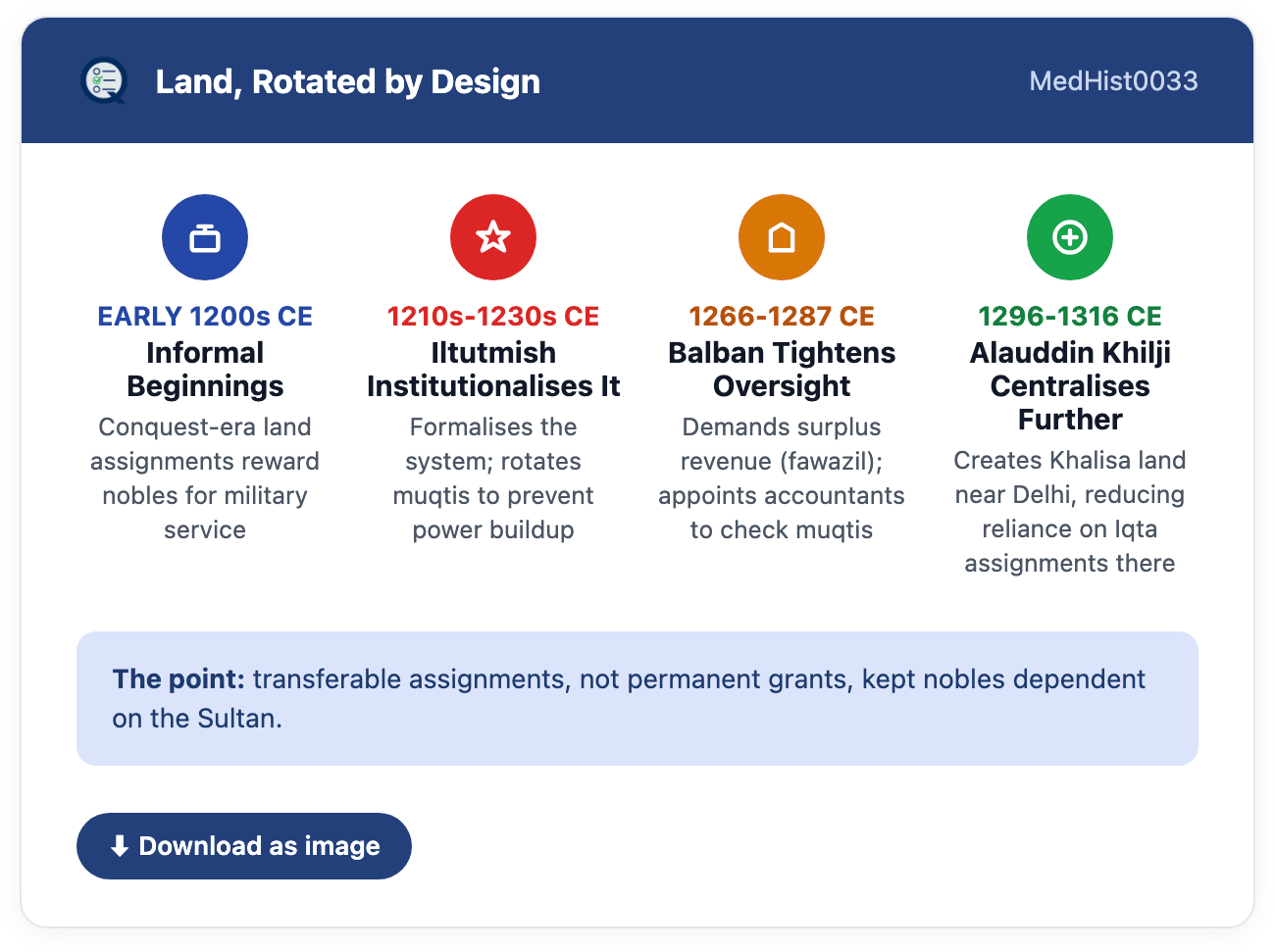
- Early 1200s CE: Informal land assignments reward nobles for military service during the early Delhi Sultanate’s conquests.
- 1210s-1230s CE: Sultan Iltutmish institutionalises the Iqta system. He rotates its holders, called muqtis, between assignments to prevent any noble from building lasting local power.
- 1266-1287 CE: Sultan Balban tightens fiscal oversight. He demands surplus revenue, called fawazil, and appoints accountants to check muqtis’ collections.
- 1296-1316 CE: Alauddin Khilji centralises further. He creates Khalisa land directly around Delhi, reducing his own reliance on Iqta assignments near the capital.
How the Iqta System Actually Worked Need to Know
- An Iqta assigned the right to collect land revenue, not land ownership itself, to a noble in exchange for military service.
- Its holder, called a muqti (also called an iqtadar or wali), collected taxes from the assigned territory. He used that revenue to maintain his own troops, who could be summoned by the Sultan during campaigns.
- A muqti held real, combined authority. He handled tax collection, troop maintenance, and local administration together, sending any surplus revenue up to the central treasury.
- Iqtas were transferable, not hereditary. A noble could hold a wealthy assignment one year and be moved elsewhere the next, with no fixed term guaranteed.
Iltutmish and Balban: Institutionalising Control Need to Know
- Sultan Iltutmish formalised the system in the 1210s-1230s CE. He rotated muqtis between different Iqtas specifically to stop them from accumulating permanent regional power.
- Balban tightened central control further during his reign (1266-1287 CE). He demanded surplus revenue, called fawazil, and appointed accountants to verify muqtis’ collections directly.
- Alauddin Khilji expanded direct central revenue collection by creating Khalisa land near Delhi. This land stayed entirely under state control, distinct from land assigned out under the Iqta system.
- For Khalisa land and other Sultanate revenue terms, see MedHist0029 — Administrative and Revenue Terminology of the Delhi Sultanate.

Iqta vs. Later Jagir: A Real Structural Difference Good to Know
- The Mughal Jagir system, tied to the Mansabdari ranking structure, grew out of the Iqta system. The two aren’t the same thing, though they’re often confused.
- A muqti held real, combined administrative and military authority over his Iqta. A Mughal jagirdar generally held only the right to collect revenue, with a more limited direct administrative role.
- Under the Iqta system, part of the empire’s land was directly held by iqtadars. Under the later Jagir system, all land nominally belonged to the emperor. Jagirdars held only a revenue right over their assigned area, not the land itself.
- Mansabdari also added a standardised military rank (mansab) that determined a noble’s position and obligations, a more bureaucratic structure than the Sultanate’s simpler revenue-for-service exchange.
Test Yourself



Legacy Great to Know
- Rotating muqtis between assignments was a deliberate anti-entrenchment mechanism. A noble who never stayed long enough in one place could not easily build an independent local power base to challenge the Sultan.
- The system solved a real problem: paying a standing military without a large cash treasury. Revenue rights substituted for salary, letting the state fund its army without constant cash transfers from the centre.
- Balban’s fawazil demands and Alauddin’s Khalisa expansion both moved in the same direction. Each Sultan pulled more direct revenue control toward the centre, at the expense of the nobility’s independent income.
- The Iqta system evolved into the Mughal Jagir and Mansabdari systems. Later empires kept solving the same core problem: funding an army and administration without a large cash treasury. Each new version was more standardised and centralised than the last.
Beyond the answer
Browse all medieval-indian-history topics →
📚 Keep reading
Eripatti, Ghatikas, and Taniyurs: Chola-Era Land TermsThe Banjaras: Medieval India's Traveling TradersChampaka, Durgara, and Kuluta: Matching Medieval Hill StatesFeudalism in Indian History: A Weak Center, Not a Strong OneBabur and the Founding of Mughal Rule in India❓ Practice this topic
🎲 Take a Medieval Indian History Quiz
Leave a Reply