India’s single largest tiger reserve isn’t Ranthambore or Jim Corbett. It sits inside a lesser-known range called the Nallamala Hills.


 MCQ Questions
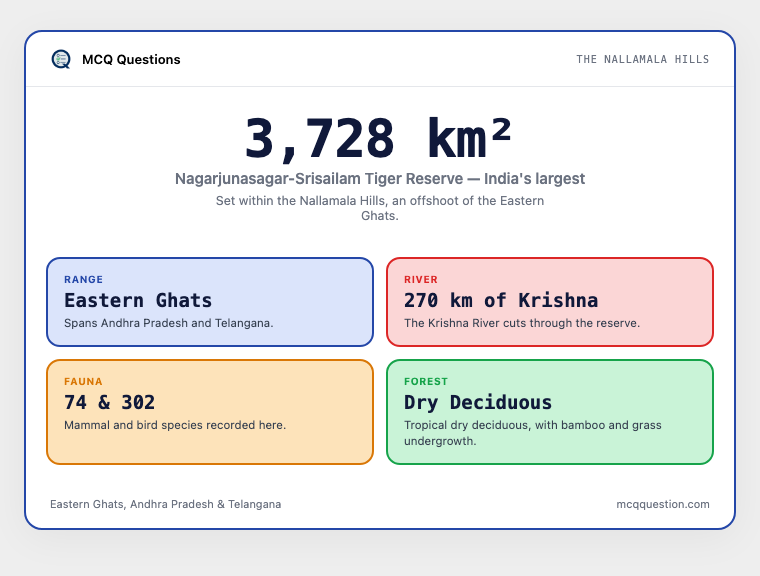
India's single largest tiger reserve isn't Ranthambore or Jim Corbett. It sits inside a lesser-known range called the Nallamala Hills.
1. The Hills and the Reserve They Hold
1.1 Where are the Nallamala Hills, and what do they hold?
The Nallamala Hills are part of the Eastern Ghats, mainly in Andhra Pradesh and Telangana. They host the Nagarjunasagar-Srisailam Tiger Reserve, known as NSTR.
- NSTR is India's single largest tiger reserve, covering about 3,728 square kilometres.
- The Krishna River flows through the reserve for around 270 kilometres.
- The hills run mainly north-south, forming a long ridge line across two states.
- NSTR spreads across five districts: Nandyal, Prakasam, Palnadu, Nalgonda, and Mahabub Nagar.
- Three of these districts lie in Andhra Pradesh and two in Telangana, since the reserve straddles both states.
- The Srisailam Dam, on the Krishna River, sits inside the reserve itself.
- The dam generates hydroelectric power and supplies irrigation water to both Andhra Pradesh and Telangana.
- It is one of the largest masonry dams in the world, built directly across a deep gorge on the Krishna.
- The reservoir behind it also supports drinking-water needs for towns across both neighbouring states.
- The hills take their name from the Telugu word for a creeper-covered range, "Nallamala" meaning black forest.
- They form part of the wider Eastern Ghats, a broken, discontinuous range unlike the continuous Western Ghats.
- Average elevations in the Nallamala Hills run from about 520 to 700 metres above sea level.
- The range stretches roughly 430 kilometres, from the Krishna River in the south to the Godavari River area further north.
- Locally, different stretches of the range carry their own names, including the Yerramalas and the Velikonda range.
- Rainfall here is moderate, arriving mostly from the retreating northeast monsoon rather than the summer monsoon.
True or False: The Nagarjunasagar-Srisailam Tiger Reserve is India's single largest tiger reserve by area.
Correct! At 3,728 sq km, NSTR beats every other Indian tiger reserve in size.
Not quite. NSTR, at 3,728 sq km, is actually India's largest tiger reserve.
2. Terrain, Forest, and Wildlife
2.1 What does the terrain and wildlife look like here?
The terrain includes plateaus, ridges, gorges, and deep valleys. The forest type is tropical dry deciduous, with an undergrowth of bamboo and grass.
- The reserve is home to around 74 mammal species and 302 bird species.
- Predators found here include the leopard, wolf, Asiatic wild dog, and Indian pangolin.
- Srisailam, a major Jyotirlinga pilgrimage site, sits within the reserve's boundary.
- The reserve holds a genuinely huge Critical Tiger Habitat, the largest of any reserve in India.
- Several thousand families still live inside the reserve's core area, in villages predating the reserve itself.
- The reserve was formed by merging two older sanctuaries, Nagarjunasagar and Rajiv Gandhi Wildlife Sanctuary.
- It falls under Project Tiger, India's flagship tiger-conservation programme launched in 1973.
- Chenchus, a designated Particularly Vulnerable Tribal Group, live traditionally within these forests.
- They have traditionally practised hunting and gathering, alongside limited shifting cultivation on the hills' slopes.
- The terrain's ridges and gorges make parts of the reserve difficult to access, helping shield its core habitat.
- Andrographis nallamalayana grows only here, an endemic medicinal plant named directly after the hills.
- The reserve's dry deciduous forest turns notably green during the southwest monsoon, from June to September.
- Sloth bears, four-horned antelope, and mouse deer also live within these forests, alongside the reserve's tigers.
- Rock formations across the hills also shelter ancient cave paintings, evidence of long human presence in the region.
Exam Practice: PYQ Pattern
Common traps in this topic:
- Questions test the Srisailam-Nallamala pairing against similar-sounding pilgrimage-hill pairs elsewhere in India.
- How to prepare: fix the anchor facts — Nallamala Hills, Eastern Ghats, NSTR at 3,728 sq km.
A Common Pilgrimage-Geography Trap. UPSC tested three place-of-pilgrimage-to-hill-range pairs.
Answer: (a) 1 only. Srisailam, a major Shiva pilgrimage site, correctly sits in the Nallamala Hills, on the Andhra Pradesh–Telangana border. Omkareshwar is wrongly paired with the Satmala Hills — it actually sits on a Narmada river island, near the Vindhyas; see IndReligion0038 — Jyotirlinga. Pushkar is wrongly paired with the Mahadeo Hills — it actually sits in Rajasthan's Aravalli Range; see ArtnCulture0093 — Pushkar Mela.
The Largest Critical Tiger Habitat. UPSC asked which reserve has the largest core/critical tiger habitat by area, among Manas, Pakke, Nagarjunasagar Srisailam, and Periyar.
Answer: (c) Nagarjunasagar Srisailam. Its critical tiger habitat covers roughly 2,595 square kilometres, the largest of any Indian reserve.
Quick recall: Across how many districts and states does NSTR spread?
5 districts across 2 states — three in Andhra Pradesh, two in Telangana.
3. Endemic Species and an Exam Contrast
3.1 What's the exam trap here, and what else is worth knowing?
The region also holds several endemic plant species, found nowhere else on Earth, including Andrographis nallamalayana.
- Despite being India's largest tiger reserve by area, NSTR remains far less publicly known than Ranthambore or Jim Corbett.
- This is a useful exam contrast: being the largest reserve doesn't automatically mean being the most famous.
- Amrabad Tiger Reserve, just across the border in Telangana, was once part of the same undivided reserve.
- The two reserves were split administratively after Telangana's formation in 2014, though they remain ecologically connected.
- NSTR's Eco-Sensitive Zone has been formally notified, one of only 29 tiger reserves nationally with that status.
- A proposed National Highway upgrade through the reserve raises real habitat-fragmentation concerns for planners.
- Railway lines already cross parts of the reserve, prompting proposals for wildlife underpasses and fencing.
- Invasive plants like Lantana camara and Prosopis juliflora are actively managed here through annual weed removal.
- NSTR has identified fringe forest areas for the Green Credit Programme, a Union government afforestation initiative.
- The programme invites voluntary participation from government agencies, PSUs, and private organisations to restore degraded land.
4. Thousands of Families Still Live Inside the Core
4.1 What did the 2026 STRIDES report find?
NSTR has 4,700 families across 17 villages still living inside its notified Critical Tiger Habitat. (Source: The New Indian Express, July 15, 2026)
- This comes from the NTCA's latest STRIDES report, a nationwide assessment of tiger-reserve infrastructure and social parameters.
- NSTR ranks fifth nationally for unrelocated families, behind Amrabad, Veerangana Durgavati, Ranthambore, and Sanjay-Dubri.
- No villages or families have been relocated from NSTR's core area so far, and no Forest Rights Act claims are pending there.
- This shows the human side of managing India's single largest tiger reserve by area.
MCQ on The Nallamala Hills
Try 6 practice questions on The Nallamala Hills.
Question 1 of 1
Question 1 of 1
Question 1 of 1
Question 1 of 1
Question 1 of 1
Question 1 of 1
Leave a Reply