In December 2025, Parliament rewrote a law that had stood since 1962. It opened India’s nuclear sector to private companies for the first time. This article covers India’s nuclear energy programmes — from Homi Bhabha‘s original three-stage plan to the reform that just reshaped it.

Timeline
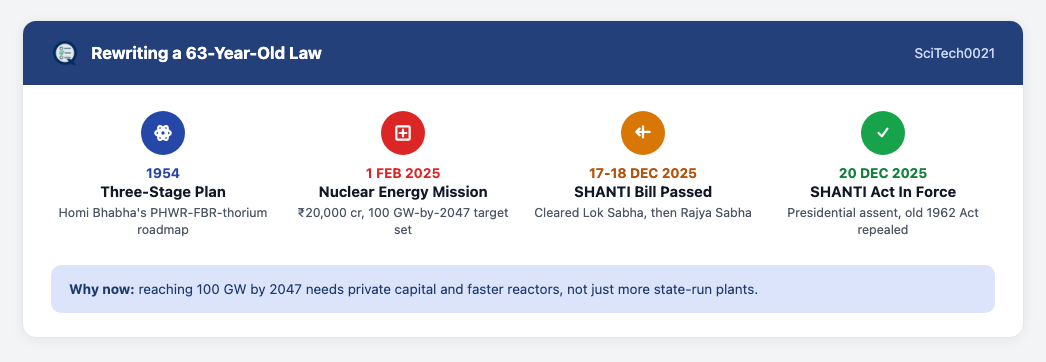
- 1954: Homi Bhabha lays out India’s three-stage nuclear power programme. See SciTech0051 — Homi J. Bhabha for his full biography.
- 1 February 2025: The Union Budget launches the Nuclear Energy Mission for Viksit Bharat, with ₹20,000 crore allocated and a 100 GW-by-2047 target.
- 17-18 December 2025: The SHANTI Bill clears the Lok Sabha, then the Rajya Sabha.
- 20 December 2025: President Droupadi Murmu gives assent. The SHANTI Act takes effect, repealing the Atomic Energy Act, 1962.
Must Know
- India’s installed nuclear capacity is about 8.78 GW as of 2026, just over 3% of the country’s electricity.
- The Nuclear Energy Mission for Viksit Bharat, launched 1 February 2025, targets 100 GW of nuclear capacity by 2047.
- The SHANTI Act, in force since 20 December 2025, replaces both the Atomic Energy Act, 1962 and the Civil Liability for Nuclear Damage Act, 2010.
- SHANTI opens India’s nuclear sector to private and foreign investment for the first time, permitting joint ventures with up to 49% FDI.
Good to Know
- Bhabha’s original plan had three stages: Pressurised Heavy Water Reactors on natural uranium, then fast breeder reactors, then thorium-based reactors.
- The government wants at least five India-designed Small Modular Reactors operational by 2033, including a 200 MW “Bharat Small Modular Reactor” planned for Tarapur.
- The Nuclear Energy Mission’s 2025-26 budget of ₹20,000 crore is earmarked mainly for SMR research and development.
- SHANTI replaces flat liability caps with a five-tier cap based on reactor size, capping maximum liability per incident at 300 million SDR (about $430 million).
Previous Year Question.
Asked as: “Consider the following statements. Which one of the following is correct in respect of the above statements?” This was asked in UPSC CSP 2023, GS Paper I. View this question.
Test Yourself

Great to Know
- SHANTI’s liability cap and its private-sector opening are linked, not separate reforms. Without a capped, predictable liability, private companies had little reason to enter a sector long reserved for state-run NPCIL.
- Going from 8.78 GW today to 100 GW by 2047 needs more than bigger PHWRs. It needs private capital and faster-to-build SMRs alongside the traditional public-sector construction model.
- Opposition parties wanted SHANTI sent to a parliamentary committee before passage, citing safety and accountability concerns. That tension — between speed and scrutiny — has run through India’s nuclear-liability debates since the original 2010 Act.
- Watch how the licensing regime under SHANTI actually gets written. The Act permits private participation broadly, but reserves sensitive fuel-cycle activities for government control — where exactly that line gets drawn will shape how much private investment actually follows.
Current Affairs
- In a separate 5 August 2026 reply, Minister Jitendra Singh addressed public concerns near planned nuclear plant sites. These covered plant safety, rehabilitation, and the loss of traditional livelihoods, like fishing and horticulture. (Source: Business Standard)
- He said these concerns had been addressed, through public awareness programmes using a “multipronged and credible approach.” Safety upgrades, he added, continue based on evolving global standards and operating experience. (Source: Business Standard)
- On 22 July 2026, a Parliament reply added new detail on the HTGCR demonstration reactor planned for BARC, Vizag. Siting consent has been received, along with the environmental-clearance Terms of Reference from the Ministry of Environment, Forest and Climate Change. (Source: PIB)
- The reply also detailed BARC’s vendor-development push. BARC is engaging Indian industries through knowledge-sharing and handholding, to build domestic SMR-component suppliers and grow a private-sector R&D ecosystem. (Source: PIB)
- It further detailed the AERB’s new statutory powers under SHANTI. The regulator can now draft its own regulations, carry out independent oversight, take enforcement action, and make recommendations to the Central Government. (Source: PIB)
- On 30 July 2026, Parliament also detailed nuclear technology’s use in medicine. (Source: PIB)
- BARC produces radioisotopes and radiopharmaceuticals, distributed nationwide through BRIT. (Source: PIB)
- DAE runs dedicated cancer-care units too: RMC Mumbai, and RMRC Kolkata, live since January 2024. (Source: PIB)
- It has also developed PSMA-617, an indigenous ligand for prostate-cancer therapy. (Source: PIB)
- Separately, the government detailed nuclear-project employment estimates. (Source: PIB)
- Each project employs about 8,000 workers at peak construction, and 2,000 permanently once operational. (Source: PIB)
- On 29 July 2026, Parliament got fresh detail on reactor project costs. (Source: PIB)
- The Kudankulam KKNPP-5&6 units alone carry an approved cost of ₹69,437 crore. (Source: PIB)
- The Kalpakkam PFBR, by contrast, cost ₹8,181 crore, and should be fully commissioned by March 2027. (Source: PIB)
- NPCIL has also signed new capacity-augmentation pacts, with MAHAGENCO, MITRA, and NLC India. (Source: PIB)
- On 23 July 2026, Parliament reviewed India’s Three-Stage Nuclear Power Programme. (Source: PIB)
- Its final stage uses thorium, bred into Uranium-233, to fuel the KAMINI reactor at Kalpakkam. (Source: PIB)
- BARC is also researching Molten Salt Reactor technology, for future thorium use. (Source: PIB)
- Separately, the SHANTI Act set graded nuclear-liability caps, by reactor size. (Source: PIB)
- The largest reactors face up to ₹3,000 crore in liability; smaller facilities, as little as ₹100 crore. (Source: PIB)
- Two new PHWR sites were also confirmed: Chutka, Madhya Pradesh, and Mahi Banswara, Rajasthan. (Source: PIB)
- As of August 2026, India’s installed nuclear capacity stands at 8.78 GW (8,780 MW), across 24 plants. This excludes RAPS-1’s 100 MW. A further 18 reactors, totalling 13,600 MW, are under implementation. Of these, 8 are under construction, including the 500 MW Kalpakkam Prototype Fast Breeder Reactor. The remaining 10 are in pre-project activities. Capacity is expected to reach about 22 GW by 2031-32, as these projects complete. (Source: Dr. Jitendra Singh, written Lok Sabha reply, 5 August 2026)
- Beyond 2032, NPCIL plans a further 32 GW of indigenous capacity, using Pressurised Heavy Water Reactors (PHWR) and Light Water Reactors (LWR). That takes NPCIL’s own pathway to about 54 GW by 2047. The remaining 46 GW of the 100 GW target is expected from other routes: other Public Sector Enterprises, State Governments, private players, and joint ventures. This is separate from the Small Modular Reactor programme already covered above. (Source: PIB, Lok Sabha reply, 5 August 2026)
- India’s Prototype Fast Breeder Reactor at Kalpakkam attained criticality on 6 April 2026. (Source: PIB, Lok Sabha reply, 5 Aug 2026)
- Unit-8 of the Rawatbhata Atomic Power Project is in advanced commissioning. It should become operational later in 2026. (Source: PIB)
- Two Kudankulam reactors under construction, KKNPP-3 and 4, are due in June 2027 and June 2028. Two more, KKNPP-5 and 6, are due by March 2030. (Source: PIB)
- As of August 2026, no new nuclear power project has been sanctioned since the Middle East conflict began. (Source: PIB)
- The Atomic Energy Commission has approved Tarapur, Maharashtra, as the site for both demonstration SMRs, the BSMR-200 and the SMR-55. (Source: PIB)
- BSMR-200’s financial-sanction proposal has cleared the Atomic Energy Commission, alongside Empowered Technology Group approval. (Source: PIB)
- A third demonstration reactor, the High Temperature Gas Cooled Reactor (HTGCR), is planned for BARC, Vizag. It will generate heat for hydrogen production, not electricity. (Source: PIB)
- All three demonstration SMRs need 60 to 72 months to build, once financial sanction is granted. (Source: PIB)
- India has indigenously developed ApuRVA, a special alloy used for the SMRs’ reactor pressure vessels. (Source: PIB)
- A capacity augmentation of the BSMR-200 demonstration reactor, to 300 MWe, is envisaged. This is based on operating experience from the initial 220 MWe demonstration reactor. (Source: PIB PRID 2294813)
- The SHANTI Act (Sustainable Harnessing and Advancement of Nuclear Energy for Transforming India), 2025, was notified on 21 December 2025. It grants the Atomic Energy Regulatory Board (AERB) statutory status, strengthening its regulatory oversight powers. (Source: PIB PRID 2294813)
- The SHANTI Act also reforms India’s nuclear liability regime, to align with international conventions. It fixes graded liability by facility type and reactor power, intended to widen scope for public and private sector participation. (Source: PIB PRID 2294813)
- On 10 July 2026, NITI Aayog convened a Stakeholder Consultation on the SHANTI Act’s implementation, at the Dr. Ambedkar International Centre, New Delhi. Government officials, regulators, and industry experts attended, including AERB’s Director and NTPC’s CMD. (Source: PIB)
- Discussions covered three areas: the Act’s draft rules and FDI policy, financing and insurance mechanisms, and domestic manufacturing capacity. The consultation aims to strengthen the Act’s operational framework, ahead of its full rollout. (Source: PIB)
India’s Full Reactor Pipeline: Units Beyond the Current Rollout
Beyond RAPP-8, GHAVP-1&2, KKNPP-3-6, and PFBR, a further 13 project groups are at earlier pre-project or planning stages. (Source: PIB, Lok Sabha reply, 5 August 2026)
| Project | Location | Capacity | Technology | Status / Target |
|---|---|---|---|---|
| GHAVP-1&2 | Gorakhpur, Haryana | 2×700 MW | Indigenous | Under construction, ~6 years from First Pour of Concrete |
| GHAVP-3&4 | Gorakhpur, Haryana | 2×700 MW | Indigenous | Pre-project, targeted 2031-32 |
| KAIGA-5&6 | Karnataka | 2×700 MW | Indigenous | Targeted June 2031 / June 2032 |
| Chutka-1&2 | Madhya Pradesh | — | Indigenous | Pre-project, targeted 2031-32 |
| Mahi Banswara-1&2 and 3&4 | Rajasthan | — | Indigenous | Pre-project, targeted 2031-32 |
| FBR-1&2 | Kalpakkam, Tamil Nadu | — | Indigenous | Pre-project, targeted 2031-32 |
| RAPP-9&10 | Rajasthan | — | — | Planned / proposed |
| KAPP-5&6 | Kakrapar, Gujarat | — | Indigenous | Planned / proposed |
| NAPP-3&4 | Narora, Uttar Pradesh | — | Indigenous | Planned / proposed |
| Jaitapur-1 to 6 | Maharashtra | 6×1,730 MW | Foreign | In-principle approved |
| Kovvada-1 to 6 | Andhra Pradesh | 6×1,208 MW | Foreign | Planned / proposed |
| Haripur-1 to 6 | West Bengal | 6×1,000 MW | Foreign | Planned / proposed |
| Mithi Virdi-1 to 6 | Gujarat | 6×1,000 MW | Foreign | Planned / proposed |
| Bhimpur-1 to 4 | Madhya Pradesh | 4×700 MW | Indigenous | Planned / proposed |
Leave a Reply