India tested a nuclear device in 1974 and called it peaceful. Twenty-four years later, it tested five more and called them exactly what they were. This article covers India’s nuclear tests at Pokhran — Smiling Buddha in 1974, and Operation Shakti in 1998.

Timeline
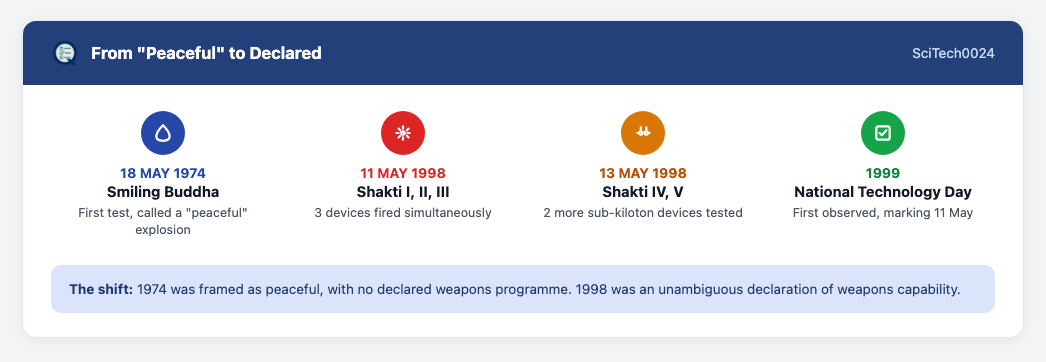
- 18 May 1974: India conducts Smiling Buddha, its first nuclear test, at Pokhran.
- 11 May 1998: Three devices are fired simultaneously in Operation Shakti’s first round.
- 13 May 1998: Two more sub-kiloton devices are tested, completing Pokhran-II.
- 1999: India first observes National Technology Day on 11 May, commemorating Pokhran-II.
Must Know
- India’s first nuclear test, Smiling Buddha, happened on 18 May 1974 at Pokhran. It was an implosion-type device, framed as a “peaceful nuclear explosion,” with a yield of 6-10 kilotons.
- Pokhran-II (Operation Shakti) ran 11-13 May 1998: five devices across two days, including a 45-kiloton thermonuclear device.
- After Pokhran-II, Prime Minister Atal Bihari Vajpayee declared a voluntary moratorium on further nuclear testing, a posture India still maintains.
- 11 May is marked as National Technology Day, commemorating Pokhran-II, first celebrated in 1999.
Good to Know
- On 11 May 1998, three devices were fired simultaneously at 3:45 pm: a 45-kiloton thermonuclear device, a 15-kiloton fission device, and a 0.2-kiloton sub-kiloton device.
- Two more sub-kiloton devices, yielding 0.5 and 0.3 kilotons, were tested on 13 May 1998.
- The same day as Shakti’s first tests, India also test-fired the Trishul missile and flew Hansa-3, its first indigenously built aircraft.
- India has declined to sign the CTBT even while maintaining its voluntary testing moratorium.
Test Yourself

Great to Know
- Smiling Buddha and Pokhran-II reflect two different postures. 1974 was framed as a peaceful explosion, with no declared weapons programme. 1998 was an unambiguous declaration of weapons capability.
- Pokhran-II triggered international sanctions and tighter export controls, reshaping India’s diplomatic relationships for years afterward.
- India’s moratorium is voluntary, not treaty-bound. India can resume testing if it judges its “supreme national interests” require it — a position it has kept even while declining to sign the CTBT.
- For India’s broader nuclear energy programme, see SciTech0021 — Nuclear Energy Programmes of India.
Leave a Reply