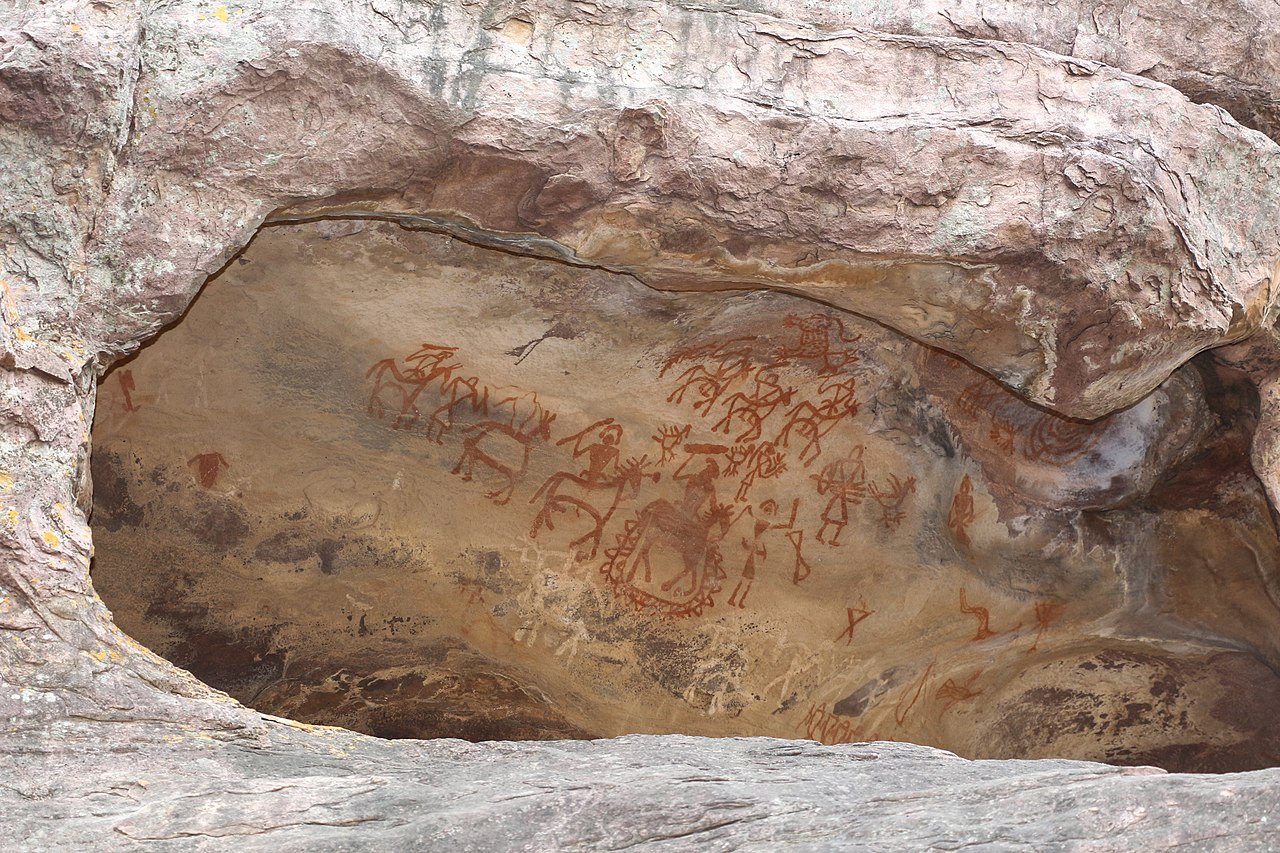
In 1957, an archaeologist named V.S. Wakankar was riding a train from Bhopal to Itarsi. He glanced out the window and saw strange, mushroom-shaped rock hills, the kind he had seen sheltering prehistoric art in France and Spain. He got off at the next station and walked back to look. What he found was Bhimbetka — and with it, the start of a painting tradition that runs from prehistoric rock art all the way to the murals inside Buddhist cave monasteries centuries later. This period, roughly prehistoric times through the early medieval era, built the techniques and visual style that later Indian painting schools used.

Must Know
Bhimbetka: The Earliest Paintings
- BhimbetkaThe earliest Indian paintings survive on rock shelters, not on cloth or paper. The most famous group sits at Bhimbetka in Madhya Pradesh, a UNESCO World Heritage Site.
- HowIts paintings span an enormous range of time, from the Upper Palaeolithic period through to the early historical era. Archaeologist V.S. Wakankar found the site by chance in 1957, spotting its odd mushroom-shaped rocks from a passing train.
- ResultEarly layers show simple hunting scenes and animals. Later layers add battle scenes and ritual life, tracking how human society itself changed.
Ajanta: Buddhist Caves and the Gupta Peak, and Fresco-Secco, Not True Fresco, and Bagh Caves: The Secular Cousin
- Ajanta CavesThe most celebrated early Indian paintings are in the Ajanta Caves in Maharashtra — Buddhist rock-cut monasteries cut into a horseshoe-shaped gorge.
- HowMost of the famous murals were painted during the Gupta period, in the 5th century CE. They show Jataka tales — stories of the Buddha’s past lives — alongside scenes of court and daily life.
- WhyThis mix of religious storytelling and secular detail is why exams keep returning to Ajanta. It captures Gupta-era belief and daily life in one place.
- MechanismAjanta’s artists used the fresco-secco technique. They applied colour to a dry, already-prepared plaster surface.
- InsteadThis is different from true “fresco buon,” where pigment is applied to wet plaster and bonds into it as it dries. Calling Ajanta’s murals plain “frescoes” is a common exam trap.
- HowThe artists used natural pigments only: ochre, lamp black, terra verte, and a blue made from imported lapis lazuli.
- Bagh CavesThe Bagh Caves, also in Madhya Pradesh, date from around the same time as Ajanta’s later phase.
- InsteadBagh’s murals share Ajanta’s style and technique, but focus more on court and social life than on religious storytelling.
- TakeawayAjanta = religious narrative first. Bagh = secular life first. Same period, same technique, different emphasis.

Good to Know
Volume Without Perspective
- MechanismAjanta’s paintings are prized for their sense of volume and movement. The artists had no linear perspective to work with.
- HowThey built depth instead through shading and outline, making figures look three-dimensional on a flat wall.
- WhyArt historians often compare this rounded, sculptural look to Gupta-era stone carving from the same period.
The Chitrasutra: Writing About Painting, and Ajanta Rediscovered in 1819
- ChitrasutraWriting about painting is even older than the paintings that survive. The Chitrasutra, part of the Vishnudharmottara Purana, is one of the oldest Indian texts on painting theory.
- HowIt covers proportion, emotional expression (bhava), and a framework of six core principles known as the Shadanga.
- TakeawayA theory text surviving separately from the paintings it describes is itself a fact worth remembering — theory and practice have different survival records.
- RediscoveryThe modern world only “rediscovered” Ajanta in 1819. A British officer named John Smith was chasing a tiger through the Sahyadri hills when a local shepherd boy pointed out a strange archway across the ravine.
- ResultThe site had sat abandoned and overgrown for centuries. Smith marked the moment by scratching his own name and the date onto a pillar inside Cave 10 — graffiti that is still visible today.
Test Yourself
Loading practice…
Great to Know
The Shadanga: Six Limbs of Painting
- MechanismLater commentary on the Chitrasutra names the Shadanga (Six Limbs) of Indian painting. They are Rupabheda (form and variety), Pramanam (proportion), Bhava (emotion and mood), Lavanya Yojanam (grace), Sadrisyam (likeness), and Varnikabhanga (colour).
- In practiceArt historians still use this exact six-part framework to study classical Indian painting today.
Ajanta’s Two Distinct Phases
- MechanismAjanta’s murals don’t all date from one period — they come in two distinct phases.
- HowAn early “Hinayana” phase, under the Satavahanas (roughly 2nd century BCE–1st century CE), left mostly stupas and simple decoration, with no Buddha figures. A later “Mahayana” phase followed, under Vakataka patronage in the 5th century CE. It produced most of the famous narrative murals and added Buddha imagery.
- InsteadDon’t treat “Ajanta” as one single-period site — the phase matters for exactly which style or feature a question is asking about.
Lapis Lazuli and Long-Distance Trade, and The Hallisalasya Painting at Bagh
- MechanismAjanta’s pigments were entirely mineral- and plant-based.
- WhySome scholars point to the lapis lazuli, imported from as far as Afghanistan for blue tones. They read it as evidence of long-distance trade supplying Gupta-era artists.
- InsteadOther art historians still debate this specific trade-route claim, so treat it as a plausible reading, not a settled fact.
- Rang MahalCave 4 of the Bagh Caves is nicknamed the “Rang Mahal” (Palace of Colours). It holds the Hallisalasya painting, a Gupta-period mural from around the 5th–6th century CE.
- HowIt shows a circular ring dance — women and men dancing hand-in-hand around a central musician. Performers play the hudukka (hand-drum) and kamsyatalas (cymbals), a form described in the Natyashastra.
- ResultIt is the earliest surviving Indian painting of a named folk dance, capturing Gupta-era secular, social life rather than a religious scene.
PYQ / Exam Angle
UPSC CSP 2026: The Hallisalasya Painting
- QuestionUPSC asked what the Hallisalasya painting in the Bagh Caves “represents.” The answer is a joyous folk dance.
- WhyThe distractors offer religious scenes instead — Buddha in meditation, Shiva and Parvati, Samudramanthan. The trap is assuming every cave painting must be religious; this one is secular.
- LinkSource: UPSC CSP 2026, GS Paper I (see Q6).
CDS (II) 2025: Two Statements on Ajanta Paintings
- QuestionCDS asked whether Ajanta’s paintings depict yakshas, gandharvas and apsaras (statement 1), and whether the artists used a “multiple perspectives” technique (statement 2). The answer is both statements are correct.
- WhyThe trap is assuming only one statement can be right. Ajanta does both — its narrative panels include celestial figures, and its artists paint figures from more than one angle within a single scene to suggest depth.
- LinkSource: CDS (II) 2025, General Knowledge (see Q62).
Beyond the answer
Browse all art-and-culture topics →
📚 Keep reading
ArtnCulture0174 — Bagh Caves, Madhya PradeshArtnCulture0013 — Buddhist and Hindu Mythological Influence on Indian PaintingArtnCulture0188 — Ajanta and Mahabalipuram: What They Do and Don't ShareArtnCulture0017 — Rabindranath Tagore: The Poet Who Became a PainterAncHist0099 — Buddhist Rock-Cut Architecture: Chaityas and Viharas❓ Practice this topic
A0982 — Which painting technique was used to create the murals at the Ajanta Caves?A0981 — The famous murals at the Ajanta Caves, depicting Jataka tales, were painted mainly during which period?A2379 — The Ajanta caves, renowned for their exceptional Buddhist rock-cut architecture and paintings, received their principal patronage from which dynasty?C6908 — Bagh Caves: pigments used in the murals🎲 Take a Art And Culture Quiz
Leave a Reply