India has promised a pucca house to 4.95 crore rural families by March 2029, and more than three crore of those houses are already standing. This guide explains how Pradhan Mantri Awaas Yojana – Gramin (PMAY-G) works, who it helps, and where the scheme stands today.


Must Know
PMAY-G: India’s Rural Housing Scheme
What is PMAY-G?
- Full formPMAY-G = Pradhan Mantri Awaas Yojana – Gramin, which means the Prime Minister’s Housing Scheme – Rural.
- DefinitionIt is India’s flagship rural housing scheme.
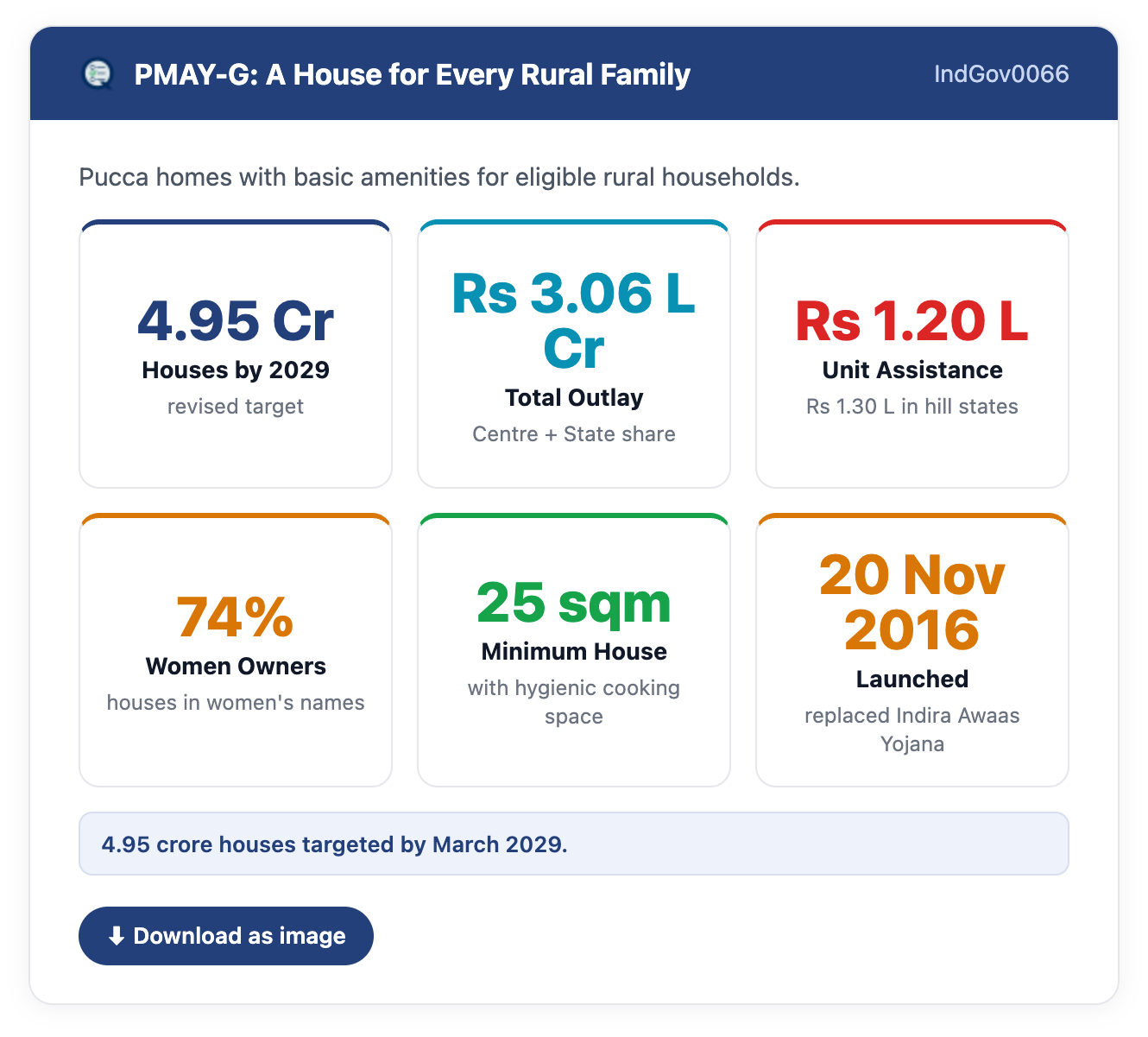
- TimelinePrime Minister Narendra Modi launched it on 20 November 2016 in Agra, Uttar Pradesh.
- TimelineIt has been implemented since 1 April 2016.
- Who runs itThe Ministry of Rural Development operates the scheme.
- GoalEvery eligible rural household should get a pucca house with basic amenities.
Why the scheme exists, and Target and timeline, and From IAY to PMAY-G
- ProblemMillions of rural families live in kutcha houses.
- DefinitionA kutcha house is built with mud, thatch, or other non-durable materials.
- ProblemMany more families live in old, dilapidated homes.
- Why it mattersSuch houses leak, crack, and fail in floods, storms, and extreme heat.
- SolutionThe scheme gives these households a permanent pucca home.
- DefinitionA pucca house is built with durable materials like brick, cement, and concrete.
- TimelineThe original target was 2.95 crore houses by March 2024.
- TimelineIn August 2024, the Union Cabinet approved 2 crore additional houses.
- TimelineThe new phase runs from FY 2024-25 to FY 2028-29.
- Full formFY = Financial Year, the April-to-March accounting year in India.
- NumbersThe revised target is 4.95 crore houses by March 2029.
- NumbersThe total outlay is ₹3,06,137 crore.
- ProgressMore than 3.05 crore houses are already complete; 3.91 crore are approved.
- Full formIAY = Indira Awaas Yojana, the earlier rural housing scheme.
- TimelinePMAY-G restructured IAY when implementation began in 2016.
- Why it mattersThe change raised unit assistance and linked houses to basic amenities.
- Who runs itThe scheme works under the Ministry of Rural Development.
- ContextPMAY-G is the rural half of India’s housing-for-all push.
Good to Know
How PMAY-G Works on the Ground
Unit assistance and cost sharing
- NumbersUnit assistance is ₹1.20 lakh in plain areas.
- NumbersIt rises to ₹1.30 lakh in North-Eastern states and hill states.
- DefinitionHill states include Himachal Pradesh, Uttarakhand, Jammu & Kashmir, and Ladakh.
- MechanismThe Centre and the States share the cost of every house.
- MechanismPlain areas split the cost 60:40 between Centre and State.
- MechanismNorth-Eastern and hill states split it 90:10.
- Why it mattersCostlier, harder regions receive a higher central share.
House design standards, and Who gets a house?, and New phase, new rules
- StandardEvery house must be at least 25 square metres.
- StandardThis includes a dedicated, hygienic cooking space.
- Why it mattersSize and design directly affect family health and dignity.
- DesignA house is planned as a home, not just a bare shelter.
- IdentificationNames come from SECC 2011 data and the Awaas+ 2018 survey.
- Full formSECC = Socio Economic and Caste Census.
- MechanismThe Gram Sabha verifies each name on the list.
- Full formGram Sabha = the village assembly of registered voters.
- MechanismA formal Appellate Process lets rejected families appeal.
- Why it mattersSelection is local, public, and contestable.
- ChangeThe new phase cut exclusion criteria from 13 to 10.
- ChangeOwning a fishing boat no longer excludes a family.
- ChangeOwning a motorised two-wheeler no longer excludes a family.
- ChangeThe income threshold was raised to ₹15,000 a month.
- Why it mattersMore rural families now qualify for a house.
Test Yourself
Question 1 of 1
Great to Know
Deeper Mechanisms and Surprising Facts
Awaas+ 2024: the mobile app
- TimelineThe Prime Minister launched the Awaas+ 2024 mobile app on 17 September 2024.
- MechanismIt uses Aadhaar-based facial recognition to verify beneficiaries.
- DefinitionAadhaar is the 12-digit unique identity number issued to residents.
- FeatureThe app offers 3D house designs for beneficiaries to choose from.
- PartnersThe designs were built with the Central Building Research Institute (CBRI).
- Full formCBRI = Central Building Research Institute.
- Why it mattersTechnology speeds up verification and cuts fraud.
Convergence: from house to home, and 74% houses owned by women, and Telangana: the lone exception, and Skilling 3 lakh rural masons, and The urban counterpart
- MechanismPMAY-G does not stop at four walls.
- MechanismIt converges with Swachh Bharat Mission – Gramin (SBM-G) for toilets.
- Full formSBM-G = Swachh Bharat Mission – Gramin, the rural cleanliness mission.
- MechanismIt converges with the Jal Jeevan Mission (JJM) for tap water.
- Full formJJM = Jal Jeevan Mission, the water life mission.
- MechanismIt converges with PM Ujjwala Yojana for LPG connections.
- Full formLPG = Liquefied Petroleum Gas.
- MechanismIt converges with PM Surya Ghar: Muft Bijli Yojana for rooftop solar.
- Why it mattersOne address stitches four schemes into a single, fully serviced home.
- NumbersAlmost 74% of sanctioned houses are owned solely or jointly by women.
- Design choiceThis is a deliberate design choice, not an incidental outcome.
- Why it mattersOwnership gives women a durable asset in their own name.
- Why it mattersIt strengthens their security, status, and bargaining power.
- InsightHousing policy here also works as women’s empowerment policy.
- Coverage GapTelangana is the only state that does not implement PMAY-G.
- CoverageEvery other state and Union Territory (UT) runs the scheme.
- Full formUT = Union Territory, a centrally administered region.
- InsightThe scheme’s national coverage is therefore almost complete.
- NumbersAlmost 3 lakh rural masons have been trained under the scheme.
- SkillsThey learn disaster-resilient construction techniques.
- Why it mattersTrained masons build houses that survive floods, earthquakes, and storms.
- LivelihoodsSkilling also creates steady rural livelihoods.
- InsightBetter-built houses mean lower repair costs for poor families.
- ContextPMAY-G is the rural half of India’s housing-for-all push.
- ContextPMAY (Urban) covers cities under the same umbrella mission.
- Full formPMAY = Pradhan Mantri Awaas Yojana.
- Read nextSee IndSoc0018 — PMAY (Urban) and Swachh Bharat Mission (Urban) for the urban side.
Current Affairs
Recent Developments in PMAY-G
October 2026: 3D-printed housing pilot in Andhra Pradesh
- FirstOn 4 October 2026, Shivraj Singh Chouhan laid the foundation of a 3D concrete-printed housing pilot at Burripalem, Guntur district, Andhra Pradesh. (Source: PIB)(PIB, 4 Oct 2026)
- NumbersThe pilot will build 177 houses for ₹14 crore, within about six months. (Source: PIB)(PIB, 4 Oct 2026)
- ClaimThe Rural Development Ministry called it the country’s first pilot housing project using 3D concrete printing. (Source: PIB)(PIB, 4 Oct 2026)
- NumbersThe same day, the Centre handed over 3 lakh PMAY-G 2.0 houses worth ₹3,600 crore to Andhra Pradesh. (Source: PIB)(PIB, 4 Oct 2026)
- WhyOfficials had first proposed 76,000 houses for the state. The allocation was raised to 3 lakh at the Chief Minister’s request. (Source: PIB)(PIB, 4 Oct 2026)
July 2026: 97.48 lakh sanctions in new phase
- NewsOn 28 July 2026, MoS Chandra Sekhar Pemmasani replied in a written Lok Sabha answer.(PIB, 28 Jul 2026)
- Full formMoS = Minister of State.(PIB, 28 Jul 2026)
- Full formLok Sabha = the lower house of India’s Parliament.(PIB, 28 Jul 2026)
- NumbersIn the new phase, 1.22 crore houses were allocated to states.(PIB, 28 Jul 2026)
- NumbersOf these, 97.48 lakh houses had been sanctioned so far.(PIB, 28 Jul 2026)
- Source(Source: PIB)(PIB, 28 Jul 2026)
July 2026: fund releases under new phase, and Why houses get delayed, and May 2026: Mother Sanction of ₹10,021.42 crore, and March 2026: ₹4 lakh crore disbursed
- NewsSince FY 2024-25, the Centre has released ₹49,407.96 crore in central share to states.(PIB, Jul 2026)
- NumbersIncluding states’ own matching share, ₹88,426.76 crore has been utilised in total.(PIB, Jul 2026)
- MechanismThe central share flows to states, which add their own share.(PIB, Jul 2026)
- MechanismTogether the funds pay for construction and beneficiary disbursement.(PIB, Jul 2026)
- Source(Source: PIB)(PIB, Jul 2026)
- NewsStates reported several recurring causes of delay on 28 July 2026.(PIB, 28 Jul 2026)
- CauseUnwilling beneficiaries slow the process down.(PIB, 28 Jul 2026)
- CausePermanent migration leaves sanctioned houses unclaimed.(PIB, 28 Jul 2026)
- CauseDisputed succession follows a beneficiary’s death.(PIB, 28 Jul 2026)
- CauseDelayed land allotment blocks landless families.(PIB, 28 Jul 2026)
- CauseElections, material shortages, and slow State Treasury releases add to delays.(PIB, 28 Jul 2026)
- Source(Source: PIB)(PIB, 28 Jul 2026)
- NewsOn 28 May 2026, Union Minister Shivraj Singh Chouhan released a “Mother Sanction” of ₹10,021.42 crore.(PIB, 28 May 2026)
- ScopeThe funds went to 12 states under PMAY-G.(PIB, 28 May 2026)
- NumbersApprovals had reached 3.91 crore houses against the 4.95 crore target.(PIB, 28 May 2026)
- NumbersMore than 3.05 crore houses were completed.(PIB, 28 May 2026)
- Next stepChouhan urged states to identify and provide land for landless poor families.(PIB, 28 May 2026)
- BottleneckLand, he said, is the main remaining bottleneck to finishing the target.(PIB, 28 May 2026)
- Source(Source: PIB)(PIB, 28 May 2026)
- NewsA 31 March 2026 PIB backgrounder put cumulative disbursement at ₹4,03,886.12 crore.(PIB, 31 Mar 2026)
- TimelineThis is the total since the scheme’s 2016 launch.(PIB, 31 Mar 2026)
- TechAI-driven tools now strengthen transparency.(PIB, 31 Mar 2026)
- Full formAI = Artificial Intelligence.(PIB, 31 Mar 2026)
- MechanismGeo-tagging verifies where houses actually stand.(PIB, 31 Mar 2026)
- MechanismAnomaly detection flags suspicious records.(PIB, 31 Mar 2026)
- MechanismAadhaar face authentication confirms the right beneficiary.(PIB, 31 Mar 2026)
- Source(Source: PIB)(PIB, 31 Mar 2026)
Exam Point of View
How PMAY-G Appears in Exams
MCQ Questions
- Full formMCQ = Multiple Choice Question.
- ScopeUPSC and other competitive exams ask about PMAY-G’s facts and numbers.
- RevisionLaunch: 20 November 2016, in Agra, Uttar Pradesh, by the Prime Minister.
- RevisionTarget: 4.95 crore houses by March 2029, with an outlay of ₹3,06,137 crore.
- RevisionUnit assistance: ₹1.20 lakh in plain areas; ₹1.30 lakh in hill and North-Eastern areas.
- RevisionCost sharing: 60:40 in plain areas; 90:10 in hill and North-Eastern areas.
- RevisionExclusion criteria cut from 13 to 10; income threshold ₹15,000 a month.
- RevisionIdentification uses SECC 2011 and the Awaas+ 2018 survey.
- TrapThe one state not implementing PMAY-G: Telangana.
Written Answer Questions
- ThemeThis is a General Studies (GS) theme: rural development and welfare schemes.
- Full formGS = General Studies.
- Sample“Evaluate PMAY-G’s role in India’s housing-for-all mission.”
- AnglesDiscuss the scheme’s design, convergence, and women’s ownership.
- AnglesAnalyse implementation challenges: land, migration, and fund flow.
- AnglesCompare rural (PMAY-G) and urban (PMAY-U) housing approaches.
- ConclusionEnd with transparency tools and the road to the 2029 target.
Was this helpful?
Leave a Reply