Britain’s colonial rulers once branded entire communities as born criminals, by law. India repealed that law in 1952, but the stigma and poverty it caused never fully lifted. SEED is a modern scheme trying to close that gap, seven decades later.

Timeline
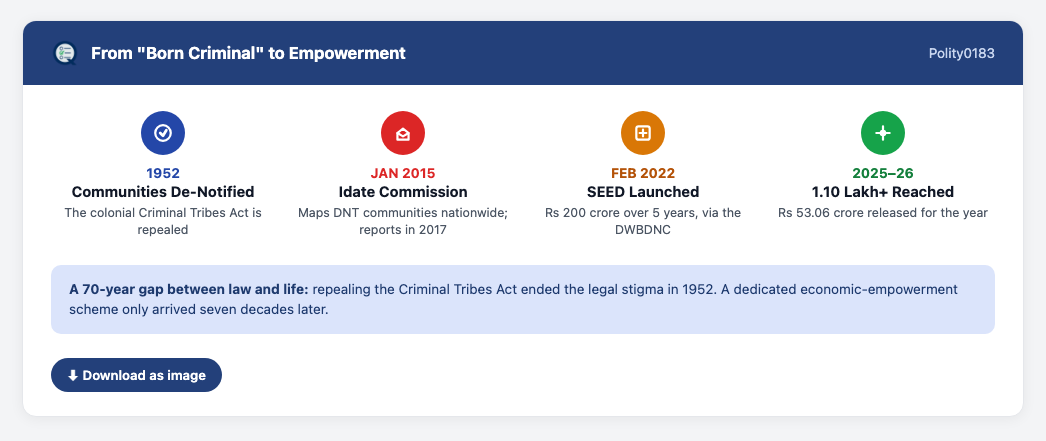
- 1871-1947: The colonial Criminal Tribes Act brands entire communities as “born criminals,” across British India.
- 1952: Independent India repeals the Act. These communities are officially “de-notified.”
- 9 January 2015: The government constitutes the Idate Commission, to identify DNT communities and assess their welfare.
- 2017: The Idate Commission submits its report, after visiting all states and Union Territories.
- 2019: The Development and Welfare Board for De-notified, Nomadic and Semi-Nomadic Communities (DWBDNC) is established.
- February 2022: The Scheme for Economic Empowerment of DNTs (SEED) is launched, with a ₹200 crore budget over five years.
- 2025-26: Over 1.10 lakh beneficiaries are covered under the scheme, with ₹53.06 crore released.
Must Know
- SEED stands for the Scheme for Economic Empowerment of DNTs — Denotified, Nomadic, and Semi-Nomadic Tribes. It was launched in February 2022 by the Ministry of Social Justice & Empowerment.
- “Denotified” communities were once branded criminal by birth, under the colonial Criminal Tribes Act (1871-1947). Independent India repealed the Act in 1952.
- SEED has four components: free competitive-exam coaching, health insurance (via PMJAY), livelihood support, and housing assistance (via PMAY).
- The scheme allocated ₹200 crore over five years (2021-22 to 2025-26).
- The Development and Welfare Board for De-notified, Nomadic and Semi-Nomadic Communities (DWBDNC), established in 2019, implements SEED.
Good to Know
- An estimated 10 crore Indians, from roughly 1,400 communities, are classified as Denotified, Nomadic, or Semi-Nomadic. That’s close to 10% of India’s population.
- The Idate Commission was constituted on 9 January 2015, chaired by Bhiku Ramji Idate. It prepared a state-wise list of DNT communities. It conducted over 300 field visits and nearly 9,000 household surveys, before submitting its report in 2017.
- SEED’s coaching component supports students preparing for Civil Services and professional courses, such as medicine, engineering, and management.
- Its livelihood component supports income-generation and entrepreneurship, aiming to build durable economic security rather than one-time relief.
- SEED complements two much larger flagship schemes, PMJAY (health insurance) and PMAY (housing), by specifically targeting DNT communities within them.
Current Affairs
- 7 July 2026: The Ministry of Social Justice & Empowerment reported strong 2025-26 results for SEED. Over 1.10 lakh beneficiaries were covered across education, livelihood, and healthcare, with ₹53.06 crore released for implementation. Secretary Sudhansh Pant said the scheme is helping beneficiaries “participate in India’s growth journey.” (Source: PIB)
Test Yourself

Great to Know
- SEED shares its “empower a historically marginalised group through a bundled scheme” design with DAJGUA, which targets Scheduled Tribes more broadly. See Polity0171 — Dharti Aaba Janjatiya Gram Utkarsh Abhiyan (DAJGUA).
- For another Ministry of Social Justice & Empowerment welfare scheme, see Polity0148 — Manual Scavenging and Sanitation Worker Safety in India.
- For the education-support model SEED’s coaching component draws on, see IndGov0025 — Scholarship Schemes for Scheduled Tribes.
Leave a Reply