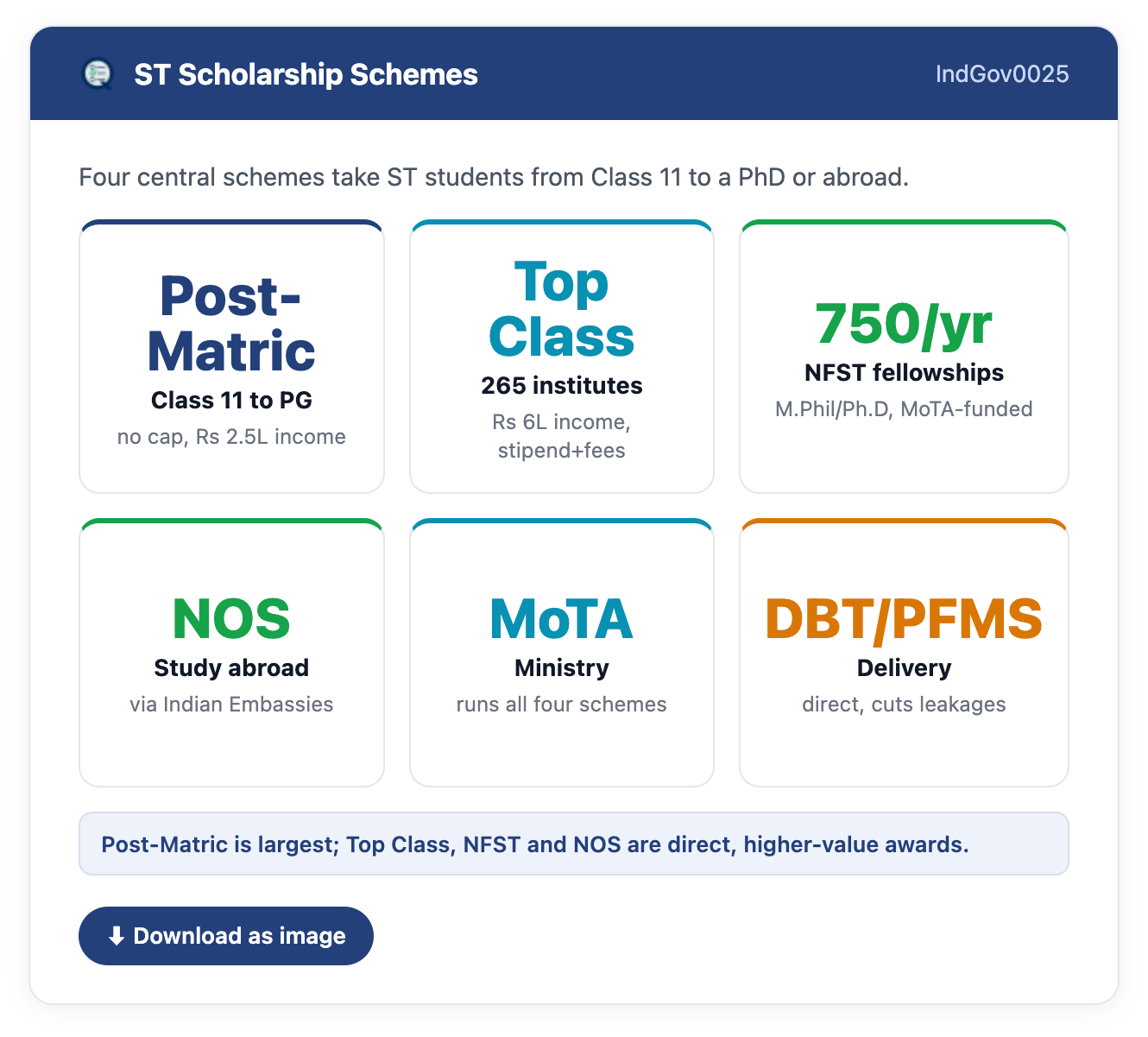
For a Scheduled Tribe student, the path from Class 11 to a PhD runs through four separate central scholarship schemes. This article explains what each one does, who it helps, and why they matter.


Must Know
Scholarship Schemes for Scheduled Tribes
What Are ST Scholarships
- PurposeScheduled Tribe scholarships help ST students afford education that would otherwise be out of reach.
- WhyThey address the higher dropout rates and financial barriers ST students historically face.
- RangeFour central schemes span Class 11 all the way to a PhD or study abroad.
- MinistryThe Ministry of Tribal Affairs (MoTA) runs all four.
Overview of the Four Schemes
- SetMoTA runs Post-Matric, Top Class, NFST and National Overseas scholarships.
- LadderTogether they form a ladder from Class 11 to a doctorate or a degree abroad.
- DesignEach scheme targets a different stage, so no student falls through the gap.
Post-Matric Scholarship
- TypeIt is a Centrally Sponsored Scheme run through States and UTs.
- OpenIt has no cap on the number of students selected.
- CoverageIt covers Class 11 to post-graduation, for families earning up to Rs 2.5 lakh a year.
- Highest volumeThis is the largest of the four schemes by reach.
Top Class Scholarship
- TypeTop Class is a Central Sector Scheme run directly by MoTA.
- CoverageIt covers graduate and postgraduate study at 265 top-tier institutes.
- IncomeFamilies with income up to Rs 6 lakh a year qualify.
- Higher ceilingIts higher income ceiling lets more students access elite institutions.
NFST Fellowship
- TypeThe National Fellowship for ST students (NFST) is fully funded by MoTA.
- ScaleIt awards 750 fresh M.Phil. and Ph.D. fellowships every year.
- PurposeIt supports ST students pursuing research degrees.
National Overseas Scholarship
- TypeNOS is a Central Sector Scheme run through the Ministry of External Affairs.
- ChannelFunds go to students and institutes via Indian Embassies abroad.
- PurposeIt helps ST students pursue degrees in foreign universities.
Good to Know
How Payments Work
Post-Matric Disbursal
- StatesStates handle applications, verification and selection.
- DBTFunds are disbursed via Direct Benefit Transfer.
- SplitThe Ministry releases the central share of funding to the states.
Top Class Components
- Component IPays a Rs 36,000-a-year stipend, books allowance and a one-time laptop allowance via DBT.
- Component IICovers tuition and admission fees, paid via PFMS to the institution.
- Why twoSplitting living and fee support ensures each reaches the right recipient.
NFST Disbursal
- ChannelNFST fellowships are released via DBT after certificate verification.
Comparing Eligibility
- Post-MatricRs 2.5 lakh income ceiling, Class 11 to PG, no selection cap.
- Top ClassRs 6 lakh ceiling, 265 top institutes, graduate and postgraduate.
- NFST750 fresh research fellowships a year, fully MoTA-funded.
- NOSDegrees abroad, routed through embassies.
Test Yourself

Great to Know
Design and Bottlenecks
Different Delivery Channels
- Post-MatricThe highest-volume scheme leans on state administrative machinery.
- OthersTop Class, NFST and NOS run through DBT, PFMS or embassy channels.
- WhyDirect channels suit smaller, higher-value awards where speed matters.
Payment Delays
- StudentsDelays to individual students stayed minimal from 2021 to 2024.
- InstitutionsInstitutional dues rose sharply in AY 2024-25 due to incomplete PFMS compliance.
- CauseThe bottleneck was on the institutions’ side, not a shortage of funds.
Why These Schemes Matter
- EquityThey help close the education gap between ST and general students.
- OpportunityThey open higher and overseas education to communities historically excluded.
- WiderThey sit within a broader welfare architecture for SC/ST and backward classes.
Current Affairs
📰 Current Affairs
Recent Scholarship Data
- SourceRecent Lok Sabha replies have detailed disbursal and institutional dues across the four schemes.
- FocusThe focus remains on clearing PFMS compliance to speed institutional payments.
- SourcePIB; Ministry of Tribal Affairs.
PYQ
Exam Point of View
MCQ Questions
- PrelimsST scholarship schemes appear in UPSC and other competitive exams.
Written Answer Questions
- ThemeSocial justice, tribal welfare and education are recurring GS-II themes.
Beyond the answer
Browse all indian-governance topics →
📚 Keep reading
UPSC CSP 2025 — General Studies Paper I (Full Question Paper)UPSC CSP 2024 — General Studies Paper I (Full Question Paper)UPSC CSP 2026 — General Studies Paper I (Full Question Paper)UPSC CSP 2023 — General Studies Paper I (Full Question Paper)UPSC CSP 2022 — General Studies Paper I (Full Question Paper)❓ Practice this topic
Which of the following is/are the aim/aims of "Digital India" Plan of the Government of India? 1. Formation of India's own Internet companies like China did. 2. Establish a policy framework to encourage overseas multinational corporations that collect Big Data to build their large data centres within our national geographical boundaries. 3. Connect many of our villages to the Internet and bring Wi-Fi to many of our schools, public places and major tourist centres.Under which flagship government programme is DigiLocker offered?What key benefit does DigiLocker offer users regarding access to their documents?Regarding DigiLocker, sometimes seen in the news, consider: 1. It is a digital locker system offered by the Government under the Digital India Programme. 2. It allows you to access your e-documents irrespective of your physical location. Which is/are correct?🎲 Take a Indian Governance Quiz
Leave a Reply