285. Exemption of property of the Union from State taxation.—(1) The property of the Union shall, save in so far as Parliament may by law otherwise provide, be exempt from all taxes imposed by a State or by any authority within a State. (2) Nothing in clause (1) shall, until Parliament by law otherwise provides, prevent any authority within a State from levying any tax on any property of the Union to which such property was immediately before the commencement of this Constitution liable, or treated as liable, so long as that tax continues to be levied in that State.
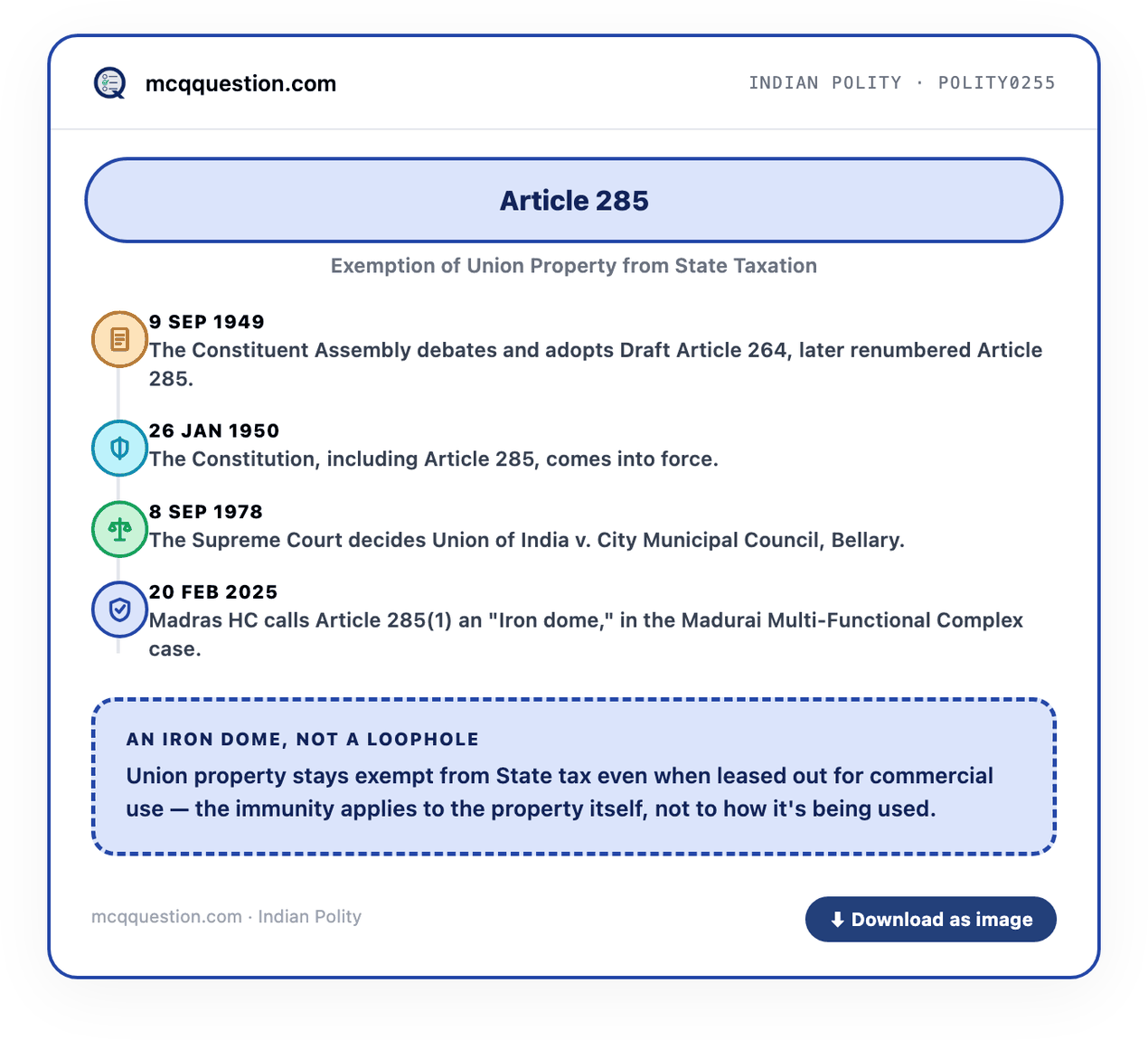
In 2025, a Madras High Court bench called this Article an ‘Iron dome which cannot be breached.’ That’s how firmly Article 285 shields Union property from State taxes — even when a private company runs a business on it. The property’s immunity is absolute; only Parliament can lift it.
 mcqquestion.com
What Article 285 Exempts
- LocationArticle 285 sits in Part XII of the Constitution, which covers Finance, Property, Contracts and Suits.
- Clause (1)Clause (1) exempts Union property from all taxes imposed by a State, or by any authority within a State — unless Parliament by law provides otherwise.
- Clause (2)Clause (2) is a savings clause: a State authority can keep levying a tax on Union property if that property was already liable to that tax immediately before the Constitution commenced, so long as the same tax still continues in that State.
- Why it mattersThe default is exemption — Parliament must actively legislate to remove the immunity; it does not have to grant it afresh each time.
The ‘Iron Dome’ Principle
- ScopeThe immunity applies to the property itself, not to how it is used — so Union property stays exempt even when leased out for commercial use.
- WhyBecause the constitutional protection runs with the property’s ownership, not its current activity, a State cannot tax a Union building just because a private business now operates there.
- TakeawayUnion ownership = immunity, regardless of use. That is the core of Article 285(1).
- BoundaryThe shield does not mean Union property can never be taxed — Parliament can lift it by law — but no State or local authority can do so on its own.
The Constituent Assembly Debate (1949)
- Amendment movedA Constituent Assembly member moved an amendment to make Union property taxable by local authorities like any private property, arguing local bodies render real services and deserve to be paid.
- Drafting replyThe Drafting Committee Chairman replied that no body should tax property whose owner has no representation in it — a local body’s taxing power flows from the State Legislature, not the Union.
- ResultThe amendment was withdrawn, and the exemption stood.
- Why it mattersThe debate explains the logic: a State body should not tax the Union, because the Union is not represented in, or subject to, that State’s legislature.
The Bellary Case (1978)
- CaseIn Union of India v. City Municipal Council, Bellary (1978), the Supreme Court held that the Railways (Local Authorities Taxation) Act, 1941 could not override Article 285(1)’s exemption without Parliament’s own explicit authorisation.
- AmountThe case involved ₹38,988 in municipal tax arrears that Bellary’s Municipal Council sought from the Southern Railway for 1957-63.
- HoldingA pre-Constitution law could not be read to override the constitutional exemption; only Parliament could lift it.
- WhyArticle 285(1) is a constitutional command, so it prevails over ordinary laws unless Parliament expressly provides otherwise.
Work through a 5-question chain on Article 285, then keep practising with a random Indian Polity question.
Fees vs Taxes: What 285 Does Not Shield
- DistinctionArticle 285 shields Union property from taxes, but not from genuine fees for services actually rendered.
- 2007 caseIn a 2007 case, the Supreme Court held that water and sewerage charges on Railway property were fees for genuine services, not taxes — so Article 285 did not shield the Railways from paying them.
- WhyA fee is payment for a specific service the local authority provides, whereas a tax is an unconditional levy — the Constitution bars the latter on Union property, not the former.
- So whatThe tax/fee line is exam-critical: Union property pays for services, but not for taxes.
- TakeawayTax = barred; fee for a real service = payable.
The Madurai Multi-Functional Complex Case (2025)
- CaseIn February 2025, the Madras High Court decided Madurai Multi-Functional Complex Pvt. Ltd. v. Madurai Corporation, holding that Union property stays exempt under Article 285(1) even when used commercially.
- QuoteThe Court called Article 285(1) an ‘Iron dome which cannot be breached’, sheltering ‘property of the Union of all kinds and hues.’
- FactsThe case involved a commercial complex built on railway land in Madurai, leased out through the Railway Land Development Authority (RLDA) and a private sub-lessee.
- RLDA statusThe Court found the RLDA has no separate legal identity from the Railways — it cannot sue or be sued or hold property independently — so the land and building stayed genuine Union property.
- So whatThe case confirms the immunity travels with Union ownership even through complex lease arrangements.
The ‘Property of the Union’ Boundary
- What counts‘Property of the Union’ covers assets owned by the Central Government and its instrumentalities that form part of the Union — the Railways being the classic example.
- Not everythingProperty of a State-owned corporation with a distinct legal personality is not automatically ‘Union property’ — the RLDA case turned on it having no separate identity.
- Why it mattersWhether an entity is a true part of the Union or a separate body decides whether its property enjoys the Article 285 shield.
- Exam lineExaminers test this by asking whether a given public body’s property is genuinely ‘Union property’.
- So whatFor the exam, ask one question first — does the entity hold property on its own account or as part of the Union? — before applying the Article 285 shield.
Why Union Property Is Exempt
- LogicThe exemption rests on the idea that one government should not tax another, and that the Union is not represented in State legislatures.
- MechanismIf a State could tax Union property, it could effectively control or burden the Union’s presence in its territory.
- WhyThe Constitution keeps the Union’s physical assets free of State taxation so that central functions — railways, defence, offices — are not held hostage to local levies.
- Parliament’s powerOnly Parliament, the body where the whole country is represented, can decide to lift the immunity.
- So whatThe rule is a federal balance: States cannot tax the Union, because the Union answers to the nation, not to any one State.
The Savings Clause in Practice
- Clause (2)Clause (2) lets a State authority keep a tax on Union property that was already levied before the Constitution commenced, so long as it still continues.
- ConditionThis is temporary and conditional — the exemption steps in once Parliament legislates, and the old levy cannot be imposed anew.
- WhyIt was a transition rule to avoid a sudden revenue gap for local bodies that had taxed Union property before 1950.
- So whatToday Clause (2) is of limited practical effect, but it is a classic exam point on when an old State tax can survive.
- TakeawayClause (2) is best remembered as a one-time transition: pre-1950 levies on Union property survive only until Parliament chooses to legislate them away.
Article 285: Exemption of Union Property
- QuestionWhich Article exempts the Union’s property from all State and local-authority taxes? Correct answer: Article 285.
- WhyArticle 285(1) exempts Union property from State/local taxes unless Parliament provides otherwise; Clause (2) saves pre-Constitution levies.
- LinkTest it: Article 285 exemption question.
The ‘What 285 Bars’ Question
- Fact testedArticle 285(1) bars State and local-authority taxes on Union property unless Parliament provides otherwise.
- TrapCommercial use of Union property does NOT strip the exemption (2025 Madurai ruling).
- TryThe immunity runs with ownership, not use.
The Tax/Fee Distinction
- Fact testedArticle 285 bars taxes but not genuine fees for services (e.g. water, sewerage).
- TrapA service charge on Union property is a fee, not a tax — not barred.
- TryUnconditional levy = tax (barred); payment for a service = fee (allowed).
Railway Land and the Iron-Dome Ruling
- DevelopmentThe 2025 Madurai High Court ‘Iron dome’ ruling reaffirmed that railway land leased for commercial use remains exempt from municipal property tax.
- Why it mattersWith the RLDA leasing out railway land across the country, the ruling has wide implications for how local bodies can (or cannot) tax those commercial developments.
- So whatAny current-affairs question on railway-property taxation or RLDA leases should connect to Article 285(1).
Local Revenue vs the Exemption
- DevelopmentDebates recur over whether local bodies are losing legitimate revenue because commercial use of Union property escapes taxation.
- Why it mattersThe tension is real: municipalities want revenue, but Article 285 ties their hands on Union-owned land.
- So whatThe resolution would require Parliament to legislate to lift the exemption — the only route Article 285 allows.
Beyond the answer
Browse all indian-polity-and-constitution topics →
📚 Keep reading
Polity0019 — Centre-State Relations and the Federal StructureLord Ripon: Local Self-Government and the Ilbert BillPolity0263 — Article 246A: Special Provision for GST Law-Making PowerUPSC CSP 2017 — General Studies Paper I (Full Question Paper)Polity0370 — Right to Property: Article 300A and Its Constitutional Journey❓ Practice this topic
Which of the following Acts, receiving presidential assent on 24 December 2023, replaced the Indian Telegraph Act 1885, the Wireless Telegraphy Act 1933 and the Telegraph Wires (Unlawful Possession) Act 1950?Under Article 61 of the Constitution, by what majority must the resolution preferring the charge of impeachment against the President be passed in each House of Parliament?Which Article of the Constitution provides that it shall be the endeavour of every State to provide adequate facilities for instruction in the mother tongue at the primary stage to children belonging to linguistic minority groups?In which situation can a State Governor issue an ordinance under Article 213 of the Constitution?🎲 Take a Indian Polity And Constitution Quiz
Leave a Reply