Banks need to recover loans, and defaulters sometimes refuse to pay. India built special tribunals to hear those cases fast, but the fastest-growing problem is now the tribunals’ own backlog.


Must Know
The Debt Recovery Tribunal
What a DRT Is
- Full formDRT is a Debt Recovery Tribunal.
- PlainThink of it as a specialist court for banks trying to recover unpaid loans.
- JobIt hears loan-recovery cases banks and financial institutions bring against defaulting borrowers.
- WhyRegular courts were too slow for recovery, so India built a faster specialist forum.
- HeadEach DRT is led by a single Presiding Officer, qualified to serve as a District Judge.
- PowersIt holds civil-court-like powers: summoning witnesses, taking evidence under oath, demanding documents.
- SoBanks get a dedicated, speedier route to recover money locked in defaulted loans.
The Governing Law
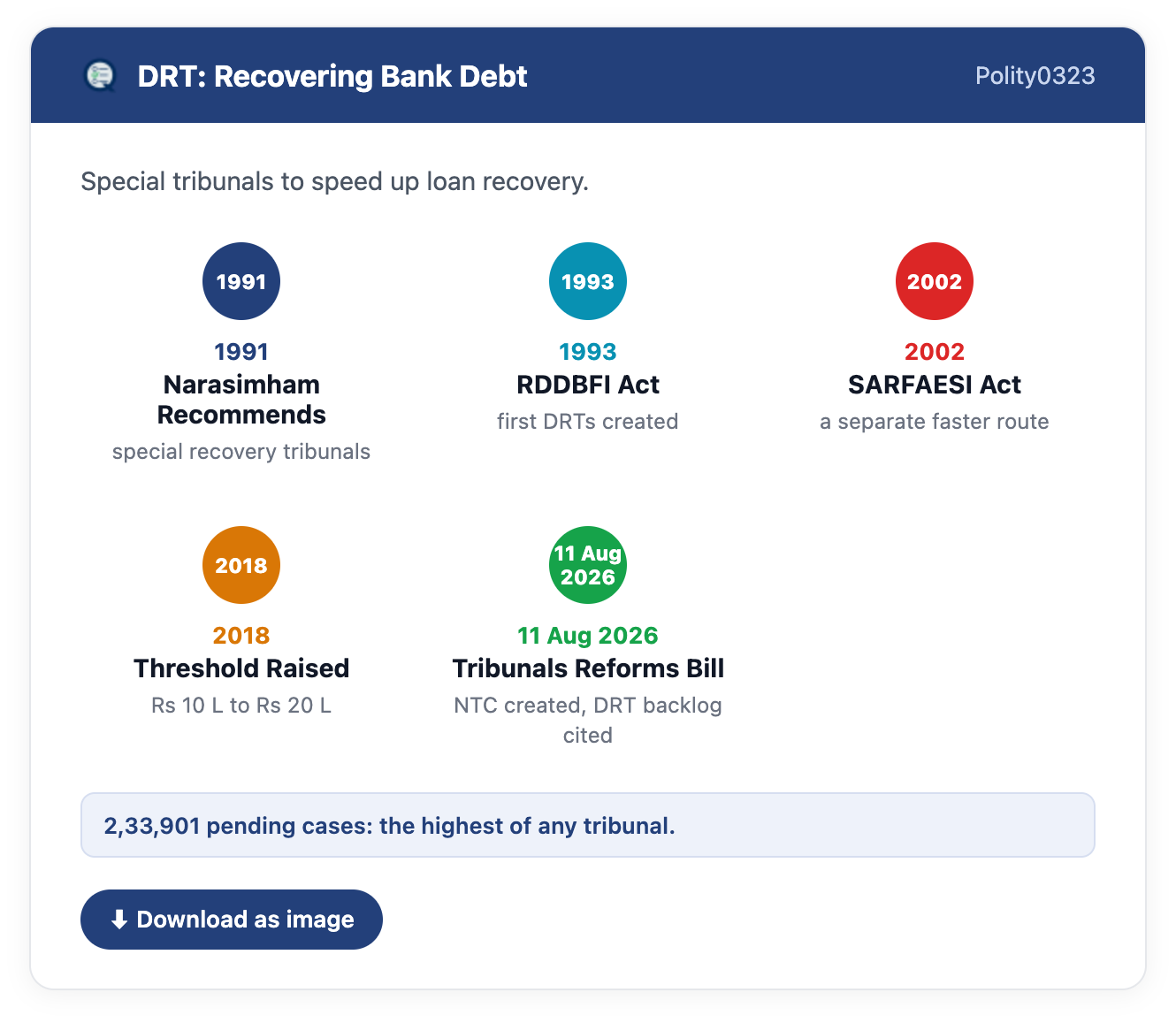
- ActDRTs were set up under the Recovery of Debts Due to Banks and Financial Institutions Act, 1993.
- Full formThis is the RDDBFI Act.
- OriginThe 1991 Narasimham Committee recommended such tribunals to speed up recovery.
- WhyThe Committee found mounting bad loans were choking the banking system.
- SoSpecialised tribunals were its answer to getting banks their money back faster.
Appeals and Powers
- AppealAn appeal against a DRT order goes to the Debt Recovery Appellate Tribunal (DRAT).
- DeadlineThe appeal must be filed within 45 days.
- DepositA DRAT appeal usually needs a 50% pre-deposit, relaxable in hardship cases.
- Why the depositIt discourages borrowers from appealing just to delay paying a debt.
- NatureProceedings are treated as judicial, bound by natural justice.
- SoThe process stays fair even as it moves fast.
DRT vs SARFAESI
- Full formSARFAESI is the Securitisation and Reconstruction of Financial Assets and Enforcement of Security Interest Act, 2002.
- PathSARFAESI lets a bank seize and sell a defaulter’s secured assets directly.
- HowUnder SARFAESI, the bank does not need to go through a tribunal first; it can act on the secured asset itself.
- ContrastThe DRT is for money recovery; SARFAESI is for seizing the collateral behind the loan.
- BothThe Supreme Court has held the two remedies can be used together.
- SoA bank can recover cash through the DRT and seize the security through SARFAESI.
The Claim Threshold
- CurrentThe minimum loan value a DRT will hear is ₹20 lakh.
- Why a floorSmall loans go to other forums, so the DRT focuses only on larger amounts.
- ChangeA 2018 notification raised it from ₹10 lakh.
- NoteThe Act’s text still says “ten lakh”; the real figure comes from the notification.
- SoAlways check the notification, not just the law’s printed words.
Good to Know
How the System Works
DRT vs SARFAESI
- Full formSARFAESI is the Securitisation and Reconstruction of Financial Assets and Enforcement of Security Interest Act, 2002.
- PathSARFAESI lets a bank seize and sell a defaulter’s secured assets directly.
- HowUnder SARFAESI, the bank can act on the secured asset without first going to a tribunal.
- ContrastThe DRT is for recovering money; SARFAESI is for seizing the collateral behind the loan.
- BothThe Supreme Court has held the two remedies can be used together.
- SoA bank can recover cash via the DRT and seize the security via SARFAESI.
The Claim Threshold
- CurrentThe minimum loan value a DRT will hear is ₹20 lakh.
- Why a floorSmall loans go to other forums, so the DRT focuses only on larger amounts.
- ChangeA 2018 notification raised it from ₹10 lakh.
- NoteThe Act’s text still says “ten lakh”; the real figure comes from the notification.
- SoAlways check the notification, not just the law’s printed words.
Appeals and Deposit
- AppealAn appeal against a DRT order goes to the Debt Recovery Appellate Tribunal (DRAT).
- DepositA DRAT appeal usually needs a 50% pre-deposit, relaxable in hardship cases.
- WhyRequiring a deposit stops borrowers from appealing simply to stall payment.
- ReliefThe tribunal can waive or reduce it in genuine hardship.
- SoThe deposit balances a fair appeal with protecting the bank’s recovery.
✅ Test Yourself
Work through a 5-question chain on Debt Recovery Tribunals, then keep practising with a random Indian Polity question.
Great to Know
The Real Problem
The Backlog
- TargetDRTs are meant to dispose of a case within 180 days.
- RealityResearch finds this target is rarely met in practice.
- WhyToo few members and too many cases push each hearing far into the future.
- ScaleAs of late 2025, DRTs had over 2.3 lakh pending cases, the highest of any tribunal.
- SoThe body built to speed up recovery is itself the most backed-up of all.
Vacant Posts
- GapAbout 18% of sanctioned tribunal-member posts sat vacant nationwide.
- Why it mattersEmpty posts mean fewer judges to hear a growing pile of cases.
- MechanismAppointments depend on government action, so delays in appointing deepen the backlog.
- AcknowledgedThe government itself has admitted this in Parliament.
- SoRecruiting members is as important as the rules that govern the tribunals.
The National Tribunals Commission
- Full formNTC is the National Tribunals Commission.
- CreatedThe Tribunals Reforms Bill, 2026 creates it to oversee appointments across all tribunals.
- WhyA 2025 Supreme Court ruling struck down parts of an earlier reform law for undermining judicial independence.
- MechanismOne commission would handle appointments for every tribunal in a transparent, merit-based way.
- HowThat removes the delays and vacancies caused by case-by-case government appointments.
- SoIt aims to fix the very vacancies and delays that cripple the DRTs.
Current Affairs
📰 Current Affairs
The Tribunals Reforms Bill, 2026
- EventOn 11 August 2026, Parliament passed the Tribunals Reforms Bill, 2026.
- ReasonIt cited DRT case pendency as a key trigger.
- CountDRTs carried 2,33,901 pending cases, the highest of any tribunal.
- SourceBusiness Standard.
🎯 Exam Angle (PYQ & MCQ Traps)
The Governing-Act Trap
- Trap option‘DRTs were set up under the SARFAESI Act.’
- DistractorDRT and SARFAESI both deal with loan recovery, so mixing them feels natural.
- Fact testedDRTs were set up under the Recovery of Debts Due to Banks and Financial Institutions Act, 1993.
- Eliminate fastSARFAESI is a separate 2002 tool; the DRT itself comes from the 1993 Act.
- Try this rule1993 = DRT; 2002 = SARFAESI. Lock the two years.
The Appeal-Deposit Trap
- Trap option‘A DRT order can be appealed to the DRAT with no pre-deposit.’
- DistractorAppeals usually feel free to file.
- Fact testedAppealing to the DRAT requires paying a pre-deposit within a fixed period.
- Eliminate fastIf an option omits the pre-deposit or the deadline, it is incomplete.
- Try this ruleDRT appeal = DRAT + pre-deposit + strict days.
The DRT-vs-SARFAESI Trap
- Trap option‘DRT proceedings and SARFAESI are alternatives, not complementary.’
- DistractorTwo recovery routes sound like a choice.
- Fact testedThe Supreme Court has described them as complementary, used together.
- Eliminate fastIf an option says ‘either/or’, it misses the concurrent design.
- Try this ruleBoth tools can run together; ‘not instead’ is the exam takeaway.
Beyond the answer
Browse all indian-polity-and-constitution topics →
📚 Keep reading
IndEco0303 — Non-Financial Debt Classification in the Indian EconomyPolity0222 — Article 262: Adjudication of Inter-State River Water DisputesPolity0037 — Quasi-Judicial Bodies and India's Institutional OdditiesPolity0022 — Grievance Redressal: RTI, Tribunals and Civil SocietyPolity0115 — Delegated Legislation and Administrative Tribunals❓ Practice this topic
On 11 December 2023, the Supreme Court ruled on the 2019 abrogation of Article 370. What did it decide?Presidential Order C.O. 272, issued on 5 August 2019, made which key legal change to remove Article 370?Under Article 370(3), before the President could declare the article inoperative, whose recommendation was required?Under the original Article 370, Parliament's power to make laws for Jammu and Kashmir on Union and Concurrent List matters was limited to which subjects, without the State's concurrence?🎲 Take a Indian Polity And Constitution Quiz
Leave a Reply