When a company collapses or a merger goes wrong, who decides? India routes these disputes through a specialist tribunal, so they are not lost in a crowded court.


Company failures need speed and technical judgement, not just legal procedure. NCLT and NCLAT are the specialist tribunals India built to give them both.
1What NCLT and NCLAT Are
1 Jun 2016
Two tribunals, one purpose
What they are
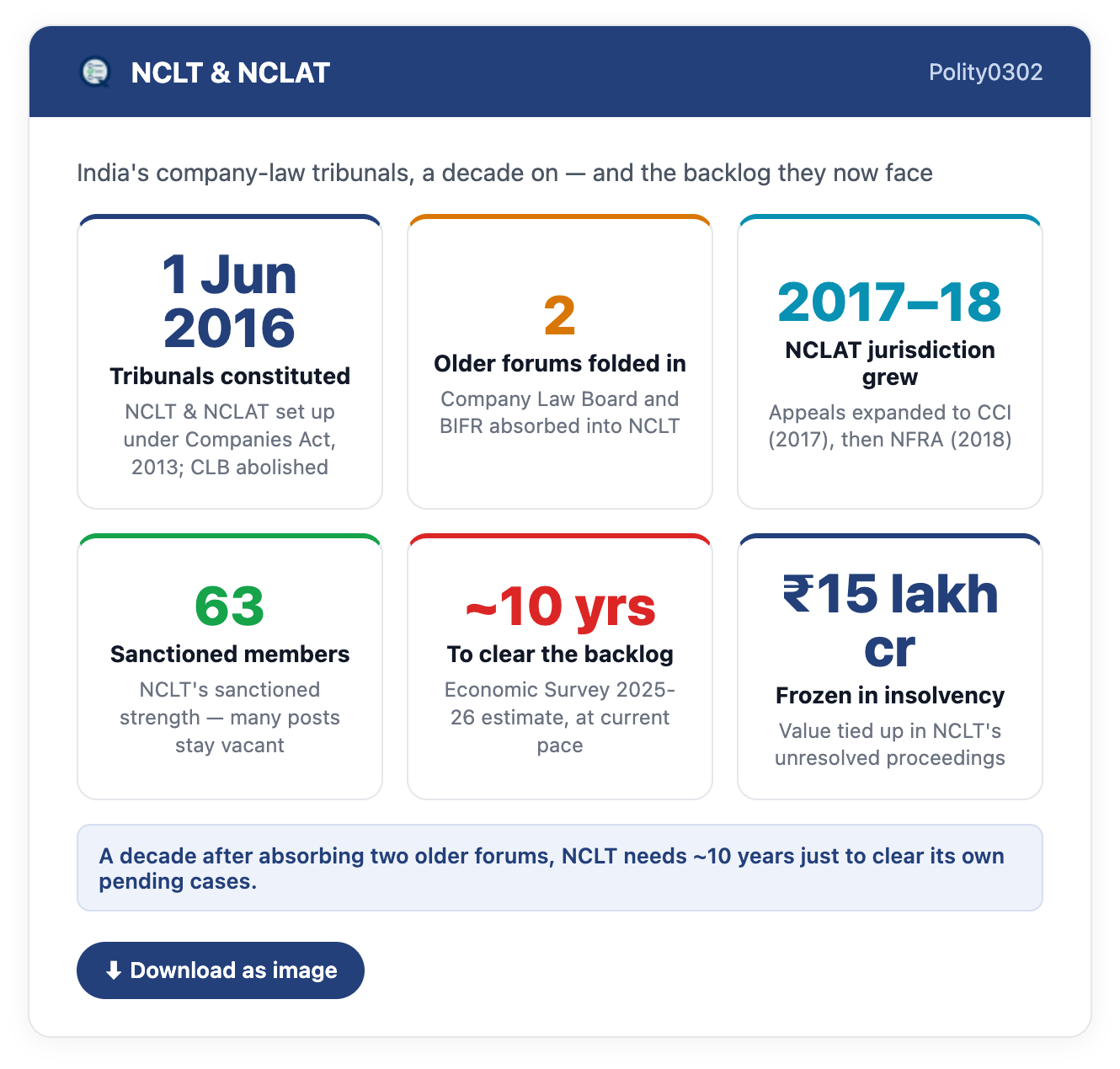
NCLT is the National Company Law Tribunal. NCLAT is its Appellate Tribunal. Both were constituted on 1 June 2016, under the Companies Act, 2013. They are specialist courts for company disputes and insolvency.
Why a specialist forum, with an example
Company insolvency is complex, so India built a dedicated forum for it. Unlike a regular civil court, the NCLT can move faster and can use technical members. For example, a bench deciding whether to liquidate a company needs an accountant’s judgement, not just a lawyer’s.
Replaced
Two older forums, folded into one
NCLT replaced the Company Law Board from June 2016. It later absorbed the pending cases of the BIFR (Board for Industrial and Financial Reconstruction) too. Consolidating them avoided conflicting rulings on the same company matters. It also gave insolvency one clear route under the IBC.
2How the Tribunals Are Run
IBC
India’s insolvency adjudicator
IBC is the Insolvency and Bankruptcy Code, 2016. NCLT is India’s adjudicating authority under the IBC, a role it has held since 1 December 2016. Insolvency cases land before the NCLT, not a regular court. In practice, once a company defaults, creditors file before the NCLT, and the tribunal either admits a resolution plan or orders liquidation.
Bench
Law and business judgement, paired
Each NCLT bench pairs a Judicial Member with a Technical Member. Judicial Members are usually retired High Court judges. Technical Members come with accounting, finance, or company law backgrounds. Combining legal and technical expertise suits complex company cases.
3What They Handle, and the Appeal Route
Jurisdiction
Mergers, mismanagement, and insolvency
NCLT approves mergers and arrangements. It hears oppression and mismanagement cases. It also handles insolvency resolution. Because all these touch both shareholder interests and the wider economy, the tribunal weighs commercial outcomes rather than applying a rigid court procedure.
Appeals
One appellate forum, three sources of appeal
NCLAT hears appeals against NCLT orders. From May 2017, it also covers appeals against Competition Commission of India (CCI) orders. From May 2018, it covers appeals against National Financial Reporting Authority (NFRA) orders too. This single appellate forum produces consistent company-law precedent, instead of divergent rulings across High Courts.
Think it through: why funnel three different regulators’ appeals into one tribunal?
CCI, NFRA, and NCLT itself all decide highly technical, business-facing disputes. Sending their appeals to ordinary High Courts risks judges without that specialist background reaching inconsistent rulings. Routing them all to NCLAT means one bench builds deep expertise across all three areas, and precedent stays consistent nationwide.
Exam Pattern
A trap built on where appeals against NCLAT go
True or False: Appeals against NCLAT’s own orders go directly to a High Court.
4Great to Know: The Backlog Crisis
Backlog
A tribunal drowning in its own success
NCLT’s sanctioned strength is 63 members, but many posts sit vacant. The Economic Survey 2025-26 found NCLTs would take almost 10 years to clear pending cases at the current pace. The backlog threatens over ₹15 lakh crore in unresolved insolvency. The Supreme Court has taken up a suo motu case on NCLT’s delays. Vacancies and delays together cripple the very recovery the tribunal was built for.
27 Apr 2026
A fix already underway, with an example
On 27 April 2026, NCLT authorised Single Judicial Member Benches for specified matters. This lets one judge hear a case instead of two, to speed up disposal. Larger or more complex insolvency and oppression matters still go before a two-member bench. For example, a routine company-name-change petition can now go before a single judge, freeing the second judge’s time for a complex insolvency dispute. Early indications are that routine filings now move faster, easing the pressure the Supreme Court flagged over delays.
Exam Pattern
A trap built on which cases go to a single judge
True or False: Since 27 April 2026, every NCLT case, including large insolvency matters, is heard by a single judge.
MCQ on NCLT and NCLAT
Answered 0 of 2 checks.
Related reading
- Polity0323 — Debt Recovery Tribunal (DRT) — a separate tribunal for bank-loan recovery, distinct from NCLT’s company-law and insolvency role.
- IndEco0079 — Insolvency and Bankruptcy Code — the law NCLT adjudicates under; this article covers the code itself in more depth.
- Browse all Indian Polity articles
Leave a Reply