Presidents of the Indian National Congress: 1885 to independence
The Congress president led the organisation and its national sessions. The office changed as Congress grew from an annual forum into a mass movement. This guide follows the presidents, sessions and turning points through 1947.
A session president chaired a national meeting. A party president could also serve between meetings. Special sessions, acting chairs and resignations make the full story richer than one name per year.

Annie Besant, circa 1910. Wikimedia Commons, public domain.
,_c._1910.jpg)
Every recorded national session, 1885–1946
The table covers the party’s listed plenary sessions and key special sessions. A dash marks a session without a short exam note. It does not mean the session lacked importance.
The party’s modern session page has some date slips. The 1923 Kakinada meeting is missing there. The Congress historical timeline confirms Kakinada. Government records confirm Calcutta 1928, Lahore 1929 and Faizpur in December 1936.
| Year | City and session | President or chair | Key point |
|---|---|---|---|
| 1885 | Bombay | Womesh Chandra Bonnerjee | First session |
| 1886 | Calcutta | Dadabhai Naoroji | — |
| 1887 | Madras | Badruddin Tyabji | First Muslim president |
| 1888 | Allahabad | George Yule | — |
| 1889 | Bombay | Sir William Wedderburn | — |
| 1890 | Calcutta | Pherozeshah Mehta | — |
| 1891 | Nagpur | P. Ananda Charlu | — |
| 1892 | Allahabad | Womesh Chandra Bonnerjee | — |
| 1893 | Lahore | Dadabhai Naoroji | — |
| 1894 | Madras | Alfred Webb | — |
| 1895 | Pune | Surendranath Banerjee | — |
| 1896 | Calcutta | Rahimatullah M. Sayani | — |
| 1897 | Amraoti | C. Sankaran Nair | — |
| 1898 | Madras | Ananda Mohan Bose | — |
| 1899 | Lucknow | Romesh Chunder Dutt | — |
| 1900 | Lahore | N.G. Chandavarkar | — |
| 1901 | Calcutta | Dinshaw Eduljee Wacha | — |
| 1902 | Ahmedabad | Surendranath Banerjee | — |
| 1903 | Madras | Lal Mohan Ghosh | — |
| 1904 | Bombay | Sir Henry Cotton | — |
| 1905 | Banaras | Gopal Krishna Gokhale | Swadeshi debate |
| 1906 | Calcutta | Dadabhai Naoroji | Swaraj goal |
| 1907 | Surat · Suspended | Rash Behari Ghosh | Meeting broke up |
| 1908 | Madras | Rash Behari Ghosh | — |
| 1909 | Lahore | Madan Mohan Malaviya | — |
| 1910 | Allahabad | Sir William Wedderburn | — |
| 1911 | Calcutta | Bishan Narayan Dar | — |
| 1912 | Bankipore | Raghunath Narasinha Mudholkar | — |
| 1913 | Karachi | Nawab Syed Mohammed Bahadur | — |
| 1914 | Madras | Bhupendra Nath Bose | — |
| 1915 | Bombay | Satyendra Prasanna Sinha | — |
| 1916 | Lucknow | Ambica Charan Mazumdar | Reunion and Lucknow Pact |
| 1917 | Calcutta | Annie Besant | First woman president |
| 1918 | Bombay · Special | Syed Hasan Imam | — |
| 1918 | Delhi | Madan Mohan Malaviya | — |
| 1919 | Amritsar | Motilal Nehru | — |
| 1920 | Calcutta · Special | Lala Lajpat Rai | Non-Cooperation proposal |
| 1920 | Nagpur | C. Vijayaraghavachariar | Mass-membership reorganisation |
| 1921 | Ahmedabad | Hakim Ajmal Khan (acting for C. R. Das) | — |
| 1922 | Gaya | Deshbandhu Chittaranjan Das | — |
| 1923 | Delhi · Special | Maulana Abul Kalam Azad | — |
| 1923 | Kakinada · Annual | Maulana Mohammad Ali | Council-entry debate continued |
| 1924 | Belgaum | M.K. Gandhi | Gandhi’s only presidency |
| 1925 | Cawnpore | Sarojini Naidu | First Indian woman president |
| 1926 | Gawahati | S. Srinivasa Iyengar | — |
| 1927 | Madras | M.A. Ansari | — |
| 1928 | Calcutta | Motilal Nehru | Nehru Report debate |
| 1929 | Lahore | Jawaharlal Nehru | Complete independence |
| 1931 | Karachi | Vallabbhai J. Patel | Rights and economic policy |
| 1933 | Calcutta | Nellie Sengupta | — |
| 1934 | Bombay | Rajendra Prasad | — |
| 1936 | Lucknow | Jawaharlal Nehru | — |
| 1936 | Faizpur | Jawaharlal Nehru | Rural session |
| 1938 | Haripura | Subhas Chandra Bose | Bose elected |
| 1939 | Tripuri | Subhas Chandra Bose | Bose’s second term |
| 1940 | Ramgarh | Maulana Abul Kalam Azad | Azad’s long wartime term |
| 1946 | Meerut | J.B. Kripalani | Kripalani before independence |
Read the gaps carefully. A missing annual row does not prove that Congress had no president. Some meetings were disrupted by repression or war. Leadership also changed between plenary sessions.
Must Know: three names, three records
| President | Session | Precise first |
|---|---|---|
| Badruddin Tyabji | Madras, 1887 | First Muslim Congress president |
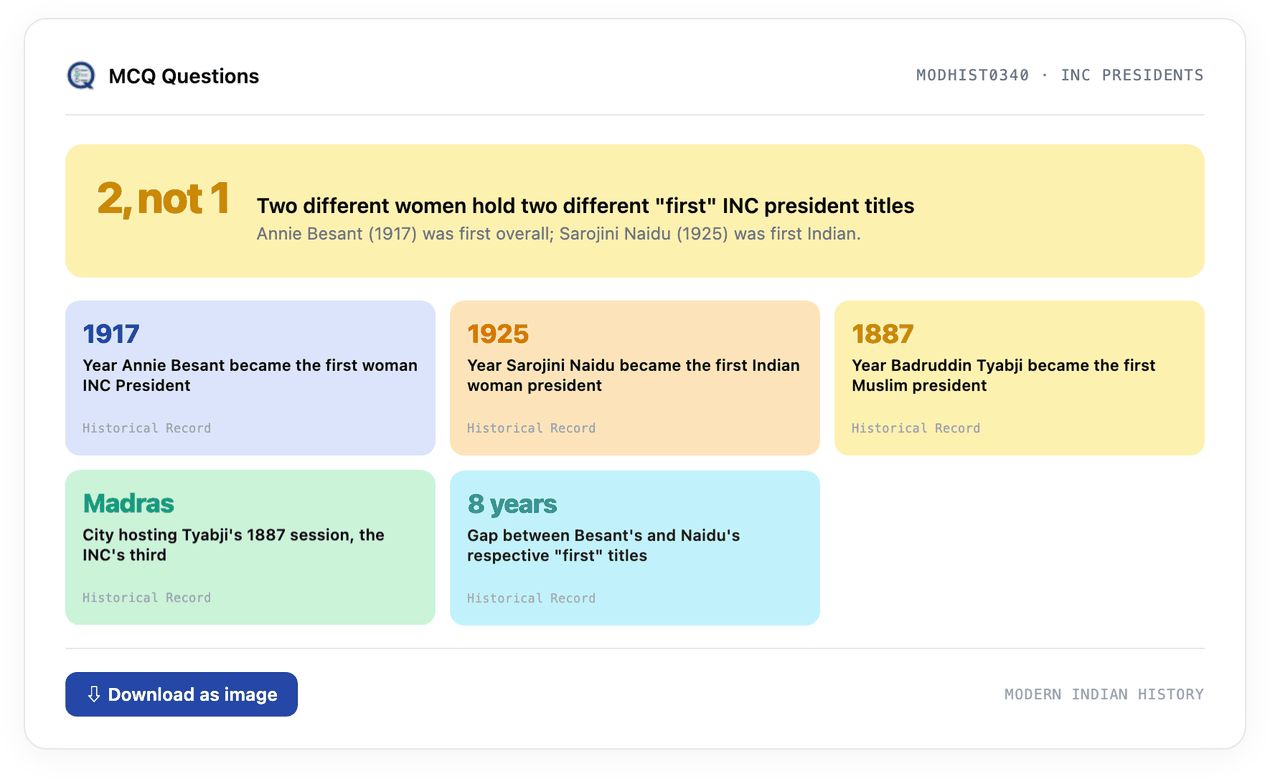
| Annie Besant | Calcutta, 1917 | First woman Congress president |
| Sarojini Naidu | Kanpur, 1925 | First Indian woman Congress president |
“First woman” includes women of any nationality. Besant was born in Britain and led the 1917 session. Naidu, born in Hyderabad, led the 1925 session.
The years are eight years apart. Tyabji’s record concerns religion, not gender. Keep the category attached to each name.
Memory line: Tyabji—Muslim—1887. Besant—woman—1917. Naidu—Indian woman—1925.
Pause and decide · 1 of 7
Sarojini Naidu was the first woman to preside over a Congress session.
Annie Besant did so in 1917. Naidu was the first Indian woman in 1925.
Show answer
False. Annie Besant did so in 1917. Naidu was the first Indian woman in 1925.
Pause and decide · 2 of 7
Badruddin Tyabji chaired the Congress session in Madras in 1887.
It was the third annual session, and he was its first Muslim president.
Show answer
True. It was the third annual session, and he was its first Muslim president.
Good to Know: why were these sessions important?
Tyabji at the third session
Congress began in 1885. Its third annual session met in Madras in 1887. Badruddin Tyabji, a Bombay lawyer, presided over it.
He argued against the idea that one religious community must stay outside Congress. He also spoke about shared political interests. His presidency did not mean every Muslim supported Congress.
Besant and Home Rule
Annie Besant pressed for Home Rule, meaning greater Indian self-government within the empire. She helped organise that campaign before 1917.
The colonial government detained her in 1917. Public protests followed. Later that year, she chaired the Congress session in Calcutta.
Besant’s presidency showed a woman could lead a major national political meeting. It did not, by itself, give all Indian women political equality.
Naidu at Kanpur
Sarojini Naidu was a poet, speaker and nationalist. She had worked for women’s rights and Indian self-rule before 1925.
At Kanpur, she became the first Indian woman Congress president. She was the second woman overall, after Besant. After independence, she became governor of the United Provinces.
How the presidency changed
Early moderates and a wider public forum
Womesh Chandra Bonnerjee chaired the first meeting in Bombay in 1885. Early leaders used petitions, speeches and annual meetings. They sought greater Indian voice in law and administration. The rotating city brought delegates from different regions together.
Dadabhai Naoroji returned as president in 1886, 1893 and 1906. Bonnerjee returned in 1892. Repeat terms matter because the presidency was not a one-time honour.
Swadeshi, Surat and reunion
The 1905 partition of Bengal sharpened the debate over protest methods. At Calcutta in 1906, Naoroji used the word swaraj for self-government. Leaders disagreed about boycott and mass protest.
The Surat meeting broke up in 1907. Rash Behari Ghosh was its chosen president, but proceedings were suspended. He chaired the next full session in Madras in 1908. Moderates and the more assertive group reunited at Lucknow in 1916. Ambica Charan Mazumdar chaired that meeting. Congress also reached the Lucknow Pact with the Muslim League.
Gandhi and mass organisation
The special Calcutta session of 1920 considered Non-Cooperation under Lala Lajpat Rai. The Nagpur session later that year adopted major changes. Congress widened its membership and used language-based provincial committees. C. Vijayaraghavachariar chaired Nagpur.
Gandhi was president only once, at Belgaum in 1924. His influence lasted far beyond that term. Do not confuse movement leadership with repeated party presidencies.
Women presidents
Besant was the first woman president in 1917. Naidu became the first Indian woman president in 1925. Nellie Sengupta chaired the 1933 Calcutta meeting amid repression. These three stories show different kinds of leadership. Their presidencies did not remove barriers faced by most women.
From dominion status to independence
Motilal Nehru chaired Calcutta in 1928. Delegates debated a proposed constitution and dominion status. His son Jawaharlal chaired Lahore in 1929. That session made complete independence its goal. Vallabhbhai Patel chaired Karachi in 1931. Congress there set out rights and social-economic aims.
Jawaharlal returned at Lucknow and Faizpur in 1936. Faizpur brought the session to a rural setting. A president’s name alone cannot describe every movement. Read each session with its policy decision and wider crisis.
Bose, wartime leadership and 1947
Subhas Chandra Bose chaired Haripura in 1938. He won again at Tripuri in 1939. Conflict over policy and the Working Committee then led him to resign. Rajendra Prasad took over later in 1939. This change happened between the listed annual sessions.
Abul Kalam Azad chaired Ramgarh in 1940 and remained president through wartime disruption until 1946. J. B. Kripalani chaired Meerut in 1946. Congress entered independence under his presidency. He resigned in November 1947, and Rajendra Prasad succeeded him.
After independence, Congress had to act as a governing party. Pattabhi Sitaramayya chaired its 1948 Jaipur session. The presidency was now part of a different political setting.
How to read a session question
First, find the year and city. Next, check whether the meeting was annual or special. Then match the chair to the decision made there. A leader may return for another term. A session may also end early, as Surat did.
The party could change its head between big meetings. This happened after Bose resigned. War also stopped the usual annual pattern. Azad stayed in office through that gap. These facts help explain why a short list of yearly sessions can mislead.
Try three pairs. Surat means a split. Nagpur means new mass rules. Lahore means full freedom. The name, place and policy form one small story. Learn that story before you memorise a row.
Ask one more question. Was this a vote for a new goal, or a change in the party’s rules? Lahore set a goal. Nagpur changed how the party worked. Both mattered, but in different ways.
Pause and decide · 3 of 7
Annie Besant’s Home Rule work came before her 1917 Congress presidency.
Her campaign and 1917 detention raised her public standing.
Show answer
True. Her campaign and 1917 detention raised her public standing.
Test Yourself
The checks in this lesson explain why each label matters.
Great to Know: what does a “first” prove?
A first marks a visible change in leadership. It does not prove that social barriers vanished. Many women and Muslims still faced limits in public life.
The early Congress also changed over time. The 1887 session differed from the mass politics of the 1920s. Do not treat all three presidencies as one political moment.
Tyabji helped show Congress could include leaders across faiths. Besant linked Home Rule with women’s public leadership. Naidu brought an Indian woman’s voice to its highest session office.
Each was more than a label. Yet the label is useful when an exam asks a precise “first”.
The older quick-reference graphic remains available here: ⇩ Download as image.
Pause and decide · 6 of 7
Gandhi chaired every Congress session during Non-Cooperation.
Gandhi chaired Belgaum in 1924. Other presidents chaired the 1920 sessions.
Show answer
False. Gandhi chaired Belgaum in 1924.
Pause and decide · 7 of 7
Rajendra Prasad took over after Bose resigned in 1939.
A change between sessions can be missed in a session-only list.
Show answer
True. Bose’s resignation caused a change between sessions.
Pause and decide · 4 of 7
The first woman president and the first Indian woman president are the same first.
The words “Indian woman” narrow the category.
Show answer
False. The words “Indian woman” narrow the category.
UPSC 2015: read both statements
UPSC asked whether two statements were correct. Statement 1 called Sarojini Naidu the first woman Congress president. Statement 2 called Badruddin Tyabji the first Muslim president.
Statement 1 is false. Besant was first overall. Statement 2 is true. Therefore the correct option is (b) 2 only.
The trap is the missing word Indian in statement 1. Naidu was the first Indian woman, not the first woman.
Pause and decide · 5 of 7
UPSC 2015 accepts only the Tyabji statement in its two-statement question.
Besant, not Naidu, was the first woman president.
Show answer
True. Besant, not Naidu, was the first woman president.
Primary sources
- Congress session archive: cities, years and presidents.
- Congress timeline, 1915–1925: Besant and Naidu sessions.
- Congress profile of Tyabji: his 1887 role.
- Congress profile of Besant: Home Rule and 1917.
- Congress account of women presidents: Besant before Naidu.
- Congress official session list.
- Congress timeline confirming Kakinada 1923.
- Ministry of Culture account of Kakinada.
- Nehru Portal on Calcutta 1928 and Lahore 1929.
- Election Commission record of Faizpur in December 1936.
- Parliament profile on the 1947 succession.
 MCQ Questions
Leave a Reply