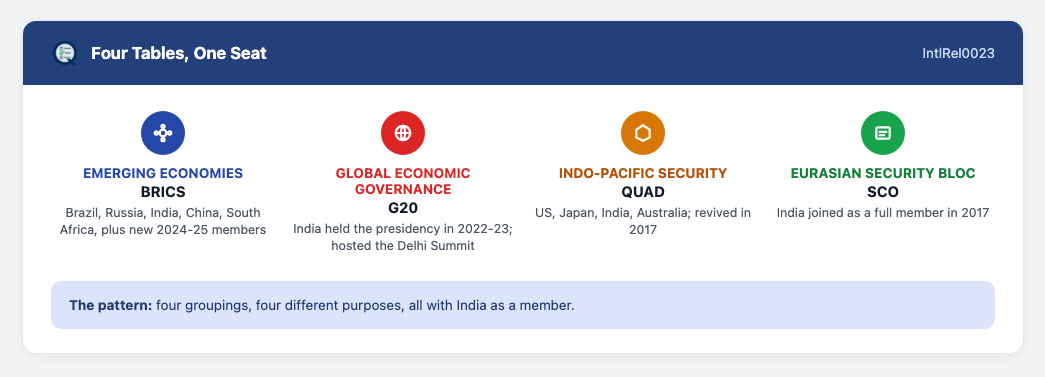
India sits at the table of four very different world groupings at once. This article covers BRICS, G20, QUAD and SCO, and what each one actually does.

Must Know
- BRICS began with Brazil, Russia, India and China in 2006, and South Africa joined soon after. In 2024, Egypt, Ethiopia, Iran and the UAE joined; Indonesia followed in 2025.
- G20 is the premier forum for global economic cooperation. India held the presidency from December 2022 to November 2023, and hosted the New Delhi Summit in September 2023.
- At that summit, the G20 admitted the African Union as a permanent member, an outcome India pushed for. It gave the AU’s 55 member states a seat, equal in status to the European Union’s.
- The QUAD (Quadrilateral Security Dialogue) groups the United States, Japan, India and Australia. First launched in 2007, it went dormant, then was revived in 2017.
- The SCO (Shanghai Cooperation Organisation) is a Eurasian security and economic bloc. India and Pakistan became full members together, at the 2017 Astana Summit.
Good to Know
- SCO’s other founding members are China, Russia, Kazakhstan, Kyrgyzstan, Tajikistan and Uzbekistan. India and Pakistan first held observer status from 2005, before their 2017 accession.
- QUAD has no formal treaty or joint military command, unlike NATO. It works instead through leader-level summits and joint statements on shared Indo-Pacific priorities.
- For a broader survey of India’s regional and global groupings, see IntlRel0004 — India and Global/Regional Political Groupings. It covers IBSA, BIMSTEC and the UNSC reform push.
Test Yourself

Great to Know
- India’s membership across all four groupings reflects a deliberate multi-alignment strategy. It balances economic ties with China and Russia through BRICS/SCO against security cooperation with the US, Japan and Australia through QUAD.
- BRICS and SCO both include China and Russia, but serve different purposes. BRICS focuses on economic and financial cooperation; SCO leans more toward regional security and counter-terrorism.
- The African Union’s G20 admission mirrors the European Union’s existing bloc-member status. It was the first expansion of G20 bloc membership since the forum’s founding in 1999.
- QUAD’s 2007-to-2017 dormant period shows how these groupings can pause and restart. Shifting regional threat perceptions, not any formal rule, is usually what revives them.
- India’s ASEAN partnership runs on a separate track from these four. See IntlRel0049 — ASEAN-India Relations and the AITIGA Trade Agreement.
Beyond the answer
Browse all international-relations topics →
📚 Keep reading
IntlRel0036 — BRICSIntlRel0039 — QUAD (Quadrilateral Security Dialogue)IntlRel0004 — India and Global/Regional Political GroupingsIntlRel0037 — Shanghai Cooperation Organisation (SCO)IndEco0041 — Infrastructure: Services, Connectivity and Investment❓ Practice this topic
D0416 — Which event, eight years after Panchsheel, is often cited as the irony of the India-China framework of peaceful coexistence?D0415 — The principles of Panchsheel gained wider resonance at which 1955 gathering of newly independent Asian and African states?D0414 — The Five Principles of Panchsheel were primarily associated with which two leaders of India and China?D0413 — Which of the following is one of the Five Principles of Panchsheel?🎲 Take a International Relations Quiz
Leave a Reply