Seventeen metals sit at the heart of your smartphone screen, your car’s catalytic converter, and the wind turbine spinning nearby. They are the rare earth elements. Despite the name, most of them are not actually rare in the Earth’s crust.

 MCQ Questions
🔬 Must Know
1. What Are Rare Earth Elements
- Definition Rare earth elements (REEs) are a group of 17 metals. They are the 15 lanthanides, plus scandium and yttrium.
- Grouping Scandium and yttrium are included because they share similar chemical properties. They also occur in the same ore deposits as the lanthanides.
- Subgroups REEs are split into “light” (lanthanum to samarium) and “heavy” (europium to lutetium, plus yttrium) rare earths. Heavy rare earths are generally scarcer and more valuable.
2. Why “Rare” Is Misleading
- Abundance Most rare earth elements are not actually rare in the Earth’s crust. Cerium, for example, is more abundant than copper.
- Real constraint They rarely occur in concentrated, minable deposits. This makes economic extraction difficult, not the total quantity present.
- Name origin The name dates to the 18th and 19th centuries. Chemists then found them in rare mineral samples and struggled to separate them from one another.
3. The Defining Properties
- Electron structure REEs have partially filled 4f electron orbitals. This gives them unusual magnetic, optical, and catalytic behaviour that few other elements share.
- Magnetic property Several REEs, especially neodymium and dysprosium, form the strongest permanent magnets known.
- Phosphorescent property Some REEs, especially europium, terbium, and yttrium, glow brightly when excited by an electric current or UV light. This is called phosphorescence.
- Catalytic property Cerium and lanthanum readily give up and absorb oxygen. This makes them effective industrial catalysts.
⚙️ Good to Know
1. Phosphors in Screens and Lighting
- Displays Europium and terbium compounds are used as phosphors in flat-panel television screens and computer monitors. Europium gives the red glow, terbium the green.
- Why it works Their phosphorescent property is the direct reason they are used here. Exciting these compounds with electricity makes them emit sharp, saturated colour.
- Lighting Yttrium and europium compounds are also used as phosphors inside compact fluorescent and LED lightbulbs. They convert invisible UV or blue light into visible white light.
2. Permanent Magnets
- NdFeB magnets Neodymium-iron-boron magnets are the strongest commercial permanent magnets available. Small amounts of dysprosium or praseodymium are often added to improve heat resistance.
- Where used These magnets go into electric vehicle motors, wind turbine generators, hard disk drives, and headphone speakers.
- Why they matter strategically Demand for these magnets is rising fast, driven by electric vehicles and offshore wind. This is a major reason rare earths have become a geopolitical flashpoint.
3. Catalysts
- Automobiles Cerium oxide is a key component of catalytic converters. It helps convert toxic carbon monoxide into carbon dioxide.
- Petroleum refining Lanthanum and cerium compounds are used as catalysts in fluid catalytic cracking. This process breaks heavy crude oil into lighter, more usable fuels.
4. Other High-Tech Uses
- Medical imaging Gadolinium compounds are used as contrast agents in MRI scans. Gadolinium’s magnetic property sharpens the resulting images.
- Lasers and fibre optics Erbium-doped fibres amplify signals in long-distance optical communication cables. Neodymium is used in high-powered solid-state lasers.
- Glass and polishing Cerium oxide is the standard polishing compound for precision optical glass, including camera lenses and smartphone screens.
Test Yourself

🇮🇳 Great to Know
1. India’s Rare Earth Reserves
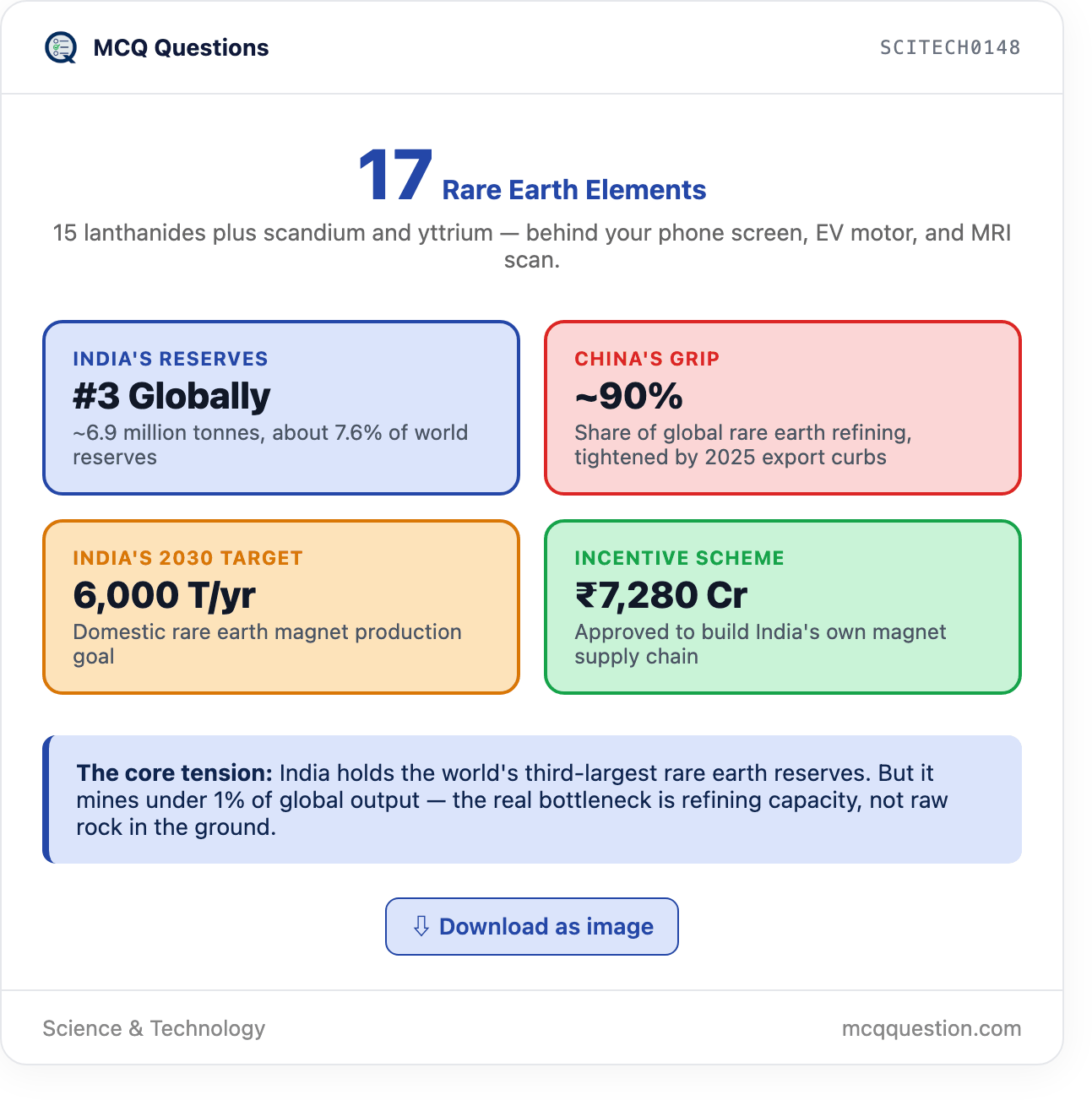
- Global rank India holds the world’s third-largest rare earth reserves, estimated at about 6.9 million metric tonnes. That is roughly 7.6% of the global total.
- Source mineral India’s rare earths mostly come from monazite, a mineral found in beach sand deposits along the coast. Total monazite reserves are estimated at 12 to 15 million tonnes.
- Where found Major monazite-bearing beach sand deposits lie along the coasts of Kerala, Tamil Nadu, Andhra Pradesh, and Odisha.
2. Why Production Lags Reserves
- Legal status Monazite is classified as a “prescribed substance” under India’s Atomic Energy Act, 1962. This is because it also contains radioactive thorium.
- Central control Mining, processing, and export of monazite need central government approval at every stage. Private mining of monazite is tightly restricted.
- Output gap Despite its large reserves, India contributes less than 1% of global rare earth mining. Infrastructure, environmental hurdles, and this regulatory framework all slow domestic output.
3. IREL and Domestic Processing
- The nodal body Indian Rare Earths Limited (IREL), a public sector undertaking under the Department of Atomic Energy, is India’s main rare earth producer. It was set up in 1950.
- Current capacity IREL’s annual production capacity for neodymium-praseodymium oxide, the key magnet-making input, stands at only around 400 tonnes.
- Expansion underway IREL is building a new monazite processing plant at Gudur, Andhra Pradesh, with a designed capacity of 10,000 tonnes a year. It is expected to strengthen domestic refining capability.
📰 Current Affairs
1. India’s Rare Earth Magnet Incentive Scheme
- [Policy] As of late 2025, the Union government has moved to approve a roughly ₹7,280–7,300 crore incentive scheme for domestic rare earth magnet manufacturing. So what: it is India’s first dedicated push to build a homegrown magnet supply chain, reducing reliance on Chinese imports. (Source: Deccan Herald)
- [Data] Under the scheme, companies must invest at least ₹200 crore to qualify, with incentives worth up to 15% of their investment. The production target is about 6,000 tonnes of rare earth magnets a year by 2030. (Source: MarketMinute)
2. China’s 2025 Export Curbs
- [Structural shift] China imposed export restrictions on rare earths and rare earth magnets starting April 2025, later widening the curbs to cover related extraction and processing technology. So what: China supplies most of the world’s refined rare earths, so this gives it major leverage over global electronics and defence supply chains. (Source: Down To Earth)
- [Impact] Foreign companies now need Chinese government approval to export magnets containing even trace amounts of Chinese-sourced rare earth material. So what: this directly complicates India’s own magnet-manufacturing plans, since much of the needed processing equipment is China-made. (Source: Business Standard)
3. National Critical Mineral Mission
- [Policy] The National Critical Mineral Mission, running through 2030-31, includes a separate roughly ₹1,500 crore push for recycling critical minerals, alongside the magnet incentive scheme. So what: it signals a longer-term strategy, not just a one-off subsidy, to secure India’s critical mineral supply chain. (Source: MarketMinute)
Previous Year Questions
- On the phosphorescent property and its use in flat-screen displays, asked as: “Consider the following statements: Statement I: Some rare earth elements are used in the manufacture of flat television screens and computer monitors.” (UPSC CSP 2025, GS Paper I). View this question.
Leave a Reply