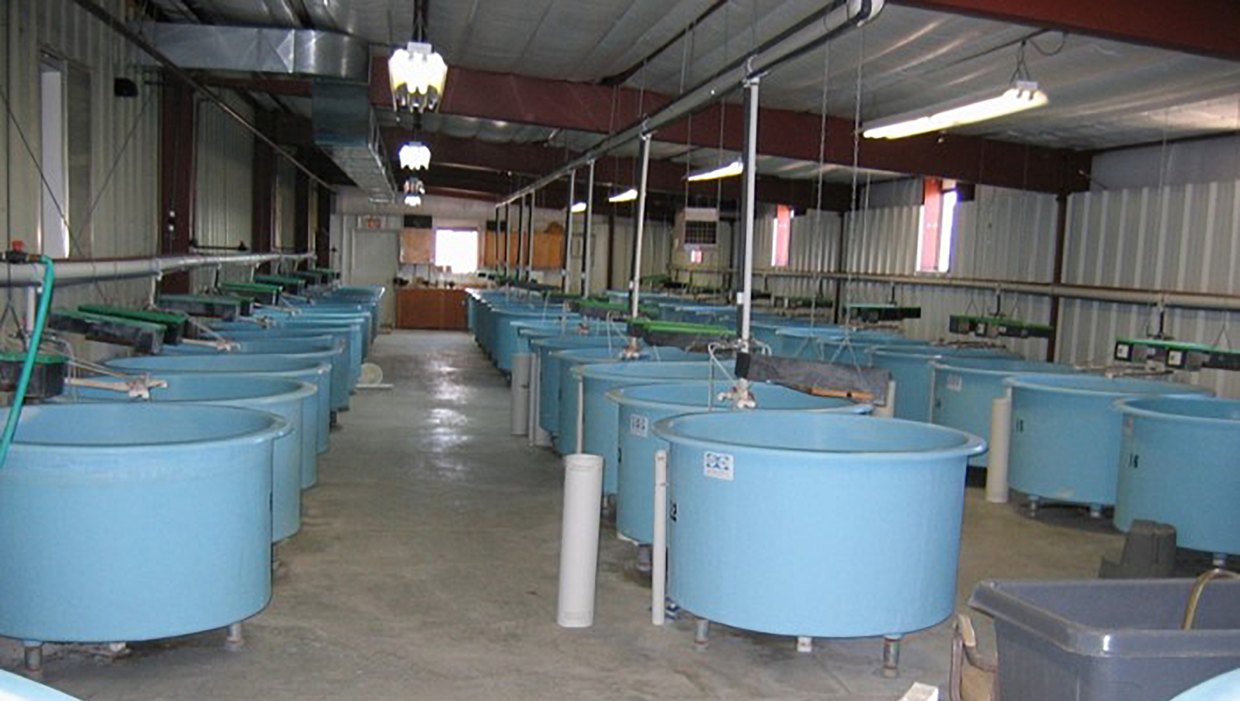
A fish farm normally needs a river, a pond, or the open sea. A Recirculating Aquaculture System needs none of them. It raises fish indoors, in tanks, and reuses more than 90% of its water. The water never really leaves the building. It gets cleaned and sent straight back to the fish. Two separate filters do that cleaning, and they do two completely different jobs. UPSC tested exactly that distinction in 2023, and most candidates got it wrong.

mcqquestion.com
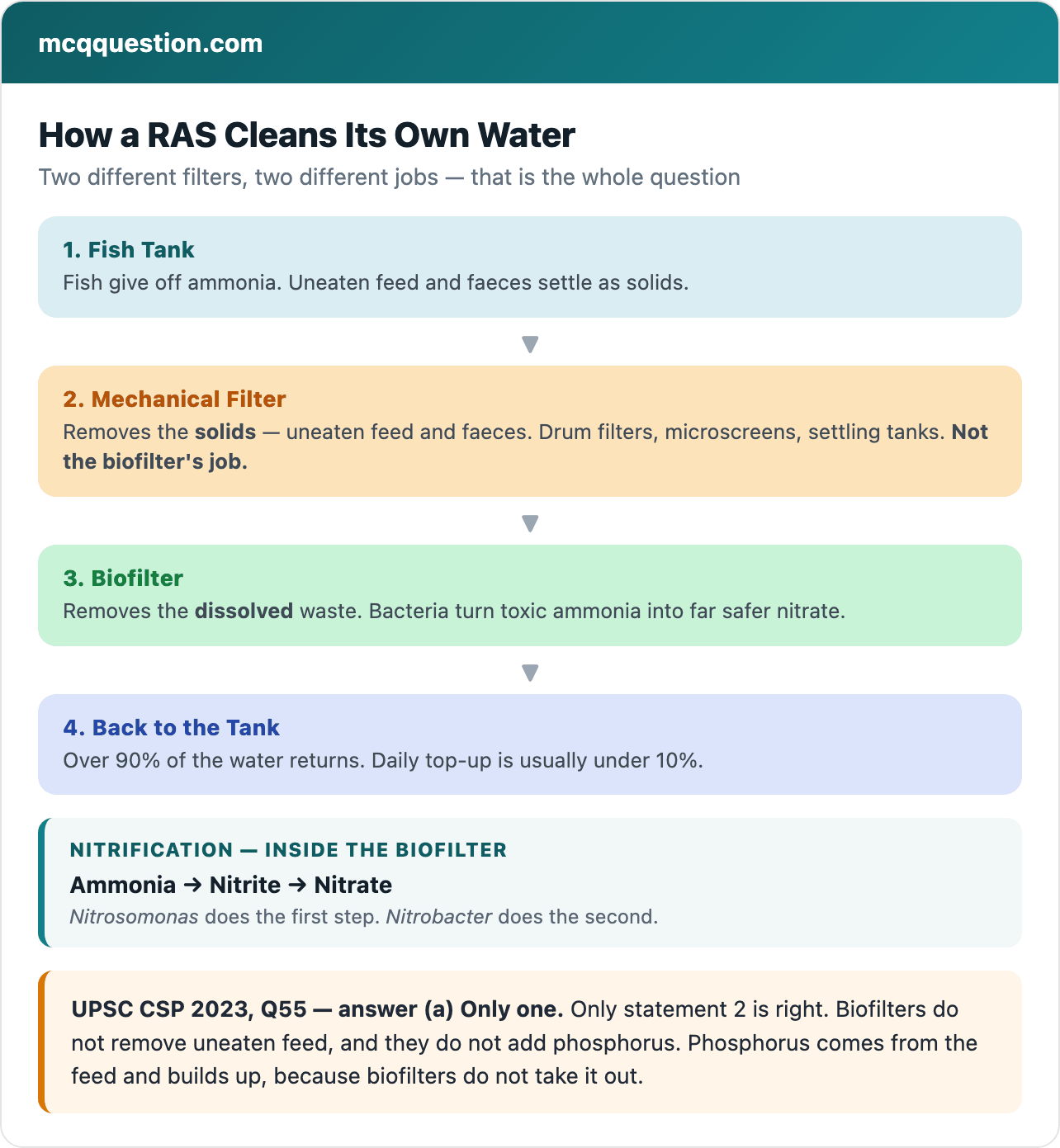
How a RAS Cleans Its Own Water
Two different filters, two different jobs — that is the whole question
1. Fish TankFish give off ammonia. Uneaten feed and faeces settle as solids.
▼
2. Mechanical FilterRemoves the solids — uneaten feed and faeces. Drum filters, microscreens, settling tanks. Not the biofilter’s job.
▼
3. BiofilterRemoves the dissolved waste. Bacteria turn toxic ammonia into far safer nitrate.
▼
4. Back to the TankOver 90% of the water returns. Daily top-up is usually under 10%.
Nitrification — inside the biofilter
Ammonia → Nitrite → Nitrate
Nitrosomonas does the first step. Nitrobacter does the second.
UPSC CSP 2023, Q55 — answer (a) Only one. Only statement 2 is right. Biofilters do not remove uneaten feed, and they do not add phosphorus. Phosphorus comes from the feed and builds up, because biofilters do not take it out.
🐟 Must Know
1. What a Recirculating Aquaculture System Is
- Definition A Recirculating Aquaculture System (RAS) is land-based fish farming in tanks. The same water is cleaned and used again, instead of being drawn in and flushed out.
- Water A system is generally called a RAS when it recirculates more than 90% of its volume. Daily fresh-water top-up is usually under 10%.
- Contrast Flow-through farms and ponds work the other way. They take in fresh water constantly and discharge the used water out.
- Why Reusing water lets a farm run almost anywhere. It needs no river frontage and no coastline.
2. Two Filters, Two Different Jobs
- Mechanical The mechanical filter removes solids. That means uneaten feed and fish faeces. Drum filters, microscreens and settling tanks do this work.
- Biological The biofilter removes dissolved waste. Mainly that is ammonia, which fish excrete through their gills.
- Order Mechanical filtration comes first, and deliberately so. Removing solids early stops the biofilter clogging and keeps nitrification stable.
- Exam Point This split is the single most tested fact about RAS. A biofilter does not remove uneaten feed — that is the mechanical stage’s job.
3. Nitrification: What the Biofilter Actually Does
- Process Nitrification is a two-step oxidation carried out by bacteria. Ammonia becomes nitrite, and nitrite then becomes nitrate.
- Step 1 Bacteria of the genus Nitrosomonas oxidise ammonia to nitrite. This first step is the rate-limiting one.
- Step 2 Bacteria of the genus Nitrobacter oxidise nitrite to nitrate. Oxygen is consumed at both stages.
- Toxicity Ammonia harms fish above roughly 0.1 mg NH₃-N per litre. Nitrite is toxic too. Nitrate is comparatively safe, even at the 50–200 mg/L levels a RAS often carries.
- Media Biofilter media are non-corrosive — plastic, fibreglass, ceramic, clay or rock. The aim is maximum surface area for bacteria to colonise.
💧 Good to Know
4. What a Biofilter Does Not Do
- Not Solids It does not remove uneaten feed. Solids are handled upstream, by mechanical filtration.
- Not Phosphorus It does not add phosphorus to the water, and it does not remove it either. Phosphorus enters only through the feed.
- Build-up Because nitrifying biofilters ignore phosphate, it accumulates. One closed-system study measured a steady rise of about 0.19 mg P/L each day.
- Fix Removing phosphorus needs something extra. Options include denitrifying bacteria, polyphosphate-accumulating organisms, chemical precipitation, or simply taking out the sludge.
- Not Fine Solids The finest particles and dissolved organics escape both filters. Farms add foam fractionation, or protein skimming, to catch them.
5. Types of Biofilter
- Submerged The media sit fully underwater. Simple to build, but oxygen supply needs care.
- Trickling Water is showered down over media open to the air. This aerates the water as it filters.
- RBC A rotating biological contactor turns discs slowly through the water. Each rotation alternately wets the biofilm and exposes it to air.
- Bead Floating-bead and dynamic-bead filters use small plastic beads. These can trap fine solids as well as host bacteria.
- Fluidised Fluidised-bed and moving-bed bioreactors (MBBR) keep media suspended in moving water. This gives very high surface area per unit volume.
6. RAS in India: PMMSY and the NFDB
- Scheme The Department of Fisheries promotes RAS through the Pradhan Mantri Matsya Sampada Yojana (PMMSY). The scheme was launched on 10 September 2020 with an investment size of ₹20,050 crore.
- Ministry It sits under the Ministry of Fisheries, Animal Husbandry and Dairying.
- Uptake Over four years, 11,995 RAS units were approved across 31 States. The cost came to ₹887.85 crore. (Source: PIB, 31 July 2024)
- Subsidy Assistance runs at 40% of unit cost for general-category beneficiaries. It rises to 60% for Scheduled Caste, Scheduled Tribe and women beneficiaries, including small-scale farmers.
- Unit Cost Indicative unit costs are ₹50 lakh for large units, ₹25 lakh for medium and ₹7.5 lakh for small ones.
- NFDB The National Fisheries Development Board has issued a detailed Action Plan on RAS. It covers culture protocol and system design.
- Regions The scheme carries special provisions for North Eastern and Himalayan states. Medium and large units there target cold-water fish such as rainbow trout.
- Regulation The Coastal Aquaculture Authority Act, 2005, as amended in 2023, requires aquaculture units to register and hold licences. RAS units are covered.
- Related Read more on India’s wider fisheries push in IndEco0126 — Blue Revolution: Fisheries and Aquaculture in India.
Test Yourself

.jpg)
🌎 Great to Know
7. The Nitrate Problem and Denitrification
- Catch A biofilter removes ammonia but leaves nitrate behind. In a closed system, nitrate keeps rising.
- Denitrification Most RAS therefore add a denitrification step. Different bacteria work in anoxic zones, with little or no oxygen.
- Result These bacteria reduce nitrate to harmless nitrogen gas, which leaves the water. That is why some daily water exchange is still needed.
- Bonus Denitrifiers also take up orthophosphate beyond their own needs. Harvesting that biomass pulls some phosphorus out of the system.
8. Archaea Changed the Textbook Answer
- Old View For decades, ammonia oxidation was credited entirely to bacteria. The β- and γ-Proteobacteria were thought to do all of it.
- Revision That view was overturned by the isolation of Nitrosopumilus maritimus. It is an archaeon, not a bacterium, and it gains energy by oxidising ammonia.
- Takeaway Ammonia-oxidising archaea are now known to share the work in many biofilters. The nitrogen cycle in aquaculture is more crowded than once assumed.
9. Why RAS Matters, and What It Costs
- Land RAS allows high stocking density in a small footprint. A backyard unit needs roughly 100 square metres.
- Environment Waste is captured rather than discharged. That reduces nutrient pollution of nearby rivers and coasts.
- Biosecurity A closed system keeps out wild pathogens and escapees. Fish do not mix with local populations.
- Cost The trade-off is capital and power. Pumps, aerators and filters run continuously, so an outage can kill a whole crop quickly.
- Context Aquaculture has now overtaken capture fisheries in global production. See EnvEco0057 — FAO’s Blue Transformation and the Four Betters.
🎓 Previous Year Question
UPSC CSP 2023 — Biofilters in a Recirculating Aquaculture System
- Question Q55 asked how many of three statements about biofilters in a Recirculating Aquaculture System were correct.
- Statement 1 “Biofilters provide waste treatment by removing uneaten fish feed.” Incorrect. Uneaten feed is a solid, and mechanical filtration removes it.
- Statement 2 “Biofilters convert ammonia present in fish waste to nitrate.” Correct. That is nitrification, the biofilter’s core function.
- Statement 3 “Biofilters increase phosphorus as nutrient for fish in water.” Incorrect. Biofilters add no phosphorus. It comes from feed and builds up unmanaged.
- Answer (a) Only one. View the question on the full 2023 paper →
Beyond the answer
Browse all science-and-technology topics →
📚 Keep reading
EnvEco0057 — FAO's Blue Transformation and the Four BettersUPSC CSP 2023 — General Studies Paper I (Full Question Paper)IndEco0126 — Blue Revolution: Fisheries and Aquaculture in IndiaIndEco0033 — Economics of Animal Rearing in IndiaIndEco0045 — India's Agricultural Revolutions: Green, White, Blue, Golden, Rainbow❓ Practice this topic
What does India's National Viral Hepatitis Control Programme aim to achieve by 2030?According to WHO, how does viral hepatitis's global death toll compare to HIV/AIDS?What can now cure most Hepatitis C infections, even without a vaccine?Since when has a Hepatitis B vaccine existed?🎲 Take a Science And Technology Quiz
Leave a Reply