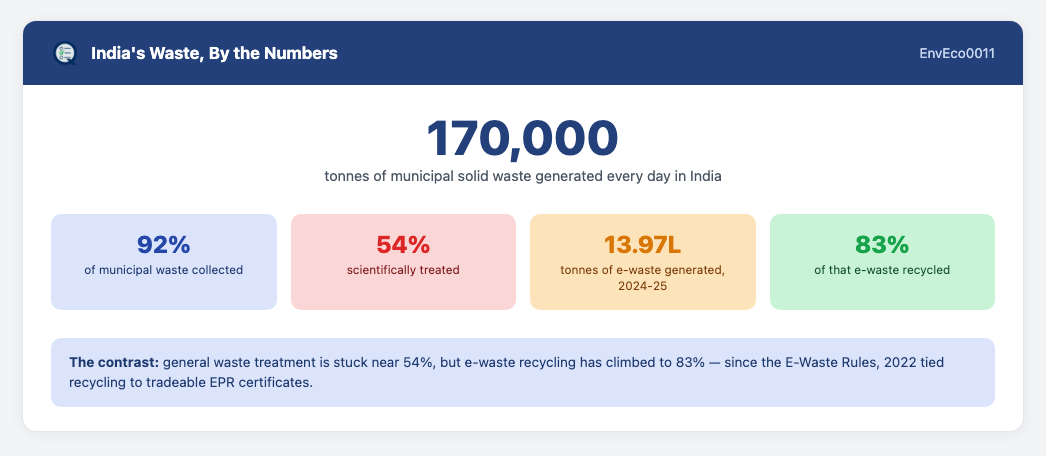
India collects 92% of its municipal solid waste. It scientifically treats only 54% of it. E-waste tells a different story — recycling there has climbed to 83%. This article covers solid and hazardous waste in India, and why one waste stream is being managed so much better than the other.

Timeline
- 2016: The Solid Waste Management Rules replace the older 2000 rules, making source segregation mandatory.
- 2 November 2022: The E-Waste (Management) Rules, 2022 are notified.
- 1 April 2023: The 2022 rules come into force, introducing a stricter Extended Producer Responsibility (EPR) regime.
- 2024-25: India generates 13.97 lakh tonnes of e-waste; 11.59 lakh tonnes get recycled.
Must Know
🏛️ Must Know
India’s Waste, By the Numbers
- Daily Generation India generates about 170,000 tonnes of municipal solid waste every day.
- Collection vs Treatment 92% of that waste gets collected. Only about 54% is actually treated scientifically.
- Segregation Rule The Solid Waste Management Rules, 2016 made source segregation mandatory. Households must sort waste into three streams: biodegradable, dry, and domestic hazardous.
- E-Waste Growth E-waste is India’s fastest-growing hazardous waste stream. India generated 13.97 lakh tonnes of it in 2024-25.
Good to Know
📘 Good to Know
E-Waste Recovery and What the 2016 Rules Actually Cover
- E-Waste Recycling Of the 13.97 lakh tonnes of e-waste generated in 2024-25, 11.59 lakh tonnes were recycled. That’s a recycling rate of about 83%.
- Rapid Growth E-waste generation has nearly doubled since 2017-18, when India generated just 7.08 lakh tonnes.
- EPR Regime The E-Waste (Management) Rules, 2022 introduced a stronger EPR regime. Producers now meet recycling targets by buying EPR certificates from registered recyclers.
- Broad Applicability The 2016 Rules apply far more broadly than just notified urban local bodies. They also cover railways, airports, defence establishments, special economic zones, and pilgrimage sites.
- Landfill Site Criteria The 2016 Rules provide exact and elaborate criteria for identifying landfill and waste-processing sites. This is one of the Rules’ most detailed technical provisions.
- No District-Crossing Ban There is no rule barring waste generated in one district from being moved to another. That claim is a common trap in exam questions about these Rules.
📝 Previous Year Questions
UPSC CSP 2019 — What’s Actually True About the SWM Rules, 2016
- UPSC 2019 The Rules do provide exact and elaborate criteria for identifying landfill and waste-processing sites. Waste is segregated into three streams, not five; the Rules cover far more than just notified urban local bodies; and there is no ban on moving waste across districts. See UPSC CSP 2019 GS Paper I, Q59. View this question.
Test Yourself

Great to Know
🌟 Great to Know
Two Waste Streams, Two Different Outcomes
- Opposite Stories Municipal solid waste and e-waste tell opposite stories. General waste treatment is stuck near 54%, despite 92% collection. E-waste recycling has climbed to 83%, helped by a stricter EPR regime.
- What Regulation Design Can Do That gap points to what regulation design can do. E-waste now carries binding recycling targets tied to tradeable certificates. Municipal waste still depends mostly on individual city capacity, which varies widely.
- Wider Legal Scope Wider legal scope matters too. The 2016 rules cover railways, airports, and pilgrimage sites, not just municipalities, a detail worth remembering for governance-focused questions.
- Related For land degradation and resource depletion elsewhere in India’s environment story, see EnvEco0009 — Environmental Degradation and EnvEco0010 — Depletion of Natural Resources.
Leave a Reply