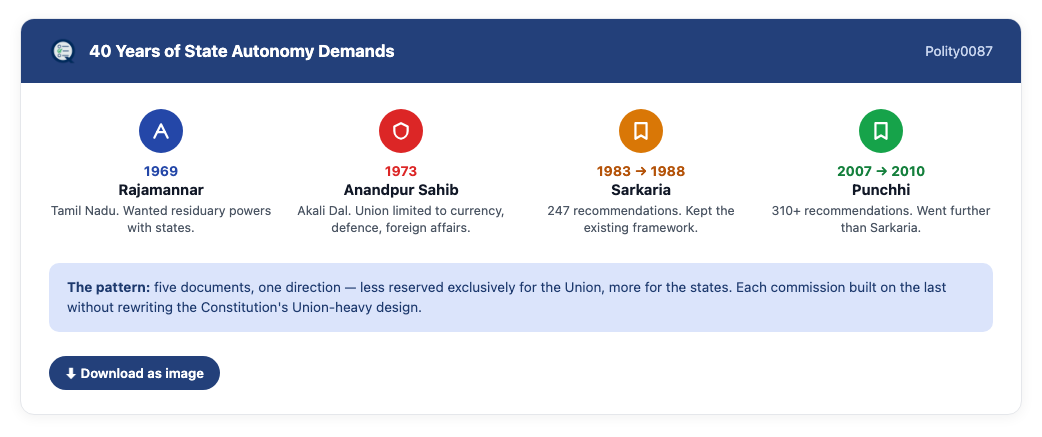
Over four decades, three states and two national commissions asked the same question in different words: why does the Union hold so much, and the states so little? None of them got everything they wanted. This article covers the demand for greater state autonomy — the committees, resolutions, and commissions that carried it, from Tamil Nadu in 1969 to Punchhi in 2010.


Timeline
- 1969: Tamil Nadu’s DMK government sets up the Rajamannar Committee. It reports in 1971, recommending residuary powers move from the Union to the states.
- 17 October 1973: The Shiromani Akali Dal adopts the Anandpur Sahib Resolution, in Punjab, asking for a much narrower Union role.
- December 1977: West Bengal’s Left Front government issues its own Memorandum on Centre-State Relations, framing autonomy as fiscal restructuring, not just grievance.
- 1983: The Centre appoints the Sarkaria Commission. It reports in 1988, with 247 recommendations, largely upholding the existing framework.
- 2007: The Centre appoints a second review, the Punchhi Commission. It reports in 2010, with over 310 recommendations, going further than Sarkaria on several points.
🏛️ Must Know
Must Know
- Tamil Nadu’s government Tamil Nadu’s government set up the Rajamannar Committee in 1969, under Dr. P.V. Rajamannar. It examined Centre-State relations and reported in 1971.
- The Committee recommended The Committee recommended transferring residuary powers from the Union to the states. It also called for abolishing the Planning Commission, which it saw as undermining states’ own planning autonomy.
- The Akali Dal The Akali Dal adopted the Anandpur Sahib Resolution on 17 October 1973, at Anandpur Sahib in Punjab. It proposed limiting the Union to currency, defence, and foreign affairs, leaving the rest to the states.
- Parkash Singh Badal Parkash Singh Badal, a senior Akali Dal leader across this period, was jailed repeatedly through the 1970s and 1980s over related agitations. See ModHist0285 — Parkash Singh Badal.
- The Centre appointed The Centre appointed the Sarkaria Commission in 1983, chaired by Justice R.S. Sarkaria. Its 1988 report ran to 247 recommendations, but it chose to work within the existing constitutional structure rather than rewrite it.
🏘️ Good to Know
Good to Know
- West Bengal’s Left West Bengal’s Left Front government prepared its own Memorandum on Centre-State Relations in December 1977. It’s often called the first attempt to argue for systematic constitutional restructuring, not just a list of individual complaints.
- Sarkaria’s recommendations inc Sarkaria’s recommendations included using Article 356 (President’s Rule) only as a last resort, and making the Inter-State Council under Article 263 a permanent body.
- The Centre set The Centre set up a second review, the Punchhi Commission, in 2007, chaired by Justice M.M. Punchhi. It reported in 2010, with more than 310 recommendations.
- Punchhi went further Punchhi went further than Sarkaria in places. It proposed a “localised emergency” limited to a district or region, instead of President’s Rule across an entire state.
📊 Commission Comparison
Rajamannar, Sarkaria, and Punchhi Side by Side
| Committee/Commission | Appointed By | Year (Appointed → Reported) | Recommendations | Key Stance |
|---|---|---|---|---|
| Rajamannar (Dr. P.V. Rajamannar) | Tamil Nadu (DMK govt.) | 1969 → 1971 | — | Residuary powers to states; abolish Planning Commission |
| Sarkaria (Justice R.S. Sarkaria) | Union Government | 1983 → 1988 | 247 | Worked within the existing framework; Article 356 as last resort |
| Punchhi (Justice M.M. Punchhi) | Union Government | 2007 → 2010 | 310+ | Went further than Sarkaria; proposed “localised emergency” |
Test Yourself


⚡ Great to Know
Great to Know
- Every demand in Every demand in this history pointed the same direction: shrink what’s reserved exclusively for the Union, expand what states control — especially over their own finances and planning. None succeeded exactly as first proposed.
- The Planning Commission The Planning Commission that Rajamannar wanted abolished in 1971 was eventually abolished — but only in 2015, replaced by NITI Aayog, for reasons that had little to do with the 1969 demand.
- Across 40 years Across 40 years and five documents, the pattern holds: each new commission built on the last, without overturning the Union-heavy design the Constitution’s framers chose. Reform at the margins, not a rewrite.
- For the institutional For the institutional machinery these demands were reacting against — the Seventh Schedule, the Finance Commission, the Inter-State Council — see Polity0055 — Centre-State Relations.
Leave a Reply