In 1970, he became Punjab’s youngest-ever Chief Minister. In 2012, at the same job, he became its oldest sitting one. He is often described as the only person to hold both records in the same state.


Five Terms, Five Decades Need to Know
- Parkash Singh Badal (8 December 1927 to 25 April 2023) was a senior Shiromani Akali Dal leader. He served as Chief Minister of Punjab five times, more than anyone else.
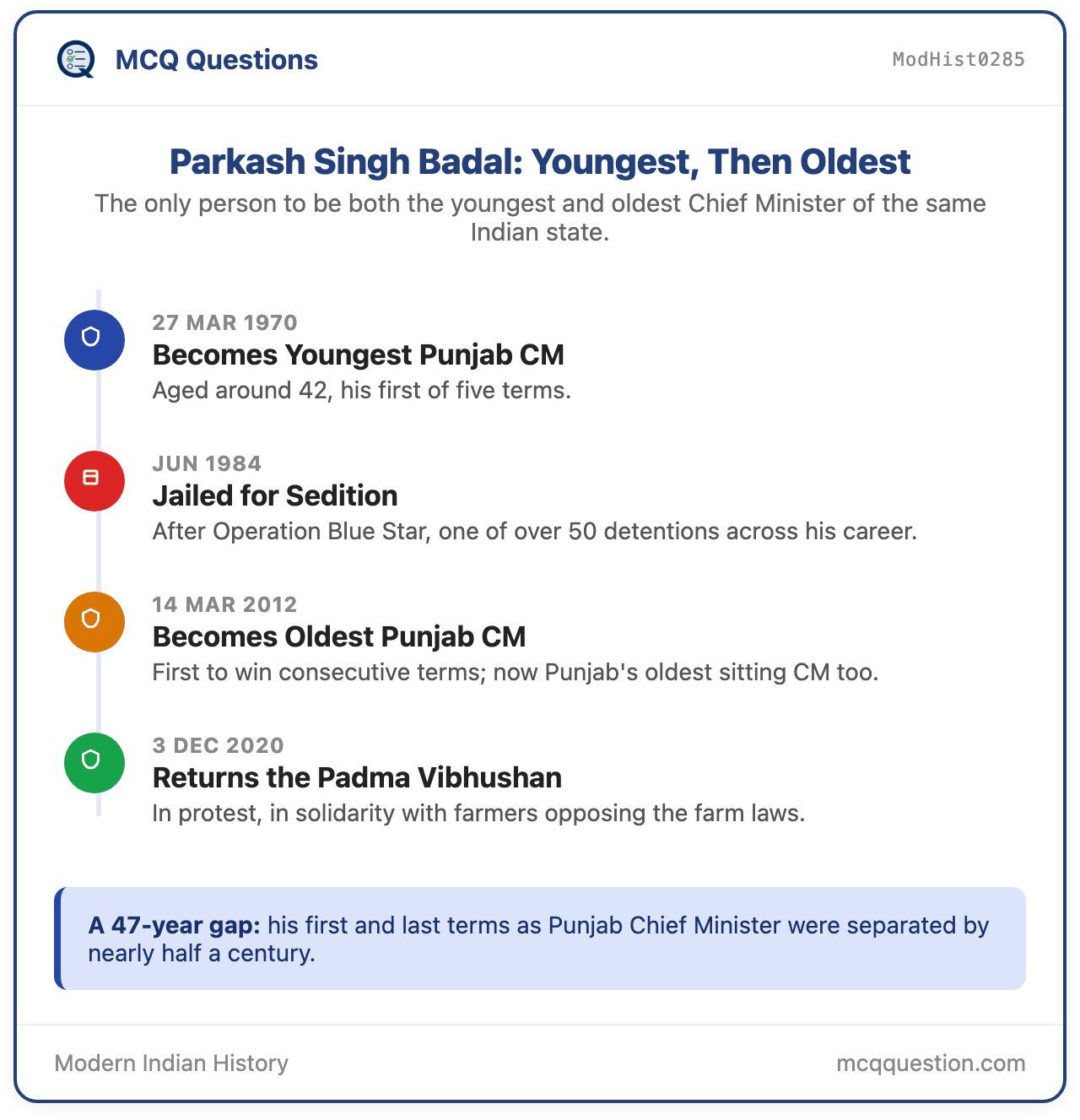
- He became Chief Minister for the first time on 27 March 1970, aged around 42. This made him Punjab’s youngest-ever Chief Minister at the time. That term ended on 14 June 1971.
- His second term ran from June 1977 to 17 February 1980, formed after the post-Emergency Janata wave. It ended when Indira Gandhi’s return to power at the Centre brought President’s Rule to Punjab.
- He served a third term from 1997 to 2002, and a fourth from 1 March 2007 to 14 March 2012.
- His fifth term began on 14 March 2012 and ran until 16 March 2017. By 2012, he had become Punjab’s oldest sitting Chief Minister, and the first to win consecutive terms in the state. He is often described as the only person to hold both the youngest-ever and oldest-sitting records in the same state.
- He was Union Minister of Agriculture and Irrigation for about eleven weeks in 1977, under Prime Minister Morarji Desai.
- He died on 25 April 2023, in Mohali, Punjab, at age 95.
Detentions, a Water Dispute, and a Contested Chapter Good to Know
- He was detained many times across his career. This included MISA detention during the Emergency (1975-1977), and a sedition charge in June 1984, after Operation Blue Star.
- He served as national president of the Shiromani Akali Dal from the mid-1990s to 2008, before his son, Sukhbir Singh Badal, succeeded him.
- He received the Padma Vibhushan in 2015. He returned it in early December 2020, in solidarity with farmers protesting the central government’s new farm laws.
- He opposed the Sutlej-Yamuna Link Canal throughout his career, viewing it as harmful to Punjab’s water resources. In 2016, Haryana returned a disputed compensation cheque to Punjab, over the same dispute.
- Critics alleged he showed sympathy toward Khalistan separatist positions around 1992, including attending funeral rites for militants and boycotting that year’s state election. He denied these allegations, and by 1998 had moved firmly back into mainstream electoral politics.
- He, his wife, and his son Sukhbir Singh Badal were charged under the Prevention of Corruption Act in 2003. After a seven-year trial, a Mohali court acquitted all the accused in 2010.
Test Yourself

A Title, a Resolution, and a Rare Arc Great to Know
- In 2011, the Akal Takht at the Golden Temple honoured him with the title “Panth Rattan Fakhr-e-Qaum.” Some Sikh bodies later called for the title to be withdrawn.
- His own party’s landmark autonomy demand, the 1973 Anandpur Sahib Resolution, was adopted while he was a senior Akali Dal leader. See Polity0087 — The Demand for Greater State Autonomy.
- His political career also runs through the reorganisation of Punjab itself. See ModHist0039 — The Punjabi Suba Movement and the 1966 Reorganisation of Punjab.
- His youngest-to-oldest arc is a rare pattern in Indian politics. It reflects a political career spanning close to five decades, not unusual longevity in a single stretch of power.
- Returning a Padma Vibhushan is a significant, uncommon act. It signals a public break from the very government that had honoured him five years earlier.
Beyond the answer
Browse all modern-indian-history topics →
📚 Keep reading
GK0036 — Punjab: Capital, Government, and the Food Bowl of IndiaLord Dalhousie: The Doctrine of Lapse, Railways and AnnexationIndGeo0065 — The Doab Region of PunjabModHist0277 — K. Karunakaran: Four Terms, One Very Short OneModHist0039 — The Punjabi Suba Movement and the 1966 Reorganisation of Punjab❓ Practice this topic
According to a 2022 CAPF exam question, which princely state actually joined India through a plebiscite — not Travancore, as one exam option falsely claimed?Which political party did V.P. Menon join after leaving government service?Around April 1947, V.P. Menon proposed an alternative to the stalled Cabinet Mission Plan. What did he propose?Maharaja Hanwant Singh of Jodhpur used an unusual object while signing the Instrument of Accession. What was it?🎲 Take a Modern Indian History Quiz
Leave a Reply