K. Karunakaran
He was Chief Minister of Kerala four separate times. His first term lasted exactly one month. Decades later, he was forced from office amid an espionage case in which investigators found no evidence against the accused scientist.
Four terms as Chief Minister
Karunakaran’s four terms as Kerala’s Chief Minister ranged from one month to almost five years, an unusual pattern in the state’s political history.
K. Karunakaran was a senior Congress leader from Kerala. He lived from 5 July 1918 to 23 December 2010.
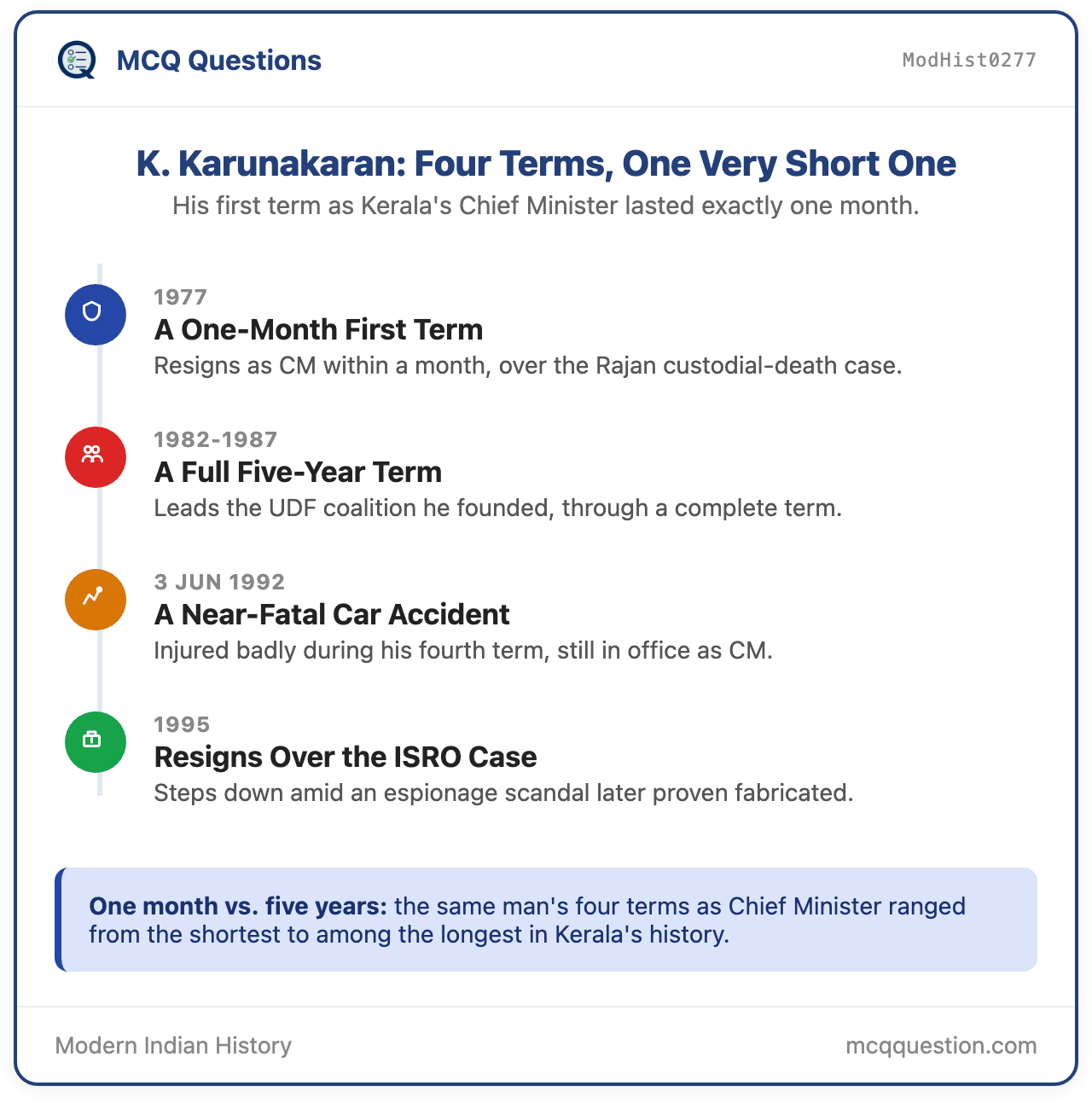
He served as Kerala’s Chief Minister four separate times. The dates show how widely those four terms varied in length.
His first term lasted just one month, from 25 March to 25 April 1977. He resigned over the Rajan case. Rajan had died in police custody during the Emergency, when civil freedoms were restricted.
His second term lasted under three months, from 28 December 1981 to 17 March 1982, before his coalition lost its majority.
His third term ran from 24 May 1982 to 25 March 1987, almost five years. It remains one of the few complete terms in Kerala’s history.
He helped form the United Democratic Front (UDF) in 1979. A coalition is a group of parties working together. He led the UDF government from 1982.
His fourth term ran from 24 June 1991 to 16 March 1995. He was forced out amid the ISRO espionage case.
Source: Government of Kerala, list of Chief Ministers.
Pause and decide · 1 of 10
Karunakaran served only three terms as Chief Minister: 1977, 1982–87, and 1991–95. True or false?
False. The list misses his second term, from December 1981 to March 1982. His four terms began in 1977, 1981, 1982, and 1991.


From trade unionist to state Congress boss
Karunakaran began as a labour organiser and later held several leading posts in Kerala Congress.
Karunakaran began public life as a trade union organiser. He worked among labourers on Kerala’s Thattil rubber estates.
He was a founding member of the Indian National Trade Union Congress, in 1947. This gave him an early base among organised workers.
He won a landmark Assembly election from Mala in 1965. The seat had long been considered safe for the Left.
He served as Kerala’s Home Minister from 1971 to 1977. Later, he led Congress governments as Chief Minister.
He represented the Mala constituency across seven consecutive Assembly elections. Voters there kept returning him for three decades.
He was known simply as “Leader,” a nickname used even in English. It reflected his hold over Kerala’s Congress unit.
Source: Rajya Sabha biographical sketch and Kerala Legislative Assembly records.
Pause and decide · 2 of 10
Karunakaran served as Kerala’s Home Minister before becoming Chief Minister in 1977. True or false?
True. Rajya Sabha records list him as Home Minister from 1971 to 1977. He became Chief Minister in March 1977.
Kingmaker for a Prime Minister, builder of an airport
Karunakaran left a mark on national politics and Kerala’s infrastructure alike, though a corruption case shadowed him to his death.
His government started the Cochin International Airport project in 1994. The airport opened in 1999, after his final term. It was India’s first airport built through a public-private partnership. That means government and private investors shared the project.
He also backed the Rajiv Gandhi Centre for Biotechnology. Both projects reflected his focus on infrastructure and modernisation.
He is widely credited with steering Congress toward P.V. Narasimha Rao. Rao became Prime Minister in 1991, after that internal push.
He was also accused in the Palmolein oil import scam. His case was still pending when he died. The charge against him ended because an accused person cannot be tried after death.
He died on 23 December 2010. This was exactly six years after P.V. Narasimha Rao’s own death, on the same calendar date.
Sources: Cochin International Airport Limited and Kerala High Court palmolein ruling.
Pause and decide · 3 of 10
Karunakaran was formally convicted in the Palmolein oil import scam before his death in 2010. True or false?
False. He was accused but never convicted. The charge against him ended when he died in 2010. Proceedings against others continued.
The Rajan case that ended his first term
A student’s death in police custody, exposed by a determined father, cost Karunakaran his very first term as Chief Minister within a month.
The case followed an attack on Kayanna police station in February 1976. Police suspected Naxalites, a Maoist insurgent group.
Police arrested P. Rajan, an engineering student, on 1 March 1976. He was taken to the Kakkayam police camp for interrogation.
Rajan died in custody, from torture that included a practice called “uruttal.” His body was never recovered.
Rajan’s father, T.V. Eachara Warrier, fought for years to expose the truth. He filed a habeas corpus petition. This asks a court to make officials account for a detained person.
Karunakaran was Kerala’s Home Minister when Rajan died in custody. He became Chief Minister soon after, in March 1977.
The Kerala High Court found he had given false testimony, in the habeas corpus case. He resigned on 25 April 1977, exactly one month into his first term.
Source: Kerala school textbook on the Rajan case.
Pause and decide · 4 of 10
Karunakaran was Kerala’s Home Minister, not yet Chief Minister, when P. Rajan died in police custody in 1976. True or false?
True. He became Chief Minister in March 1977. He resigned one month later after the Kerala High Court found his statement false.
A contested legacy
His fourth term ended amid the ISRO espionage case. Later investigations found no basis for the spying charge against scientist Nambi Narayanan.
The ISRO case saw scientist Nambi Narayanan arrested in 1994, on spying charges. The CBI found no evidence of spying. The Supreme Court later reviewed the case and awarded Narayanan compensation.
The case caused a political crisis within Congress. Karunakaran left the Chief Minister’s post in March 1995.
The Rajan case remains the most contested chapter of his career. Critics still weigh it against his record as a builder of infrastructure.
The UDF coalition he co-founded has outlasted him by decades. It still competes for power in Kerala today.
His four terms form an unusual case study, in political survival. The same man served one month in 1977 and almost five years in his third term.
Sources: Supreme Court ISRO judgment and Government of Kerala term dates.
Pause and decide · 5 of 10
Investigators later found no evidence that scientist Nambi Narayanan had committed espionage. True or false?
True. The CBI found the spying charge baseless. The Supreme Court later awarded Narayanan compensation for his arrest and treatment.
Family in Kerala politics
Karunakaran’s own children built political careers, keeping his family’s name active in Kerala politics long after his final term.
His son, K. Muraleedharan, became a senior Congress leader in his own right. He served as president of the Kerala Pradesh Congress Committee.
His daughter, Padmaja Venugopal, also entered active politics. She held a position on the Kerala Congress executive committee.
In 2005, Karunakaran split from Congress to form his own party. He rejoined Congress in December 2007, late in his career.
His family’s continued presence in Kerala politics fuels debate. Their careers also raised questions about family influence in party politics.
Source: Rajya Sabha biography and Kerala Legislative Assembly member records.
Pause and decide · 6 of 10
Karunakaran remained a Congress member without interruption for his entire political career, never founding a separate party. True or false?
False. He split from Congress in 2005 to form his own party, before rejoining Congress in December 2007, late in his career.
Exam Angle: What to Expect
No Previous Year Question in this site’s index has directly tested this yet.
Do not confuse Karunakaran with E.M.S. Namboodiripad, Kerala’s first Chief Minister. Namboodiripad led the Communist side; Karunakaran led the Congress-UDF side.
Exams often test exact term dates for Chief Ministers. Remember his first term ran only from 25 March to 25 April 1977, and his lesser-known second term ran December 1981 to March 1982.
Questions may link him to the ISRO espionage case or the Rajan case. Both test whether you know the specific event, not just his name.
Source: Government of Kerala term dates; no exact PYQ is claimed here.
Pause and decide · 7 of 10
Karunakaran and E.M.S. Namboodiripad both led the same political side in Kerala politics, just in different decades. True or false?
False. Namboodiripad, Kerala’s first Chief Minister, led the Communist side, while Karunakaran led the Congress-UDF side — they were rivals, not successors on the same side.
Pause and decide · 8 of 10
P. Rajan’s body was never recovered, despite his father’s years-long fight through the courts to expose what happened to him. True or false?
True. T.V. Eachara Warrier’s habeas corpus petition still forced the custodial-death case into the open, even without his son’s body.
Pause and decide · 9 of 10
Karunakaran survived a serious car accident in June 1992 while still in office during his fourth term as Chief Minister. True or false?
True. He was injured badly on 3 June 1992, but remained Chief Minister until his eventual removal amid the ISRO case in March 1995.
Pause and decide · 10 of 10
Kochi International Airport was built as a purely government-funded project during one of Karunakaran’s terms as Chief Minister. True or false?
False. The airport used government and private investment. Karunakaran backed the project in 1994, and it opened in 1999.
Check your understanding
Answer the ten checks above. You will see each explanation after choosing.
Sources and court records
- Government of Kerala, Chief Ministers of Kerala: exact dates of all four terms.
- Rajya Sabha biographical sketch: birth, public offices, and Union ministry.
- Kerala school textbook, “Custodial death of Rajan”: Rajan’s arrest, his father’s petition, and the court finding.
- Supreme Court, Nambi Narayanan judgment (2018): findings on the ISRO allegation and compensation.
- Kerala High Court, Jiji Thomson v. State of Kerala (2015): the palmolein charge against Karunakaran ended after his death.
- Cochin International Airport Limited, About Us: the airport’s public-private model and Karunakaran’s role.
Practice what you learned
Question 1 of 1
Leave a Reply