One artist moved this painting style from mud walls onto paper. That single shift carried an ancient tribal art form onto the world stage.
 MCQ Questions
Warli Painting
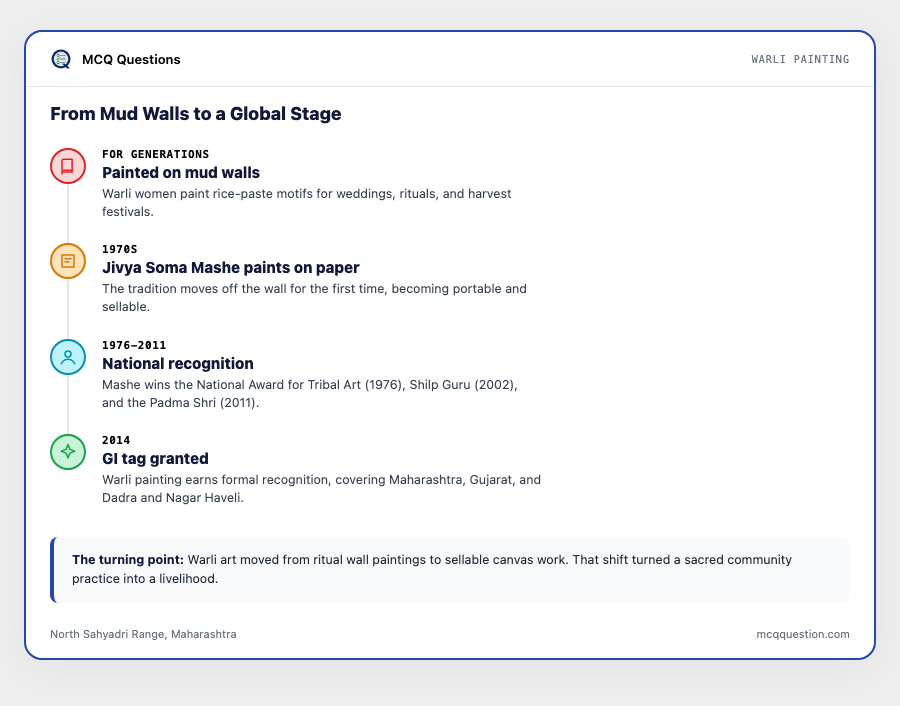
From Mud Walls to a Global Stage
For generations
Painted on mud walls
Warli women paint rice-paste motifs for weddings, rituals, and harvest festivals.
1970s
Jivya Soma Mashe paints on paper
The tradition moves off the wall for the first time, becoming portable and sellable.
1976-2011
National recognition
Mashe wins the National Award for Tribal Art (1976), Shilp Guru (2002), and the Padma Shri (2011).
2014
GI tag granted
Warli painting earns formal recognition, covering Maharashtra, Gujarat, and Dadra and Nagar Haveli.
The turning point: Warli art moved from ritual wall paintings to sellable canvas work. That shift turned a sacred community practice into a livelihood.
⬇ Download as image
Must Know
- Warli painting is a tribal art form of the Warli community, from the North Sahyadri Range in Maharashtra.
- The Warli are an Adivasi (Scheduled Tribe) community, based mainly around Palghar and Dahanu.
- It received a Geographical Indication (GI) tag on 31 March 2014.
- The GI tag covers Maharashtra, Gujarat, and the Union Territory of Dadra and Nagar Haveli and Daman and Diu.
Good to Know
- Warli art uses simple geometric shapes: circles, triangles, and squares.
- A circle represents the sun or moon; a triangle represents mountains or trees.
- The base is a mix of cow dung and mud, giving the wall a red-ochre background.
- The paint itself is a white paste of rice flour and water, sometimes mixed with natural gum.
- Traditionally, Warli women painted these murals inside their homes, not men.
- Paintings marked rituals, weddings, and harvest festivals.
- The central motif is a sacred square, called the chauk.
- A wedding chauk, called the Lagnachauk, encloses an image of Palaghata Devi, the Warli goddess of fertility.
Test Yourself

Great to Know
- Jivya Soma Mashe is regarded as the father of modern Warli art.
- In the 1970s, he began painting the traditional motifs on paper and canvas, not just mud walls.
- That shift made the art portable, durable, and sellable beyond Warli villages for the first time.
- His work reached international audiences, including a show at the Centre Pompidou in Paris.
- He won the National Award for Tribal Art in 1976, the Shilp Guru award in 2002, and the Padma Shri in 2011.
- His recognition encouraged other Warli artists to take up painting as a livelihood, not just a ritual practice.
Beyond the answer
Browse all art-and-culture topics →
📚 Keep reading
IndSoc0042 — Tribal Groups and Welfare in India: PVTGs and ProtectionSciTech0208 — Tribal Knowledge Systems: Uniqueness vs Mainstream KnowledgeGK0023 — Chhattisgarh: Steel, Minerals, and the Bastar RegionPolity0274 — Article 244 of the ConstitutionArtnCulture0082 — Madhubani Painting: Bihar's Mithila Folk Art❓ Practice this topic
D0421 — Which Director-General led the revival of the ASI under Lord Curzon in 1902?D0420 — Under which Ministry does the Archaeological Survey of India function?D0419 — Which Act governs the protection of monuments and archaeological sites of national importance in India?D0418 — Who is regarded as the founder and first Director-General of the Archaeological Survey of India?🎲 Take a Art And Culture Quiz
Leave a Reply