One tribe’s population has fallen to just 43 people. Another has never let an outsider count them at all. This article covers India’s most vulnerable tribal groups, and the two very different ways the state tries to protect them.


PVTG Classification and Key Welfare Schemes Need to Know
Classification and Schemes
PVTGs
- 75 PVTGs India has 75 Particularly Vulnerable Tribal Groups (PVTGs), spread across 18 states and one Union Territory. Odisha has the most, with 13.
- Four Criteria A tribe is classified as a PVTG using four criteria. These are pre-agricultural technology, a stagnant or declining population, extremely low literacy, and a subsistence-level economy.
- Named Examples The Irular and Konda Reddi tribes are both officially on the PVTG list.
- PM-JANMAN Launched on 15 November 2023 (Janjatiya Gaurav Divas, Birsa Munda’s birth anniversary). It has a ₹24,104 crore outlay, aimed at 100% coverage of PVTG habitations with housing, water, and roads. The Ministry of Tribal Affairs also runs a separate education-focused scheme, IndSoc0045 — Eklavya Model Residential Schools (EMRS).
- DAJGUA PM-JANMAN sits alongside a broader village-level scheme, DAJGUA, which covers all tribal-majority villages rather than only PVTG habitations.
- Fifth Schedule The Fifth Schedule of the Constitution provides special tribal-area administration across 10 states. These include Andhra Pradesh, Chhattisgarh, Jharkhand, Madhya Pradesh, and Odisha.
- State Keeps Power Declaring an area a Scheduled Area does not strip the State of its executive power there; the State continues to administer it. The Union’s role is limited to giving directions to the State, based on the Governor’s report to the President — not taking over total administration, a common exam trap.
How a Community Becomes a Scheduled Tribe
- Article 342 It is the President, not the Governor, who specifies Scheduled Tribes by public notification. Where a State is concerned, this happens after consulting that State’s Governor.
- State-Specific Notifications are issued separately for each State or Union Territory. A community can be a Scheduled Tribe in one State but not recognised as one in another.
- Parliament’s Role Only Parliament, by law, can add a tribe to or remove one from an existing notification. A later notification alone cannot vary an earlier one.
Previous Year Question
Asked as: “It is the Governor of the State who recognizes and declares any community of that State as a Scheduled Tribe. A community declared as a Scheduled Tribe in a State need not be so in another State.” (UPSC CSP 2024, GS Paper I). View this question.
Previous Year Question
Asked as: “If an area in a State is declared as Scheduled Area under the Fifth Schedule, which of the given statements is/are correct?” (UPSC CSP 2025, GS Paper I). View this question.
Andaman Tribes, the Sentinelese, and the Sixth Schedule Good to Know
Andaman & Nicobar’s Tribes
Isolation
- Six Groups The Andaman and Nicobar Islands host six tribal groups. On Andaman: the Great Andamanese, Onge, Jarawa, and Sentinelese. On Nicobar: the Shompen and Nicobarese. Five of the six are PVTGs; only the Nicobarese, with an active economic role and a population near 27,000, is excluded.
- Great Andamanese Their population has collapsed to just 43 people, a loss of about 99% since British colonisation began.
- Sentinelese Estimated at 100-150 people on North Sentinel Island, they remain completely uncontacted and are legally protected from all outside approach.
- Sixth Schedule This is a separate constitutional tool. It gives self-governing autonomous councils to tribal areas in Assam, Meghalaya, Tripura, and Mizoram. See Polity0093 — The Sixth Schedule and Inner Line Permit.
Current Affairs
- 15 August 2026: Union Minister for Tribal Affairs Jual Oram and Dr. R. Balasubramaniam, Member, NITI Aayog, jointly released two publications strengthening India’s tribal-development machinery. These were the National Framework and the Operational Guidelines for Strengthening of ITDAs and ITDPs.
- Integrated Tribal Development Agencies and Projects (ITDAs/ITDPs) are the Ministry’s main field-level delivery institutions. The twin publications translate a nationwide consultative exercise into an actionable reform roadmap. The exercise itself covered 217 ITDAs/ITDPs across 19 States/UTs.
- An Evidence-Weighted ITDA Diagnostic Scoring Framework now assesses each institution across 15 parameters. These parameters span five institutional domains, and let every ITDA build its own Performance Improvement Roadmap.
- The exercise reached a milestone on 3 June 2026, at a National Conclave on Strengthening of ITDAs and ITDPs. The event was held at Vigyan Bhawan, New Delhi, and was graced by President Droupadi Murmu.
- 6 August 2026: The Ministry of Tribal Affairs signed MoUs with 10 State and Technology Business Incubators, under the Venture Capital Fund for Scheduled Tribes (VCF-ST).
- Partner incubators include IIM Calcutta Innovation Park, T-Hub Foundation, Startup Tamil Nadu, Startup Odisha, IIM Udaipur, Kerala Startup Mission, and PRIME Meghalaya, among others.
- The partnerships aim to reach about 1,000 ST entrepreneurs, funding and incubating a minimum of 100, with structured mentorship and market-linkage support.
- 6 August 2026: In a batch of Lok Sabha replies, MoS Tribal Affairs Durgadas Uikey detailed DAJGUA’s village-inclusion criteria and district-level rollout.
- DAJGUA villages must be tribal-majority, with a population of 500 or more and at least 50% ST residents. Karnataka’s Hassan district has 6 villages across 4 blocks on the DAJGUA list; Madhya Pradesh’s Chhindwara and Pandhurna districts have 591 villages across 11 blocks.
- Regular inter-ministerial coordination meetings and a Project Management Unit (PMU) monitor implementation across DAJGUA’s 25 interventions. See Polity0171 — DAJGUA for the scheme’s full framework.
- 6 August 2026: A separate reply gave EMRS academic outcomes for 2025-26. Pass rates were 93.62% in Class X and 87.82% in Class XII, with 173 and 92 schools respectively hitting a 100% pass rate.
- EMRS students qualified in national exams: 346 in JEE Main, 41 in JEE Advanced, 408 in NEET, 9 in NIFT, and 1 in CLAT. 9,111 teaching/non-teaching staff have been recruited via ESSE-2023, with ESSE-2025 underway for 7,267 more.
- An AI-enabled teaching platform, Medha AI, now runs in all functional EMRSs, alongside 284 smart classrooms and a dedicated Eklavya DTH channel.
- 6 August 2026: A reply on Alipurduar district, West Bengal, confirmed it is covered under both DAJGUA and PM-JANMAN. DAJGUA carries a total outlay of ₹79,156 crore; PM-JANMAN, ₹24,104 crore.
- Alipurduar’s ST students also draw on national scholarship schemes, including Pre-Matric, Post-Matric, and National Overseas Scholarship (20 awards/year, for study at top-1000 QS-ranked institutes abroad).
- 6 August 2026: A reply named Telangana State Girijan Co-operative Corporation Ltd as the state implementing agency for Van Dhan Vikas Kendras (VDVKs) in Telangana.
- Separately, the Ministry provides equity support to the Tribal Cooperative Finance Corporation (TRICOR) for concessional loans to tribal entrepreneurs.
- 6 August 2026: A reply on tribal land rights confirmed forest-land diversion for government facilities is capped at 1 hectare per case under FRA Section 3(2). This also needs Gram Sabha recommendation.
- FRA Section 4(5) bars evicting forest occupants until the rights-recognition process is complete. Forest-land diversion proposals are processed via the PARIVESH portal, but land acquisition and rehabilitation records are not centrally maintained — these stay with State Governments and project authorities.
- 6 August 2026: A reply detailed Direct Benefit Transfer (DBT) for ST scholarships, including the SNA SPARSH Model — a just-in-time disbursement system.
- Once a State raises a scholarship bill, Central and State shares transfer directly from the RBI account to the student’s account, eliminating fund parking at the state level. The DBT Tribal Portal also enables automated deduplication checks against the National Scholarship Portal.
- 6 August 2026: A reply addressed the Van Gujjar community’s seasonal migration disputes in Uttarakhand.
- The Ministry wrote to Uttarakhand’s government and 9 district administrations (including Dehradun, Uttarkashi, and Haridwar) in June 2025, after which the state’s Tribal Welfare Department directed districts to resolve the issues.
- The Ministry cited FRA Section 3(1)(d), which protects nomadic and pastoralist communities’ traditional seasonal resource-access rights.
- 6 August 2026: In a Lok Sabha reply, MoS Tribal Affairs Durgadas Uikey detailed tribal rehabilitation under the Ken-Betwa Link Project.
- Of 1,913 Project Affected Families (about 8,339 people) expected to be displaced in Phase-I, 648 families are Scheduled Tribes.
- Rehabilitation itself is implemented by state governments, with the Ministry of Tribal Affairs sitting on the project’s Steering and Monitoring Committees.
- The Ministry said it had received no complaints of undelivered compensation, but had forwarded displacement-related representations to Madhya Pradesh for action.
- 7 August 2026: The Ministry of Tribal Affairs and TRIFED marked the 12th National Handloom Day with “Tribal Weaves of India,” at the RISA Flagship Store in New Delhi, showcasing India’s tribal textile heritage through the RISA: Timeless Tribal brand.
- The event displayed GI-tagged weaves including Kotpad Cotton, Tussar Silk, Eri Silk, Muga Silk, Toda embroidery, and Dongria embroidery, alongside collections by designers who source directly from tribal weavers.
- It also featured specialised handicrafts — Longpi Pottery (Manipur), Turtuk Brass Cutlery (Ladakh), Warli Art (Maharashtra), and Dokhra Art (Chhattisgarh) — plus live Warli and Gond art demonstrations and the felicitation of Tribal Master Artisans.
- 5 August 2026: MoS Tribal Affairs Durgadas Uikey told the Rajya Sabha that TRIFED runs Van Dhan Vikas Kendras (VDVKs) under two schemes. These build tribal livelihoods around Minor Forest Produce (MFP) and other tribal enterprises. (Source: PIB)
- A typical PMJVM VDVK has 15 Self-Help Groups (SHGs) of 20 beneficiaries each. A PM-JANMAN VDVK is smaller, with 5 SHGs of 10 beneficiaries each. (Source: PIB)
- Under PMJVM, 4,172 VDVKs are sanctioned across 28 States/UTs, covering 12.48 lakh beneficiaries. Under PM-JANMAN, 540 VDVKs are sanctioned across 18 States/UTs, covering 0.46 lakh beneficiaries. (Source: PIB)
- So far, 2,922 VDVKs (7.13 lakh beneficiaries) have received training in sustainable MFP collection, processing, packaging, branding, and marketing. 3,406 VDVKs are now operational. (Source: PIB)
- Operational VDVKs have collectively sold about ₹174 crore worth of value-added tribal products. Sales came through local markets, melas, and the Bharat Tribes Fest (BTF). (Source: PIB)
- One concrete PM-JANMAN example: the Irula tribal community, a PVTG in Tamil Nadu. TRIFED has sanctioned 37 VDVKs across 7 districts there, of which 34 specifically serve 2,135 Irula beneficiaries. (Source: PIB)
- These centres process locally-collected forest produce, including wild honey, spices, cashew, broom sticks, herbs, tamarind, and soap nut. Irula beneficiaries have sold ₹75.89 lakh worth of value-added products so far. (Source: PIB)
- 5 August 2026: MoS Tribal Affairs Durgadas Uikey told the Rajya Sabha that FRA claims filed from FY 2023-24 to FY 2025-26 totalled 8.56 lakh. Of these, 2.34 lakh titles were approved, and 14,462 claims were rejected. The Act itself sets no time limit for deciding a claim. States report land-occupation-date disputes and missing evidence as the top rejection reasons. (Source: PIB)
- 5 August 2026: Uikey also gave the Rajya Sabha a full scheme-by-scheme update on Scheduled Tribe welfare. Eklavya Model Residential Schools (EMRS) enrolment nearly doubled in four years, from 92,075 students in 2020-21 to 1,38,336 in 2024-25. Beyond EMRS and PM-JANMAN, the Ministry runs several other schemes too. These include NSTFDC, an apex body giving concessional credit to ST beneficiaries, and Article 275(1) constitutional grants to Scheduled Areas. (Source: PIB)
- 5 August 2026: Uikey told the Rajya Sabha that TRIFED has empanelled 470 tribal artisans in Tripura, linked to 2,957 families. In the state, 80 of 87 sanctioned VDVKs are operational, selling ₹113.85 lakh worth of value-added forest produce. The Ministry has also notified Minimum Support Price rates for 87 Minor Forest Produce items nationwide, including in Tripura. (Source: PIB)
- 5 August 2026: Uikey told the Rajya Sabha that most ST scholarship schemes currently have no pending institutional dues. The National Fellowship (NFST) and Overseas Scholarship both report zero pending claims right now. One exception stands out: the Top Class Scholarship scheme owed institutions over ₹20 crore in pending tuition and admission fees, for Academic Year 2024-25 alone. (Source: PIB)
- 5 August 2026: Uikey told the Rajya Sabha that West Bengal has identified 3 PVTGs: Birhor, Lodha, and Toto, across 428 villages. Habitation mapping there has covered 495 habitations and 19,991 households. All 3,372 sanctioned households in the state have been electrified, and DAJGUA has approved ₹125.75 crore in projects there this year. (Source: PIB)
- 5 August 2026: Union Minister Jual Oram laid a statement in Parliament on PM-JANMAN’s progress in Odisha. The state has 73,092 PVTG households, covering a population of over 3.12 lakh. Odisha’s own 47 EMRS schools are functional, with enrolment nearly doubling since 2021-22, to 13,367 students. Under PMJVM, 152 of 170 sanctioned VDVKs are already operational, reaching over 50,000 beneficiaries. (Source: PIB)
- 30 June 2026: President Droupadi Murmu graced the first convocation of the Central Tribal University of Andhra Pradesh, at Vizianagaram. She said the university should build self-confidence, leadership, and policy-making capabilities within tribal society, and help improve tribal livelihoods in areas like forest produce, handicrafts, millets, medicinal plants, eco-tourism, and local entrepreneurship. (Source: PIB)
Test Yourself

Two Philosophies of Tribal Protection Great to Know
Integration vs. Isolation
Two Opposite Strategies, Side by Side
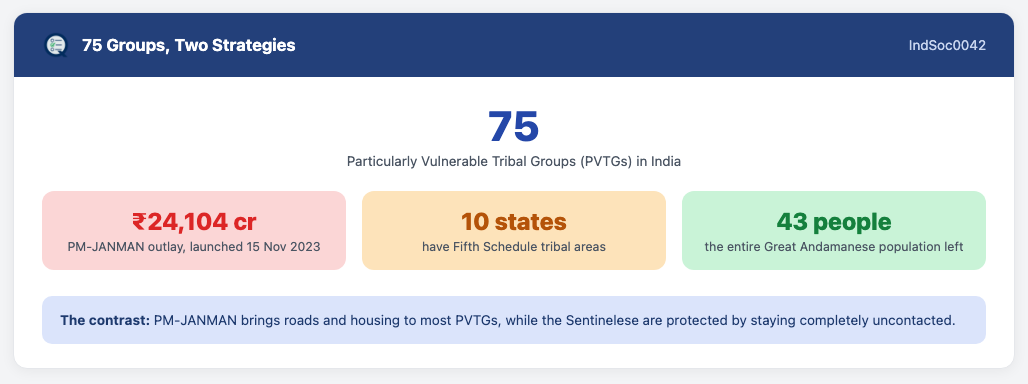
- Two Philosophies India runs two opposite tribal-welfare philosophies at once. PM-JANMAN integrates most PVTGs through roads, housing, and services. Policy toward the Sentinelese does the reverse: protection through total isolation, on the belief that contact itself is the greater threat.
- The Andamanese Case The Great Andamanese case is the strongest argument for that second approach. Their population didn’t collapse from neglect. It collapsed specifically because of contact with outsiders, through disease and displacement.
- Growing List The PVTG list grew in two stages, not one: 52 groups identified in 1975, then 23 more added in 1993. A category built to flag the most vulnerable tribes kept finding more of them for nearly two decades.
- Two Schedules Reading the Fifth and Sixth Schedules together shows the Constitution offers two different tools for a similar goal. The Fifth Schedule keeps a Governor-led administrative check within existing state structures, while the Sixth Schedule hands tribal areas their own elected councils entirely.
Leave a Reply