India runs a wide network of schemes for children’s health, protection, education and nutrition. This article covers the most important of these, from early-childhood ICDS to adolescent and school-linked schemes.


Must Know
Welfare Schemes for Children
Integrated Child Development Services
- RoleICDS delivers health, nutrition, and early-education services together to young children and mothers, rather than as separate programmes.
- BeneficiariesIt serves children up to six years of age, along with pregnant women and lactating mothers, covering the full early-life window.
- AnganwadiIt works through a nationwide network of Anganwadi centres, each a real local point of contact rather than a distant office.
- Six ServicesIt bundles supplementary nutrition, immunisation, health check-ups, referral, pre-school education, and nutrition education into a single coordinated package.
Rashtriya Bal Swasthya Karyakram
- ScreeningRBSK screens children aged 0 to 18 years for a defined set of common health conditions. This catches problems early, rather than waiting for a family to seek treatment on its own.
- 4D FocusIt covers defects at birth, deficiencies, diseases, and developmental delays, including disabilities, under one structured framework.
- InterventionDetected cases are referred for free treatment under the National Health Mission, so a diagnosis is not left unfunded.
- Why it mattersScreening this broadly, across four distinct categories, is what makes RBSK different from a narrower single-disease check-up programme.
Child Protection and Labour Prohibition
- Safety netThe Integrated Child Protection Scheme creates a safety net for children in difficult circumstances, including those abandoned, abused, or in conflict with the law.
- Who monitors itThe National Commission for Protection of Child Rights monitors this rights framework, investigating complaints and recommending action where protections fall short.
- Child labour lawThe Child Labour (Prohibition and Regulation) Amendment Act restricts children’s employment. It bans children below 14 from any occupation, and adolescents from hazardous work specifically.
- Why they’re pairedA protection scheme and a labour-prohibition law both exist to intervene before a child’s circumstances get worse, using different tools for the same underlying goal.
Creche Scheme
- SchemeThe Rajiv Gandhi National Creche Scheme provides childcare support for the children of working mothers, especially those in daily-wage and informal-sector jobs.
- NeedIt addresses a real care gap. Many informal-sector women workers had no safe place to leave a young child while at work before this scheme existed.
- Why it mattersWithout reliable childcare, a mother’s own ability to take or keep paid work is directly constrained. That holds regardless of any other welfare support she qualifies for.
Good to Know
Girl Child, Education and Adolescent Schemes
Girl Child and Adolescent Schemes
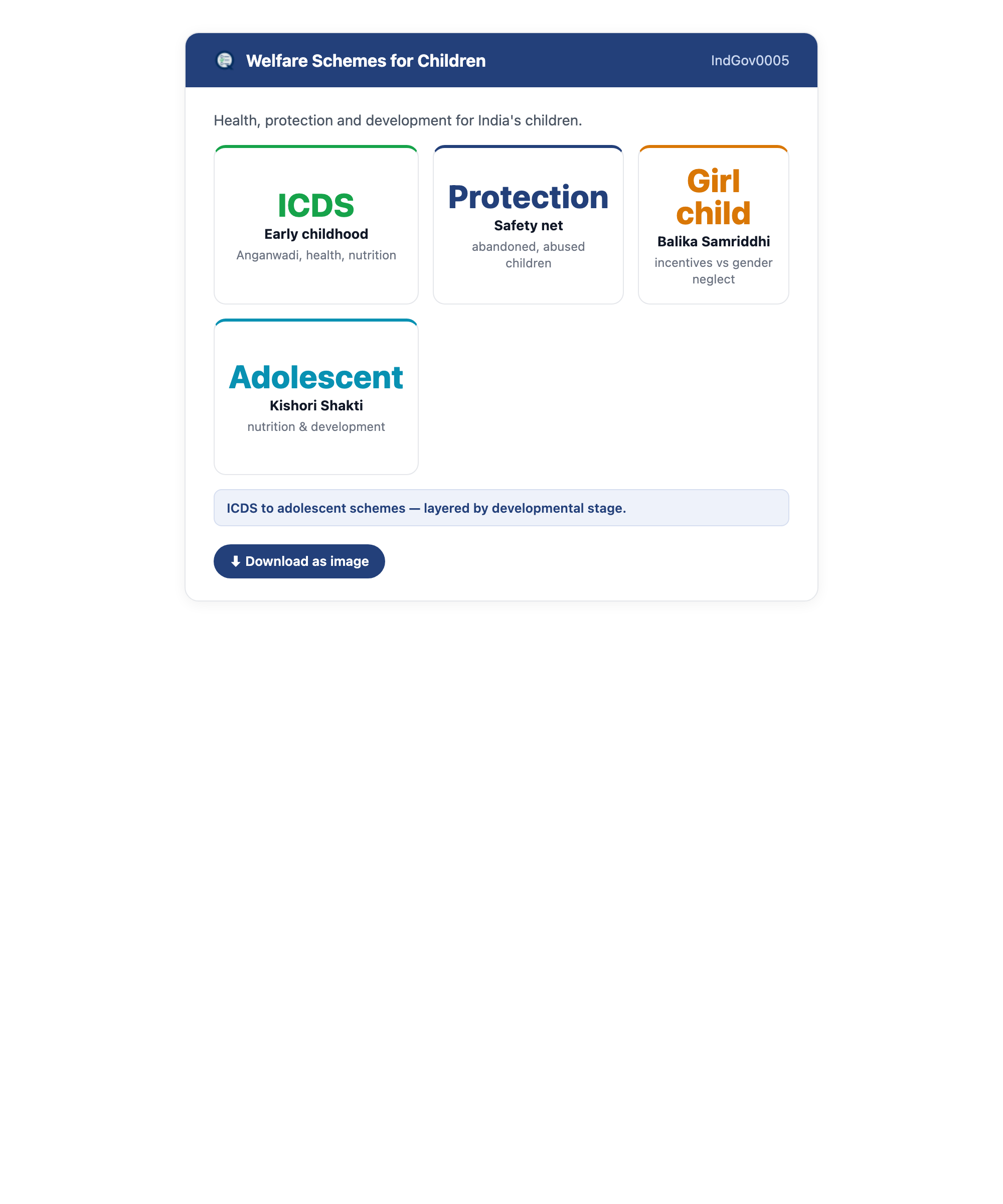
- Balika Samriddhi YojanaThis scheme provides financial incentives tied directly to a girl child’s birth and her later education. It aims to counter gender-based neglect and improve survival and school retention.
- Kishori Shakti YojanaThis scheme focuses on adolescent girls specifically, building on ICDS with nutrition, life-skills, and empowerment inputs for girls who are out of school.
- Adolescent NutritionThe Nutrition Programme for Adolescent Girls addresses a nutritional gap in a critical growth period that early-childhood-focused programmes like ICDS often overlook.
- Why they’re groupedAll three schemes target the specific vulnerability of girls, at different life stages, rather than treating “child welfare” as one undifferentiated category.
Samagra Shiksha
- IntegrationSamagra Shiksha is the umbrella scheme for school education, spanning everything from pre-school through senior secondary in a single unified programme.
- MergeIt absorbed the earlier Sarva Shiksha Abhiyan, the Rashtriya Madhyamik Shiksha Abhiyan, and teacher education into one combined scheme.
- AimIt supports quality, access, and inclusion, while directly carrying the Right to Education mandate through the entire school system.
- Why it mattersMerging three separate schemes into one avoided the coordination gaps that come from running related programmes through entirely separate administrative structures.
Test Yourself
Loading practice…
Great to Know
Layered by Stage and the Nutrition Mission
Layered by Stage
- PatternThese schemes are layered by developmental stage: ICDS covers young children first, then dedicated adolescent-specific schemes take over as a child grows.
- ReasonA single scheme cannot realistically cover a child’s entire developmental span, since a six-year-old and a sixteen-year-old need genuinely different kinds of support.
- The continuumHealth, education, nutrition, and protection interventions together form a care continuum, each handing off to the next as a child ages.
- Why it mattersExams sometimes test whether you can correctly place a named scheme at its right developmental stage in this continuum.
Poshan Abhiyaan
- MissionPoshan Abhiyaan, the National Nutrition Mission, targets a real reduction in stunting, undernutrition, and anaemia across its target groups.
- BeneficiariesIt focuses on children under six, adolescent girls, and pregnant and lactating mothers, the same core groups ICDS itself serves.
- DeliveryIt rides on the existing Anganwadi network, using community-driven convergence and technology tools rather than building a wholly separate delivery system.
- Why it mattersPoshan Abhiyaan is a targeted nutrition mission layered on top of ICDS’s broader mandate, not a replacement for it.
Current Affairs
📰 Current Affairs
Mission Saksham Anganwadi
- March 2026Mission Saksham Anganwadi and Poshan 2.0 now track nearly 14.03 lakh Anganwadi Centres, reaching roughly 8.95 crore eligible beneficiaries nationwide.
- Real new featureAn IT-enabled Home Visit scheduler was integrated into the Poshan Tracker app in April 2026. It supports 23 structured home visits, covering pregnant women and children up to age three.
- Training scaleBy 31 March 2026, over 10.58 lakh Anganwadi Workers had been trained in early-childhood pedagogy and nutrition-service delivery under this mission.
- Why it fits hereThis is a real, current example of exactly what this article’s own ICDS card describes. It is the same Anganwadi network, now measured and tracked at genuine national scale.
- LinkSource: PIB, Saksham Anganwadi and Mission Poshan 2.0 IT Systems Update.
Child Rights Monitoring
- 9 September 2026The NCPCR proposed a draft framework for dedicated child-only de-addiction facilities, recognising children’s distinct developmental and confidentiality needs.
- Non-punitive by designThe framework explicitly bars suspending, expelling, or publicly shaming a child for suspected substance use, treating them as needing care rather than punishment.
- Prahari ClubsSchools would establish student volunteer groups called Prahari Clubs, giving students a confidential channel to report concerns about a peer.
- Why it fits hereThis is a live, current example of exactly what this article’s own Child Protection card describes. NCPCR is actively shaping new protective policy, not just monitoring existing rules.
- LinkSource: Deccan Chronicle, NCPCR Proposes Dedicated De-Addiction Facilities for Children.
PYQ
Exam Point of View
MCQ Questions
- PrelimsChild welfare schemes like ICDS and RBSK appear in UPSC and other competitive exams.
Written Answer Questions
- ThemeChild welfare and protection schemes are recurring GS-II themes.
Beyond the answer
Browse all indian-polity-and-constitution topics →
📚 Keep reading
Polity0374 — National Policy for Children, 2013: Provisions and ImplementationIndGov0004 — Welfare Laws and Schemes for WomenIndGov0034 — POSHAN Abhiyaan and Mission Poshan 2.0: India's Nutrition MissionIndGov0003 — Welfare Schemes for SC, ST and Backward ClassesIndSoc0090 — India's Higher Education Sector: A Decade of Growth❓ Practice this topic
Polity0387 — Article 24 of the ConstitutionPolity0391 — Article 47 of the ConstitutionPolity0390 — Article 46 of the ConstitutionC7659 — Consider the following statements in the context of interventions being undertaken under Anaemia Mukt Bharat Strategy: 1. It provides prophylactic calcium supplementation for pre-school children, adolescents and pregnant women. 2. It runs a campaign for delayed cord clamping at the time of child-birth. 3. It provides for periodic deworming to children and adolescents. 4. It addresses non-nutritional causes of anaemia in endemic pockets with special focus on malaria, hemoglobinopathies and fluorosis. How many of the above statements are correct? [UPSC CSP 2023]🎲 Take a Indian Polity And Constitution Quiz
Leave a Reply