Brazil is nearly as wide as the continental United States, yet it runs on just four time zones. Denmark is a small country, yet its clocks span far more than that. Size alone does not decide how many time zones a country has.
 mcqquestion.com
World Geography · WorldGeo0044
Time Zones of the World
The Rule
Time zones follow territory, including overseas islands.
Not just a country’s mainland width.
More Than Four
UK, Denmark, New Zealand, Australia: each more than four.
Their scattered territories add extra zones.
Exactly Four
Brazil: four zones, despite its huge mainland area.
No scattered overseas territories to add more.
Why this matters for the exam
A 2025 UPSC prelims question asked how many of five countries have more than four time zones. The answer was four: UK, Denmark, New Zealand, and Australia.
Must Know.
The Five-Country Case.
Which Countries Have More Than Four.
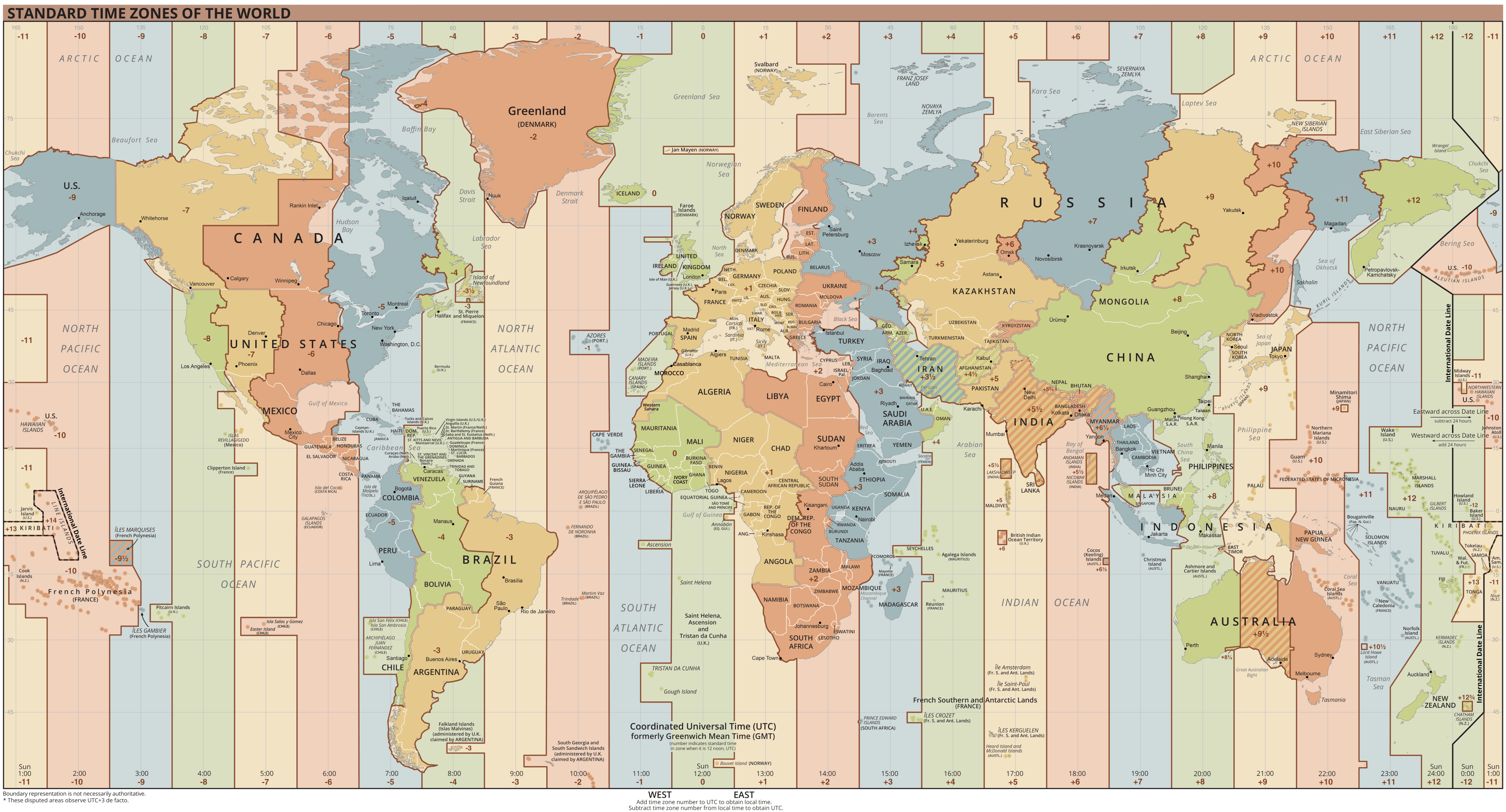
- United Kingdom. The UK mainland uses one time zone. Counting its overseas territories, from Bermuda to the Pitcairn Islands, the total rises to about nine.
- Denmark. Denmark proper uses one zone. Its self-governing territories, the Faroe Islands and Greenland, add several more; Greenland alone spans multiple zones.
- New Zealand. The mainland uses one zone, plus the Chatham Islands on a 45-minute offset. Its outlying territories, including the Ross Dependency in Antarctica, push the total to around five.
- Australia. The mainland alone spans three zones. External territories like Norfolk Island and Christmas Island push the country’s total up to around nine.
- Brazil. Brazil uses exactly four zones, from Fernando de Noronha (UTC-2) to Acre (UTC-5). It has no scattered overseas territories, so the count stops there.
Good to Know.
How the System Works.
Territory, Not Just Landmass, Decides the Count.
- Standard Time Zones. The world is divided into roughly 24 standard time zones, each about 15 degrees of longitude wide, each offset from UTC by whole or half hours.
- Overseas Territories Count. A country’s total is usually counted including its dependencies and overseas territories, not just its contiguous mainland.
- Political Choices Matter. Some large countries choose to use fewer zones than their width would suggest. China, despite spanning about five geographic zones, uses only one official time nationwide.
- Islands Multiply Zones. Countries with scattered island territories, even small ones, often end up with more time zones than much larger but geographically compact countries.
Previous Year Question.
Asked as: “How many of the above countries [United Kingdom, Denmark, New Zealand, Australia, Brazil] have more than four time zones?” This was asked in UPSC CSP 2025, GS Paper I. View this question.
Test Yourself.

Great to Know.
Where the System Came From.
Greenwich and the 1884 Agreement.
- The Prime Meridian. In 1884, the International Meridian Conference fixed the Prime Meridian at Greenwich, England, as the world’s 0-degree reference line.
- Coordinated Universal Time. Every standard time zone today is defined as an offset from Coordinated Universal Time (UTC), which succeeded Greenwich Mean Time as the global reference.
- India’s Single Zone. India, despite spanning nearly 30 degrees of longitude, uses a single time zone, IST (UTC+5:30), based on a reference meridian near Mirzapur, Uttar Pradesh.
- Exam Angle. UPSC has repeatedly tested time zone counts and boundaries, since the topic links physical geography, political geography, and everyday life in one question.
Leave a Reply