Every summer, an area of the Gulf of Mexico roughly the size of a small country loses almost all its oxygen — and almost everything that can’t swim away from it dies.

 MCQ Questions
✅ Must Know
What a dead zone is
- A dead zone is an area of water with too little oxygen for most marine life. Scientists call this condition hypoxia.
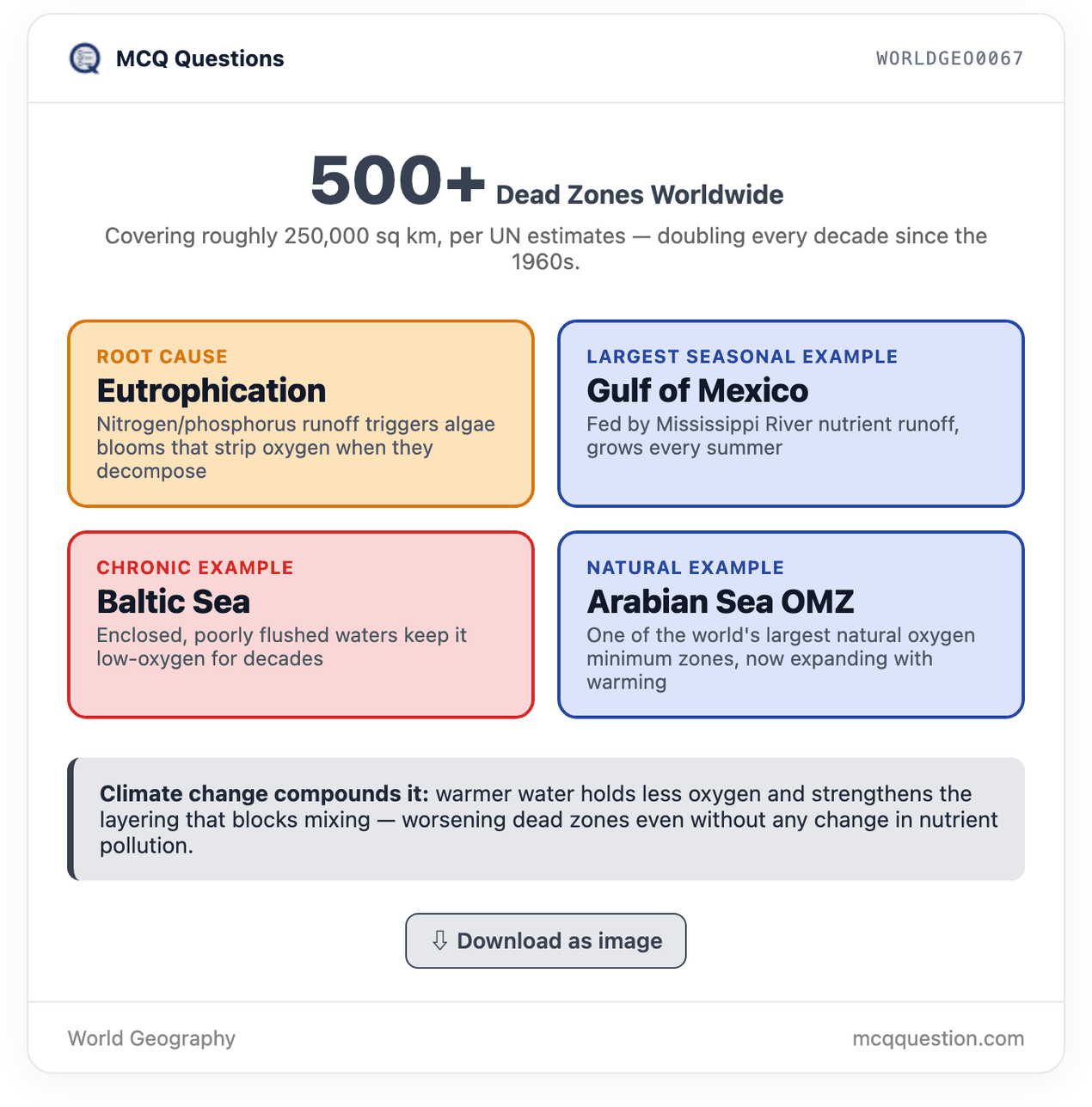
The root cause: eutrophication
- Dead zones form through eutrophication. Excess nutrients, mainly nitrogen and phosphorus, flow into coastal waters from fertilizer runoff and sewage. This triggers explosive algae growth.
How algae growth causes oxygen loss
- When algae blooms die, they sink and decompose. Bacteria breaking them down consume dissolved oxygen. This uses up oxygen faster than it can be replenished.
Scale of the problem
- The United Nations estimates more than 500 dead zones exist worldwide. Together they cover roughly 250,000 square kilometres. Their number has roughly doubled every decade since the 1960s.
💡 Good to Know
Why the bottom water suffers most
- Warm, less salty surface water often sits above cooler, denser water. This layering is called stratification. It blocks oxygen from mixing down, so bottom-dwelling species suffer the worst effects.
Consequences for marine life
- Mobile species like fish can flee an expanding dead zone. Non-mobile bottom species, like crabs, clams, and worms, often cannot escape. Many die en masse instead.
The Gulf of Mexico’s seasonal dead zone
- The Gulf of Mexico hosts one of the world’s largest dead zones. Nutrient runoff carried down the Mississippi River from Midwest farmland feeds it. It grows every summer and shrinks in winter.
The Baltic Sea’s chronic dead zone
- The Baltic Sea is largely enclosed and poorly flushed. This makes it home to one of the world’s largest human-caused dead zones. It persists for decades rather than clearing seasonally.
Test Yourself


🌟 Great to Know
A natural low-oxygen zone in the Arabian Sea
- The Arabian Sea hosts one of the world’s largest natural oxygen minimum zones. This differs from a human-caused dead zone, but is similarly low in oxygen. Warming waters are now intensifying and expanding it further.
Climate change worsens the problem
- Warmer water holds less dissolved oxygen to begin with. Warming also strengthens the stratification that blocks oxygen mixing. Both effects push existing dead zones to grow, even without any change in nutrient pollution.
Economic impact on fisheries
- Dead zones directly cut commercial fish and shellfish catches in affected areas. The species that support these fisheries either flee or die off. Coastal fishing communities bear this cost most directly.
What reduces a dead zone
- Cutting fertilizer runoff through better farming practices helps shrink a dead zone. Upgrading wastewater treatment helps too. Coordinated nutrient-management policies, like the US Gulf of Mexico Hypoxia Task Force, tie these efforts together.
📝 Previous Year Questions
UPSC Mains 2018 GS Paper I, Q7
Beyond the answer
Browse all world-geography topics →
📚 Keep reading
EnvEco0069 — Earth's Oxygen ProductionIntlRel0084 — The Strait of Hormuz and India's Energy SecurityWorldGeo0044 — Why Countries Have Different Numbers of Time ZonesIndGeo0050 — Seismic Zoning of India: Sorting the Country by RiskEnvEco0025 — Coral Reefs and Marine Biodiversity Conservation in India: Four Reef Zones❓ Practice this topic
D0095 — Where and when are small tornadoes most often reported in India?D0094 — Which statement correctly distinguishes a tornado from a tropical cyclone?D0093 — Why do the majority of the world's tornadoes form around the Gulf of Mexico?D0092 — On what basis does the Enhanced Fujita (EF) scale rate the intensity of a tornado?🎲 Take a World Geography Quiz
Leave a Reply