A war that lasted thirty years ended with two treaties, signed in two small German cities. Nearly 400 years later, the world still runs on the idea those treaties introduced: a state’s borders are its own business.

Timeline
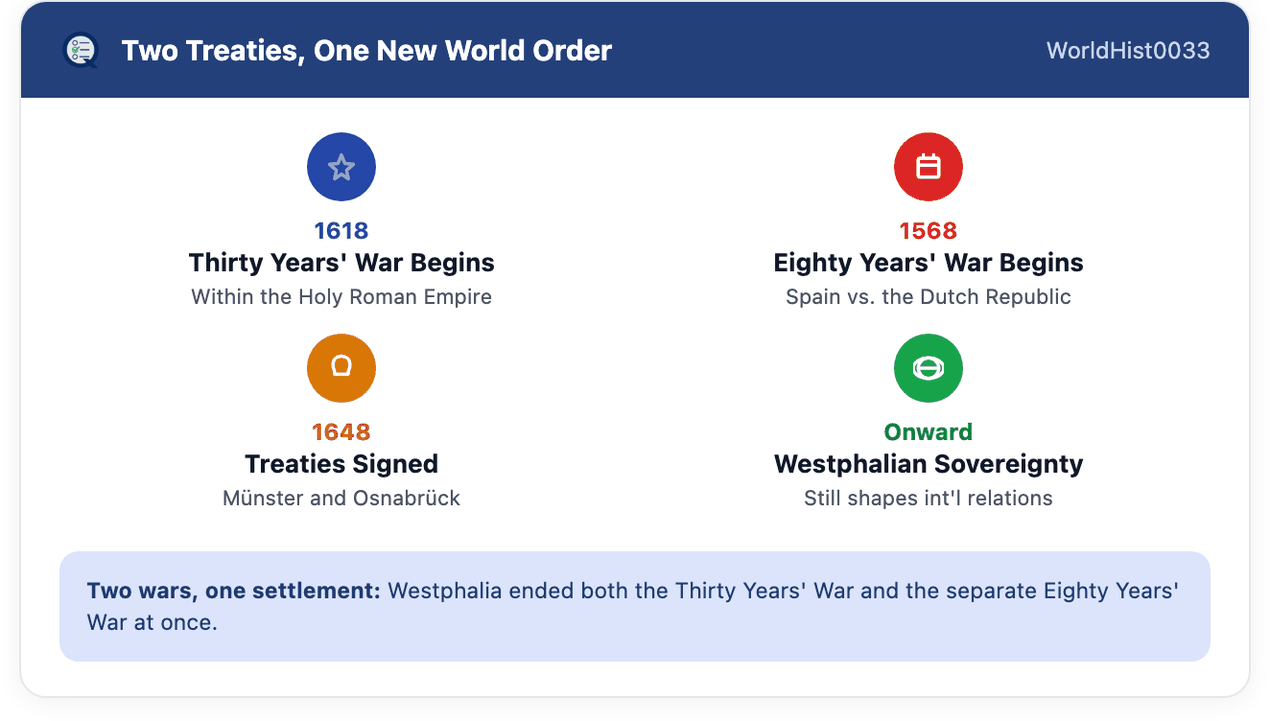
- 1618: The Thirty Years’ War begins within the Holy Roman Empire.
- 1568: The separate Eighty Years’ War begins, between Spain and the Dutch Republic.
- 1648: Treaties are signed at Münster and Osnabrück, together forming the Peace of Westphalia. Both wars end.
- Onward: “Westphalian sovereignty” becomes a foundational concept in the modern international state system.
Must Know
- The Peace of Westphalia is the name for two treaties, signed in 1648 at Münster and Osnabrück, two cities in the Westphalia region of present-day Germany.
- It ended the Thirty Years’ War (1618–1648), fought largely within the Holy Roman Empire. It also ended the separate Eighty Years’ War between Spain and the Dutch Republic, with Spain formally recognising Dutch independence.
- The treaties recognised the exclusive sovereignty of each state over its own territory, people, and foreign relations.
- This gave rise to “Westphalian sovereignty”: the idea that states, regardless of size, have the right to govern themselves without outside interference.
- Many international relations scholars credit the Peace of Westphalia with establishing the modern state system itself.
Good to Know
- Talks at Münster settled peace between the Holy Roman Empire and both France and Spain. Talks at Osnabrück settled peace between the Empire and Sweden.
- The treaties reaffirmed the earlier Peace of Augsburg (1555). They also extended equal legal status to Calvinism, alongside Catholicism and Lutheranism.
- Several territories changed hands. France gained land in Alsace, while Sweden gained Western Pomerania, Bremen, and Verden, becoming a dominant Baltic power.
- The Holy Roman Empire survived the settlement, but emerged weaker and more fragmented. Its individual member states gained the right to form their own treaties and alliances.
- The Habsburg dynasty, ruling both the Empire and Spain, lost significant influence as a result of these changes.
Test Yourself

Great to Know
- The idea that a state’s internal affairs are its own business, first formalised here, shaped centuries of later international relations. See WorldHist0021 — The French Revolution for a later moment when that same principle of sovereignty was tested from within, not between states.
- A single peace settlement rarely ends just one problem. Westphalia closed two separate wars, redrew several borders, and settled a century of religious conflict, all through the same set of negotiations.
Beyond the answer
Browse all world-history topics →
📚 Keep reading
IntlRel0065 — India-Spain RelationsWorldHist0011 — The Peace of Westphalia, 1648: Birth of the Modern State SystemUPSC CDS (I) 2021 — English (Full Question Paper)WorldGeo0047 — European Regions and Their Countries: Mallorca, Normandy, SardiniaLord Wellesley: The Subsidiary Alliance and the Conquest of India❓ Practice this topic
UPSC Mains 2017 GS1 Q4: Decolonization Problems in MalayaUPSC Mains 2016 GS1 Q7: West Africa's Educated-Elite NationalismC9287 — Which statement best describes what made Malaya's 1957 independence unusual compared to most other decolonization cases?C9286 — Malaya's Alliance Party that negotiated independence in 1957 was a coalition of UMNO, the MIC, and which third party?🎲 Take a World History Quiz
Leave a Reply