India’s art heritage spans millennia, from rock-cut temples to living classical traditions.
Safeguarding this heritage is urgent because what is lost can rarely be recovered.


Must Know
What counts as art and cultural heritage
- TANGIBLEIndia’s tangible heritage includes monuments, sculpture, paintings, manuscripts and artefacts.
- INTANGIBLEPerforming arts, crafts, oral traditions, festivals and classical languages form intangible heritage.
- SPANThis heritage stretches over five millennia, from Harappan seals to modern classical art.
- VALUEHeritage carries identity, knowledge and livelihoods for millions of Indians.
The legal framework
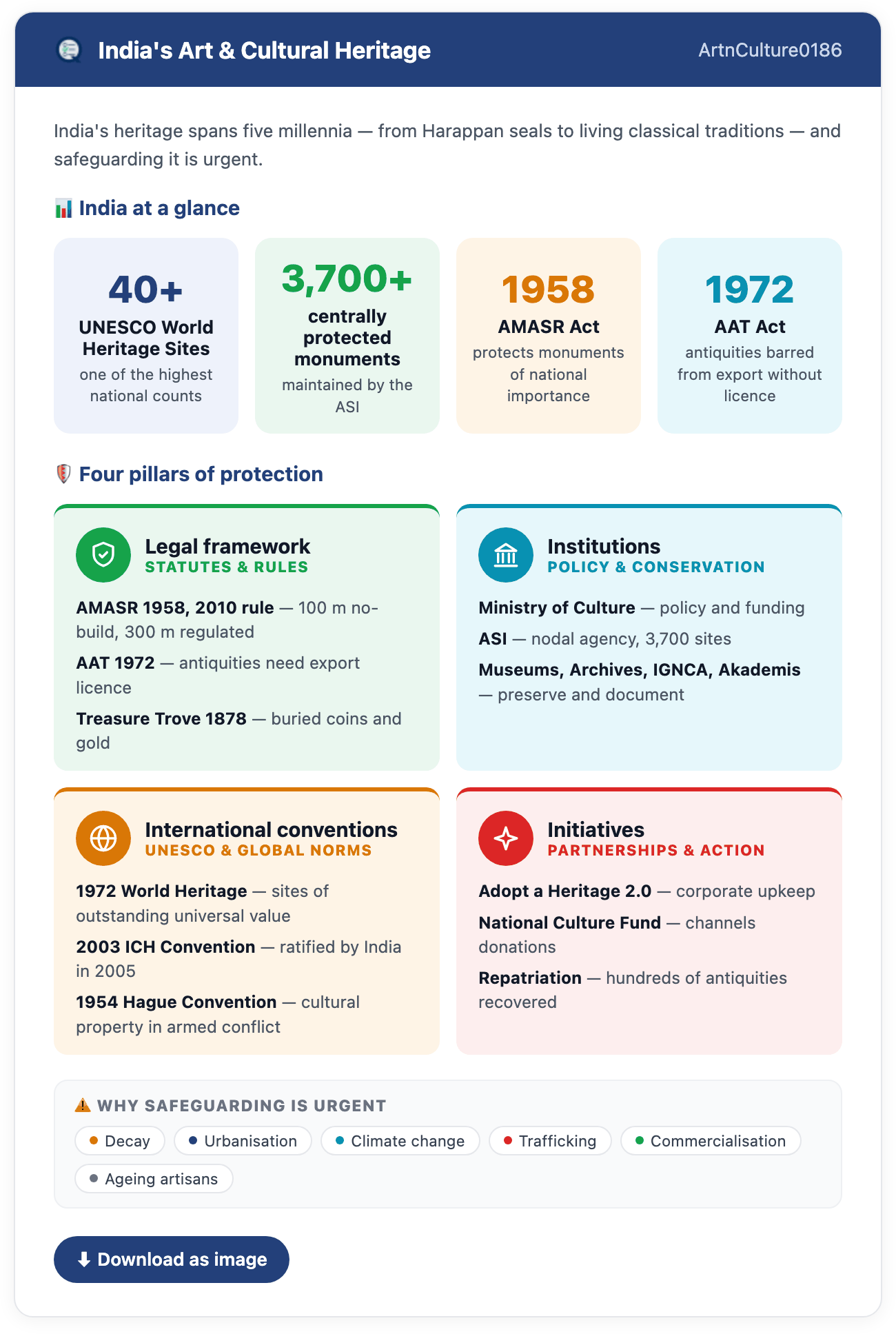
- AMASR 1958The Ancient Monuments and Archaeological Sites and Remains Act, 1958 protects monuments of national importance.
- PROHIBITED ZONEIts 2010 amendment bars construction within 100 metres and regulates work up to 300 metres.
- AAT 1972The Antiquities and Art Treasures Act, 1972 regulates antiquities and bars their export without licence.
- ASIThe Archaeological Survey of India is the nodal agency for survey and conservation.
- TREASURE TROVEThe Treasure Trove Act, 1878 covers valuable objects found buried, like old coins and gold.
- NMMAThe National Mission on Monuments and Antiquities documents India’s monuments and antiquities.
Institutions that safeguard heritage
- MINISTRYThe Ministry of Culture frames policy and funds most heritage institutions.
- ASIASI maintains about 3,700 centrally protected monuments and sites.
- MUSEUMSThe National Museum and the National Archives preserve movable heritage and records.
- IGNCAThe Indira Gandhi National Centre for the Arts documents cultural traditions.
- AKADEMISSangeet Natak, Sahitya and Lalit Kala Akademis nurture performing arts, literature and visual arts.
Good to Know
UNESCO instruments India follows
- 1972 CONVENTIONThe 1972 World Heritage Convention protects sites of outstanding universal value.
- ICH 2003The 2003 Convention safeguards intangible heritage such as rituals, crafts and festivals.
- HAGUE 1954The 1954 Hague Convention protects cultural property during armed conflict.
- RATIFICATIONIndia ratified the 2003 Convention in 2005 and is party to the 1954 Hague Convention.
India’s UNESCO listings
- WORLD HERITAGEIndia holds more than 40 World Heritage Sites, one of the highest national counts.
- RECENT ADDITIONSRecent additions include Jaipur, Dholavira, Ramappa Temple, Santiniketan and the Moidams.
- ICH ELEMENTSThe representative ICH list features Yoga, Kumbh Mela, Navroz, Durga Puja and Garba.
- EARLIER ELEMENTSEarlier inscriptions cover Kutiyattam, Ramlila, Vedic chanting and Kalbelia.
Threats — why safeguarding is urgent
- DECAYAge, neglect and weathering decay unprotected monuments year after year.
- URBANISATIONUrbanisation and encroachment swallow heritage zones around growing cities.
- CLIMATEClimate change brings floods, storms and erosion to heritage sites.
- TRAFFICKINGIllicit trafficking and theft push antiquities out of India illegally.
- COMMERCIALISATIONCommercialisation can commodify living traditions and drain their meaning.
- CRAFTSTraditional craftspeople are ageing while few young artisans take their place.
Test Yourself

Great to Know
Government initiatives
- ADOPT A HERITAGEAdopt a Heritage 2.0 lets corporates fund the upkeep of monuments.
- NATIONAL CULTURE FUNDThe National Culture Fund channels corporate donations into cultural projects.
- CULTURAL MAPPINGThe National Mission for Cultural Mapping is surveying India’s cultural assets.
- KASHI TAMIL SANGAMAMKashi Tamil Sangamam revives civilisational links between North and South India.
- INCREDIBLE INDIAIncredible India campaigns promote heritage tourism across the country.
- REPATRIATIONIndia has recovered hundreds of stolen antiquities from abroad in recent years.
The way forward
- DOCUMENTATIONDigitise manuscripts, monuments and craft knowledge before records decay.
- COMMUNITIESInvolve local bodies and communities in day-to-day monument upkeep.
- TOURISMFund conservation through sustainable and responsible heritage tourism.
- LIVELIHOODSSupport craftspeople with markets, credit and social security.
- AWARENESSTeach heritage appreciation in schools to build a culture of care.
- BALANCEConservation must balance public access with long-term preservation.
Previous Year Questions
2018 Mains — GS Paper I
- MAINS 2018Safeguarding the Indian art heritage is the need of the moment — discuss. (UPSC Mains 2018, GS Paper I, 10 marks)
- ASK“Discuss” needs a balanced answer covering urgency and action, not one-sided praise.
- PLANOpen with what heritage includes, then threats, laws, institutions, initiatives and the way forward.
- TIPName specific Acts, UNESCO conventions and schemes to show command of the topic.
📰 Current Affairs
India’s heritage-safeguarding push is surging through new UNESCO inscriptions and record repatriations of antiquities.
So-What: Garba makes the global register
- ICH 2023 UNESCO inscribed Garba of Gujarat in December 2023 as India’s 15th intangible cultural heritage element. Source: PIB — Ministry of Culture.
So-What: Deepavali joins the list
- ICH 2025 Deepavali was inscribed on 10 December 2025 at New Delhi’s Red Fort, becoming India’s 16th element on the UNESCO list. Source: PIB — Ministry of Culture.
So-What: Moidams lift the World Heritage tally
- WH Site 2024 Assam’s Moidams, the Ahom mound-burial system, became India’s 43rd World Heritage Site in July 2024, inscribed at the 46th committee session India hosted. Source: PIB — Ministry of Culture.
So-What: Stolen heritage returns home
- Repatriation In September 2024 the United States returned 297 trafficked antiquities to India under a new cultural property pact. Source: PIB — Prime Minister’s Office.
📚 Related Articles
Beyond the answer
Browse all art-and-culture topics →
📚 Keep reading
GK0004 — Monuments of IndiaUPSC CSP 2018 — General Studies Paper I (Full Question Paper)UPSC CSP 2017 — General Studies Paper I (Full Question Paper)UPSC CSP 2020 — General Studies Paper I (Full Question Paper)IntlRel0156 — UNESCO Funding Crisis: Cash, Politics and the US Withdrawal❓ Practice this topic
Which Sikh Guru compiled the Guru Granth Sahib, giving Sikhism its fixed central scripture?The Third Buddhist Council, held at Pataliputra under Emperor Ashoka, was presided over by which elder, who also compiled the Kathavatthu?Which self-taught Bengal School painter, sister of Abanindranath Tagore, developed her own folk-influenced style distinct from the movements formal academic training?British colonial authorities restricted or banned the public singing of certain nationalist songs during the freedom struggle. What does this show?🎲 Take a Art And Culture Quiz
Leave a Reply