Two kings became friends without ever meeting. They only exchanged gifts and letters. One of them was Ashoka. This article covers his reach far beyond India’s own borders.


Timeline
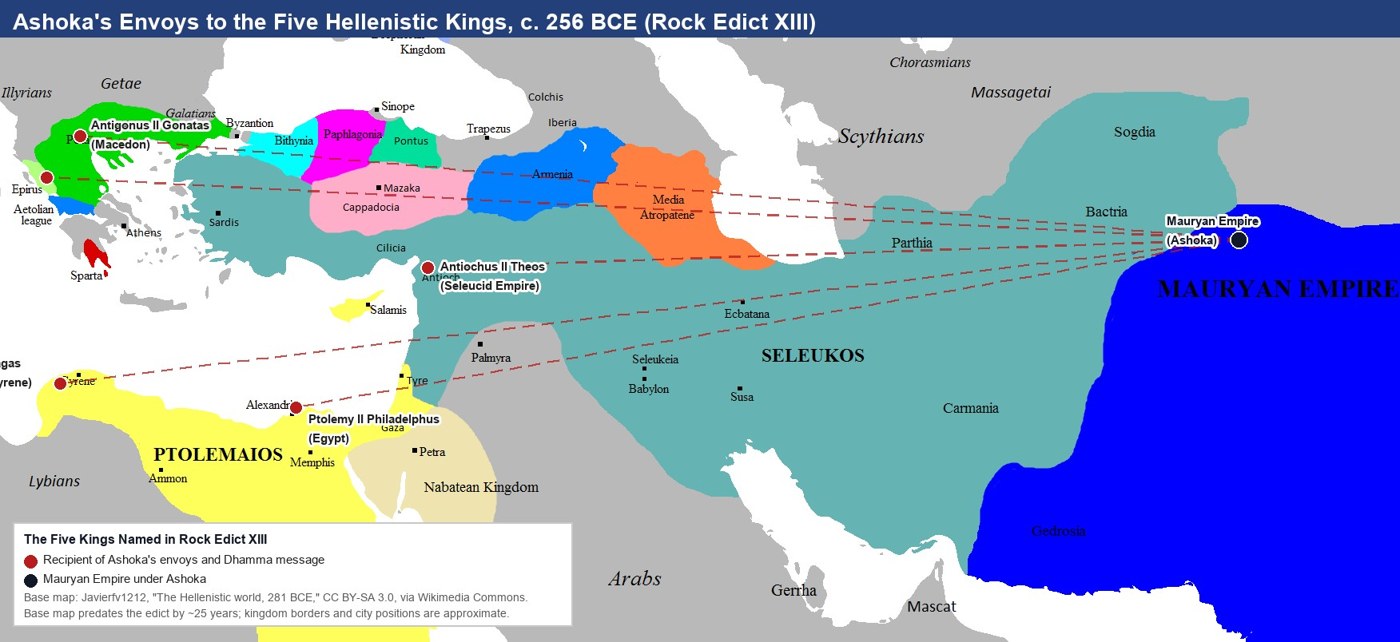
- C. 256 BCE: Ashoka’s Rock Edict XIII names five Hellenistic kings who received his envoys and message of Dhamma.
- Before Mahinda’s mission: Ashoka and Devanampiya Tissa of Sri Lanka build a friendship through exchanged gifts, without ever meeting.
- C. 250 BCE, per later tradition: Ashoka convenes the Third Buddhist Council. Elder Moggaliputta Tissa organises missions to lands beyond India.
- Same tradition: Missionaries Sona and Uttara sail to Suvarnabhumi, reaching Southeast Asia.
The Five Hellenistic Kings Need to Know
- Ashoka’s Rock Edict XIII names five Hellenistic kings as recipients of his Dhamma message: Antiochus II Theos of the Seleucid Empire, Ptolemy II Philadelphus of Egypt, Antigonus II Gonatas of Macedon, Magas of Cyrene, and Alexander II of Epirus.
- This wasn’t a cold opening. Ashoka’s grandfather, Chandragupta Maurya, had already made peace with the Seleucid king Seleucus I Nicator two generations earlier. Friendly relations, including the ambassador Megasthenes, continued in the decades between. See AncHist0057 — Greeks in India Immediately After Alexander: Seleucus Nicator.
- Naming five Hellenistic kings by name in a public inscription was itself a political statement. It projected Mauryan influence as comparable to the era’s major western powers.
- Rock Edict XIII survives at several sites, including the Kalsi Rock shown above. For the edicts as inscriptions in their own right, see AncHist0069 — Ashokan Edicts as Inscriptions: Script, Language and Decipherment, and for Ashoka’s own reign, see AncHist0014 — Ashoka and His Edicts.
Sri Lanka and the Missions East Good to Know
- Ashoka sent an embassy of ministers bearing gifts to Devanampiya Tissa, king of Sri Lanka. His message urged Tissa to take refuge in the Buddha, before his own son Mahinda later led the formal mission.
- Tradition holds that Ashoka conferred the honorary title “Devanampiya” (“beloved of the gods”) on Tissa. This comes from the Mahavamsa chronicle tradition, not a settled historical fact. Ashoka also used the same title for himself in his own edicts.
- Tissa’s existing friendship with Ashoka likely helped. Mahinda’s mission came from a familiar ally’s own son, not a stranger.
- The Third Buddhist Council, held around 250 BCE at Pataliputra under Ashoka’s patronage, comes from the same later Theravada chronicle tradition. Some historians have questioned this account’s historicity, since it isn’t corroborated in Ashoka’s own contemporary edicts.
- That same tradition credits missionaries Sona and Uttara with reaching Suvarnabhumi in Southeast Asia, following the Council.
Test Yourself



Two Foreign Policies at Once Great to Know
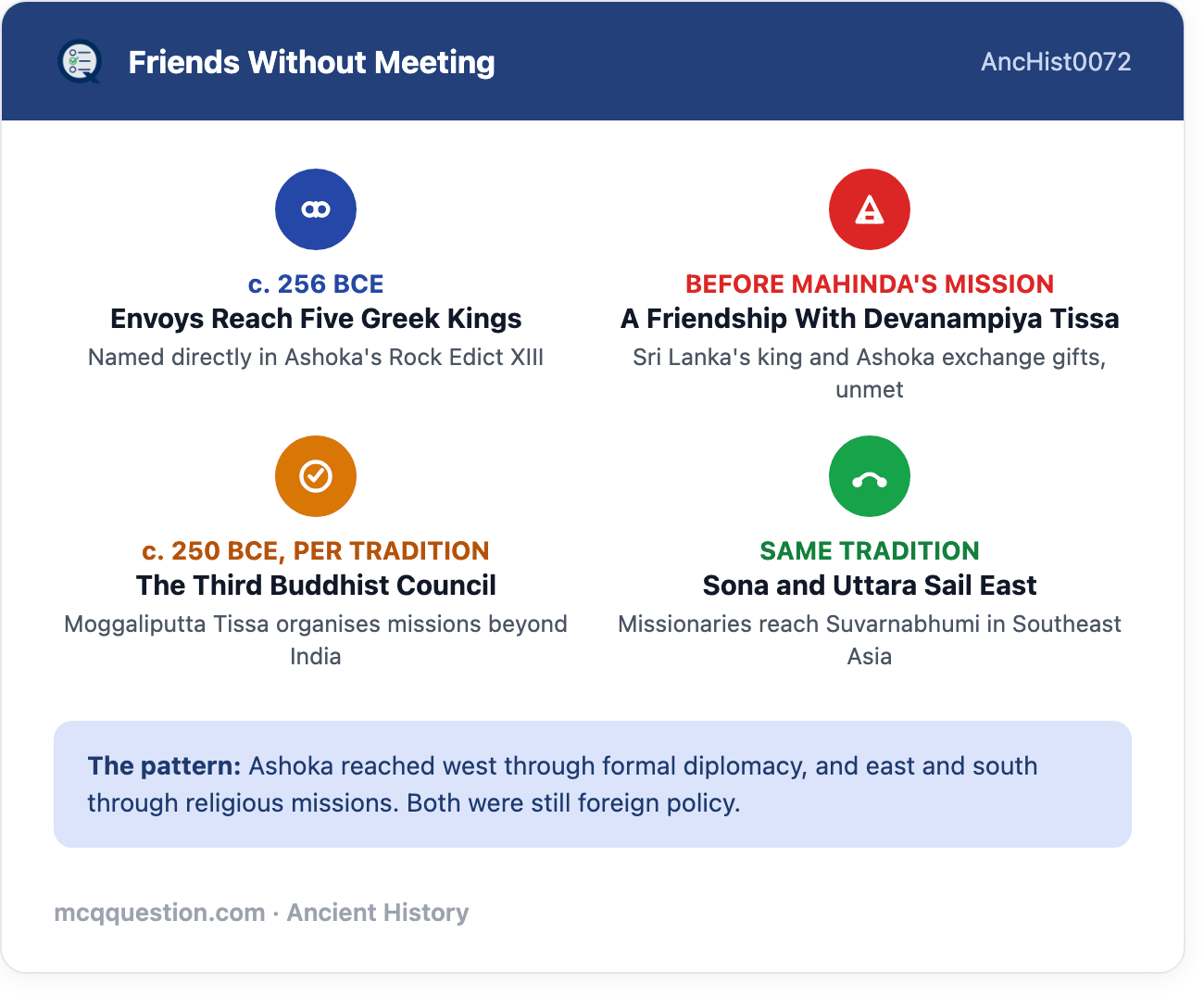
- Ashoka ran two foreign-policy tracks at once. Formal diplomatic embassies reached the Hellenistic west. Religious missions carried his influence east and south instead.
- A friendship built entirely on gifts and messages, with no face-to-face meeting, still counted as a real political bond. Intermediaries and correspondence could do that work alone.
- The standard account holds that Ashoka’s approach shifted after the brutal Kalinga War, from military conquest toward Dhamma, or moral and religious outreach. That framing comes from Ashoka’s own edicts, which he alone controlled, so treat it as his own self-presentation as much as settled history.
- Ashoka reached Southeast Asia early, well before major India-Southeast Asia trade networks matured, at least according to the Theravada mission tradition. His religious ambitions moved faster than the region’s later commercial ties.
Beyond the answer
Browse all ancient-indian-history topics →
📚 Keep reading
AncHist0014 — Ashoka and His EdictsAncHist0069 — Ashokan Edicts as Inscriptions: Script, Language and DeciphermentAncHist0001 — Sources of Ancient Indian History: Archaeology and EpigraphyAncHist0103 — SatiyaputtaJames Prinsep and the Decipherment of Ashoka's Edicts❓ Practice this topic
James Burgess founded a journal in 1872, and later served as Director General of the Archaeological Survey of India from 1886 to which year?Alexander Rea first excavated Amaravati in 1888–89. In which year did he go on to become the first Superintendent of the Archaeological Survey of Southern India?Robert Sewell's 1900 book “A Forgotten Empire” is a history of which South Indian empire, drawn from two Portuguese travellers' accounts?A.H. Longhurst's excavations from 1926 to 1931 uncovered a great stupa and several smaller structures at which site?🎲 Take a Ancient Indian History Quiz
Leave a Reply