Colostrum, the thick first milk a mother produces after birth, is sometimes called a baby’s first vaccine. It’s packed with antibodies a newborn has no other way to get. World Breastfeeding Week exists to make sure that milk, and the six months of feeding that follow it, never gets skipped.
 MCQ Questions
CA0077
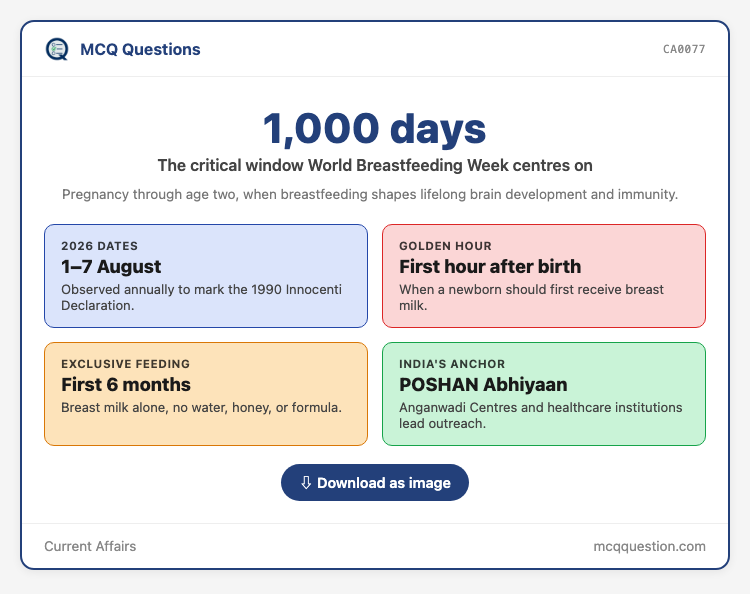
1,000 days
The critical window World Breastfeeding Week centres on
Pregnancy through age two, when breastfeeding shapes lifelong brain development and immunity.
2026 dates
1–7 August
Observed annually to mark the 1990 Innocenti Declaration.
Golden Hour
First hour after birth
When a newborn should first receive breast milk.
Exclusive feeding
First 6 months
Breast milk alone, no water, honey, or formula.
India’s anchor
POSHAN Abhiyaan
Anganwadi Centres and healthcare institutions lead outreach.
Current Affairsmcqquestion.com
Must Know
- World Breastfeeding Week 2026 runs from 1 to 7 August. This year’s theme is “Breastfeeding for a Sustainable Start in Life: Strengthen What Works.”
- In India, the Ministry of Women and Child Development carries the observance forward under POSHAN Abhiyaan. Anganwadi Centres, healthcare institutions, and community outreach platforms anchor awareness activities across the week (Source: PIB, 5 August 2026).
- The campaign centres on a child’s “first 1,000 days”: pregnancy, plus the first 24 months after birth. This window shapes brain development, immunity, and lifelong wellbeing.
- Newborns should receive breast milk within the first hour of birth, called the Golden Hour. Colostrum, the first milk produced, is rich in antibodies and is often called the infant’s first vaccine.
- Exclusive breastfeeding is recommended for the first six months. This means breast milk only, with no water, honey, ghutti, glucose, or formula milk given alongside it.
- From six months, age-appropriate complementary foods should be introduced. Breastfeeding itself should continue to age two and beyond.
Good to Know
- World Breastfeeding Week is a global observance, coordinated by the World Alliance for Breastfeeding Action (WABA), formed in 1991. The first World Breastfeeding Week was observed in 1992.
- The 1-7 August dates mark the anniversary of the 1990 Innocenti Declaration. WHO and UNICEF adopted it in Florence, Italy, urging governments worldwide to protect, promote, and support breastfeeding.
- Mothers are guided on correct positioning and attachment, and encouraged to feed on demand. Anganwadi Workers and ASHA workers offer support whenever difficulties arise.
- Working mothers are counselled on expressing and safely storing breast milk. This lets feeding continue uninterrupted even after they return to work.
- Breastfeeding benefits mothers too. It supports postpartum recovery, and lowers the risk of breast and ovarian cancers, type-2 diabetes, and postpartum depression. (Source: PIB)
- India’s broader nutrition tracking now runs through Poshan Tracker, a digital app monitoring child nutrition outcomes. See IndGov0005 — Welfare Schemes for Children for its full details.
Test Yourself
Question 1 of 1
Great to Know
- The “first 1,000 days” framing treats pregnancy and early infancy as a single continuous window, not two separate health issues. This reflects a broader shift in nutrition policy: intervening early and continuously matters more than treating malnutrition after it’s already set in.
- Calling colostrum a “first vaccine” is a useful simplification, not just a slogan. Its antibody-rich composition gives a newborn passive immune protection before their own immune system has had time to develop it independently.
- The Golden Hour recommendation and the emphasis on skin-to-skin contact point to a broader principle in newborn care: the earliest possible intervention, even in the first sixty minutes of life, can have outsized long-term effects compared to equivalent care given even a few hours later.
Was this helpful?
Leave a Reply