India has a closing window, not a permanent advantage. Its working-age population share peaks around 2041. After that, the same demographic math starts working in reverse. This article covers India’s demographic dividend, and the fertility shift that created it.

Timeline
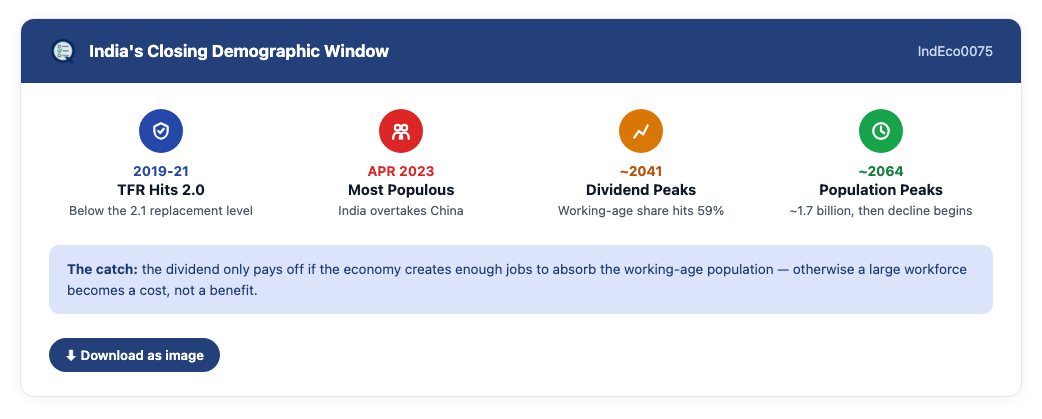
- 2019-21 (NFHS-5): India’s Total Fertility Rate falls to 2.0 children per woman, below the 2.1 replacement level.
- April 2023: India surpasses China to become the world’s most populous country, per the UN.
- 2041 (projected): India’s demographic dividend is expected to peak, with the working-age (20-59) share hitting 59%.
- 2064 (projected): India’s population is expected to peak near 1.7 billion, before beginning to decline.
📈 The Core Numbers
Population and Fertility
- Most Populous India became the world’s most populous country in April 2023, surpassing China, according to the United Nations.
- TFR The Total Fertility Rate is the average number of live births a woman would have by the end of her child-bearing age. It assumes current age-specific fertility rates hold throughout her life. India’s TFR fell to 2.0 children per woman (NFHS-5, 2019-21), below the replacement level of 2.1.
- Demographic Dividend Refers to the economic growth potential from a large working-age population relative to dependents.
- Dividend Peak India’s demographic dividend is expected to peak around 2041, when the working-age (20-59 years) population share hits 59%.
📈 Trends and Comparisons
Where India Stands
- Dependency Ratio The non-working-age population relative to the working-age population has been falling for decades. It is projected to keep falling through the 2020s and 2030s.
- Population Peak Under the UN’s medium-variant projection, India’s population keeps growing until around 2064, peaking near 1.7 billion, before it starts to decline.
- Median Age India’s median age is around 29-30 years. That’s much younger than China’s or most developed economies’, underpinning the demographic-dividend argument.
- Historical Fall Fertility has fallen sharply over the decades, from 5.9 births per woman in 1951 to 2.0 today.
Test Yourself

🌟 The Catch
Whether the Dividend Actually Pays Off
- Age Before Rich? Some researchers warn India “could age before it becomes rich.” The dividend only pays off if enough jobs and skills-training exist to absorb the working-age entrants. A large workforce without enough jobs is a cost, not a dividend.
- Uneven Across States The dividend isn’t experienced uniformly across India. States like Kerala and Tamil Nadu are aging faster, closer to their own dividend’s end. States like Uttar Pradesh and Bihar are still much younger, with more runway left.
- A Finite Window Once dependency ratios start climbing again after 2041, the opportunity doesn’t return — which is why “use it before it closes” dominates the policy conversation around this topic.
- Related For the job-market side of this challenge, whether the economy can actually absorb this workforce, see IndEco0019 — Unemployment Types and the Employment Challenge.
Previous Year Question
Asked as: “The total fertility rate in an economy is defined as.” (UPSC CSP 2024, GS Paper I). View this question.
Beyond the answer
Browse all indian-economy topics →
📚 Keep reading
IndGov0009 — Human Resource Development and the Demographic DividendIndSoc0081 — Population Education: Objectives and Measures in IndiaUPSC CSP 2022 — General Studies Paper II (CSAT) (Full Question Paper)IndSoc0040 — Depopulation and South Asian Demographic ComparisonsIndSoc0038 — Census 2011: India's Population Data and the Population Pyramid❓ Practice this topic
Per capita income can rise while inequality also rises because:Which ministry oversees the National Statistical Office (NSO) that publishes India's national income data?Why is it important to note the base year when comparing GDP figures across different time periods?Which of the following best distinguishes GDP from GNP?🎲 Take a Indian Economy Quiz
Leave a Reply