Environment and Ecology · EnvEco0218
Air Pollution in India
Air pollution is harmful particles or gases in the air we breathe. The source may be outdoors or inside a home.
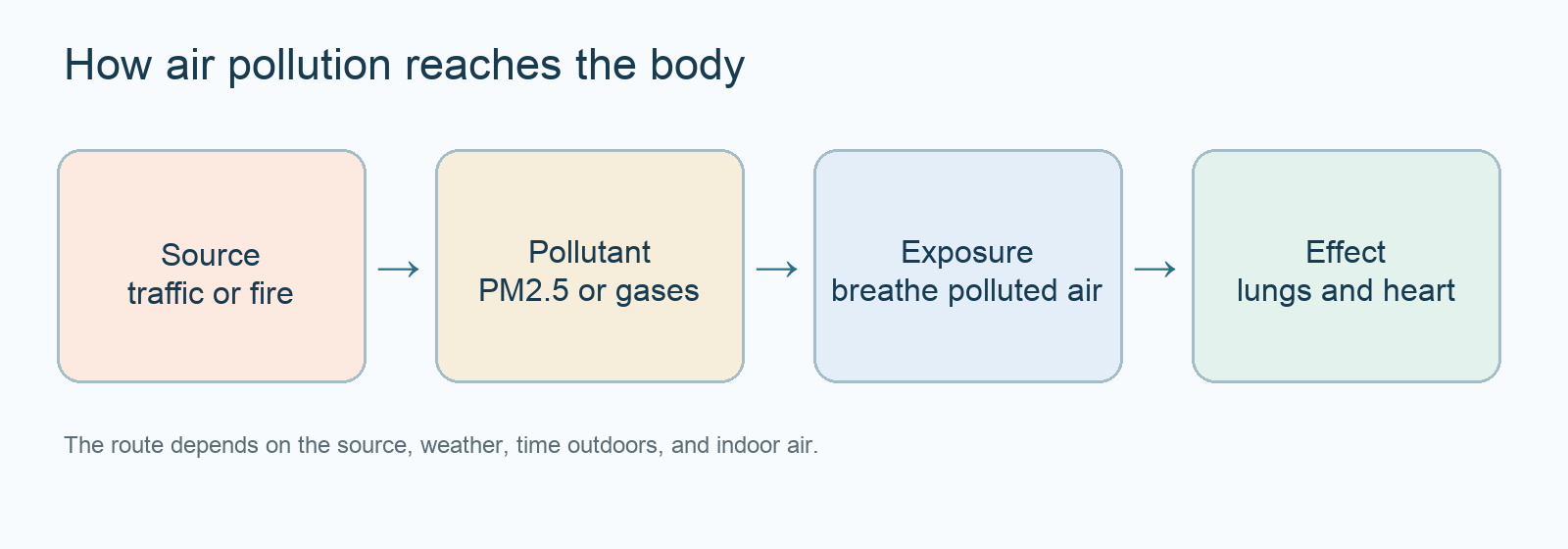
The route matters: source → pollutant → exposure → effect. Cleaner air needs action at the source.


Must Know: Where Pollutants Come From
1. Primary and secondary pollutants
Primary A primary pollutant enters the air directly. Smoke particles and carbon monoxide from burning are examples.
Secondary A secondary pollutant forms later through reactions in the air. Sunlight helps nitrogen oxides and other gases form ground-level ozone.
Gases can also react to form fine particles. Cutting a source can therefore reduce more than one pollutant.
2. Outdoor and indoor air are connected
Vehicles, industry, power plants, construction, road dust, and burning add to outdoor pollution. Their shares differ by place and season.
Cooking with polluting fuels, tobacco smoke, and poor ventilation can worsen indoor air. Outdoor pollution can enter buildings too.
Clean cooking and smoke-free rooms protect households. They do not replace citywide controls on emissions.
QUICK CHECK 1 OF 4 · TRUE OR FALSE
Ground-level ozone is always released straight from a vehicle’s exhaust pipe.
Ground-level ozone forms in air when precursor gases react in sunlight. It is a secondary pollutant.
Show answer
False. Ground-level ozone forms after gases react in sunlight.
The Major Particles and Gases
3. Particles: PM10 and PM2.5
PM means particulate matter, or tiny pieces of solid and liquid material in air. The number describes the particle’s maximum width in micrometres.
PM10 is at most 10 micrometres wide. PM2.5 is at most 2.5 micrometres wide.
Fine particles can travel deep into the lungs. Exposure also raises risks for the heart and blood vessels.
4. Six gases and one metal to recognise
Burning sulphur-containing fuel releases it. It irritates airways and helps form particles and acid rain. Read the SO2 lesson.
Traffic and combustion release these gases. Nitrogen dioxide is one member. They help form ozone and particles.
Incomplete burning produces this gas. It lowers the blood’s ability to carry oxygen.
Sunlight helps create it from precursor gases. It can irritate lungs and damage plants. It differs from protective ozone high above Earth.
Lead can enter air from some industrial activities. It can harm the nervous system, especially in children.
Agriculture and waste can release it. It can react with other gases to form fine particles.
These are not the only pollutants. They are useful starting points for reading Indian air-quality reports.
Weather, time outdoors, and indoor air can change exposure.
Open or download the static infographic (PNG).
QUICK CHECK 2 OF 4 · TRUE OR FALSE
PM2.5 names particles at most 2.5 micrometres wide, not one particular chemical.
PM2.5 is a size group. Its chemical mix changes with sources and reactions in the air.
Show answer
True. PM2.5 describes size, not one chemical.
Good to Know: How Exposure Causes Harm
5. Source to body: three examples
- Diesel exhaust: Burning releases gases and particles. People breathe them near roads. Fine particles can reach deep lung tissue.
- Cooking smoke: Solid fuels pollute indoor air. People near the stove may breathe smoke for long periods.
- Sunny-day ozone: Precursor gases react outdoors. Ground-level ozone then irritates the airways.
Exposure can worsen asthma and breathing problems. Long-term exposure also raises risks of heart disease, stroke, and lung cancer.
Children, older adults, pregnant people, and people with existing illness may need extra protection.
6. Beyond human health
Ozone can damage leaves and reduce plant growth. Sulphur and nitrogen compounds can contribute to acid rain.
Particles can lower visibility and soil buildings. These effects do not replace health concerns; they add to them.
India: Sources Change With Place and Season
7. Why winter haze can linger
In the Indo-Gangetic Plain, winter haze can mix traffic, industry, household smoke, dust, and seasonal farm fires.
A temperature inversion holds cooler air below warmer air. This slows mixing and can trap pollutants near the ground.
A sunny, warmer day can raise ozone even when winter particle levels ease. Local measurements matter more than one national picture.
See the separate lessons on crop-residue smoke and photochemical smog.
Indo-Gangetic Plain → winter stagnation can worsen haze. Sunny regions → ozone can form when precursor gases react.
Pollution levels vary within each region and across days. A fixed shaded map would mislead.
AQI, WHO Guidance, and India’s Standards
8. AQI is an index, not a pollutant
India’s Air Quality Index (AQI) turns measured pollution into an easy-to-read health category. Higher numbers mean worse reported air quality.
Its framework has breakpoints for eight pollutants: PM10, PM2.5, NO2, SO2, CO, O3, NH3, and lead.
The reported AQI depends on available monitoring data. It is not the same thing as a single PM2.5 concentration.
Read which gases India’s AQI tracks for the full calculation and exam traps.
9. WHO advice versus Indian legal standards
The World Health Organization (WHO) sets health-based air-quality guidelines. India’s National Ambient Air Quality Standards (NAAQS) set national outdoor-air limits.
For annual PM2.5, WHO’s 2021 guideline is 5 micrograms per cubic metre. India’s notified NAAQS value is 40 in the same units.
Both numbers refer to a year’s average. Do not compare one day’s reading with an annual limit.
A legal standard does not mark a risk-free line. Read the WHO air-quality guideline lesson for the detailed comparison.
QUICK CHECK 3 OF 4 · TRUE OR FALSE
An AQI number is the same measurement as an annual PM2.5 concentration.
AQI combines pollutant sub-indices into a health category. Annual PM2.5 is one pollutant’s year-long average concentration.
Show answer
False. AQI and annual PM2.5 use different scales and purposes.
Control Air Pollution at the Source
10. Law, regulators, and the city programme
The Air (Prevention and Control of Pollution) Act, 1981 creates a framework for preventing and controlling air pollution.
The Central Pollution Control Board (CPCB) and state pollution boards monitor and regulate air pollution. Read the CPCB lesson for their roles.
The National Clean Air Programme (NCAP) began in 2019. Its city plans target lower particulate pollution and better air management.
Its stated target was up to a 40% cut in PM10 by 2025–26 against 2017–18, or meeting standards. Read the NCAP lesson for changing progress data.
11. Match each source with a useful control
- Homes: Use cleaner cooking fuels, ventilation, and smoke-free rooms.
- Transport: Improve public transport and vehicle emissions control. Avoid needless idling.
- Industry and power: Control stack particles and sulphur emissions. Monitor equipment and enforce limits.
- Roads and worksites: Control loose dust at construction sites and along roads.
- Farms and waste: Support crop-residue alternatives and stop open waste burning. Manage fertiliser to limit ammonia losses.
Some pollution also affects climate. The Climate and Clean Air Coalition focuses on short-lived climate pollutants.
12. What a person can do, and what needs policy
Check local AQI before long outdoor exercise. Follow health advice when pollution is high, especially if you are at risk.
Reducing indoor smoke can help at home. One household cannot clean a city by itself.
Cleaner fuel, public transport, industrial controls, waste services, and enforcement need coordinated public action.
QUICK CHECK 4 OF 4 · TRUE OR FALSE
Cleaner household cooking helps, but citywide pollution also needs transport, industry, and waste controls.
Indoor and outdoor sources both matter. Public systems must cut emissions across sectors.
Show answer
True. Household action helps, while citywide cuts need coordinated controls.
Sources and Official Records
- WHO: types of pollutants and health effects.
- WHO: household air pollution.
- WHO: 2021 global air-quality guidelines.
- CPCB: notified 2009 National Ambient Air Quality Standards.
- CPCB: About India’s Air Quality Index.
- India Code: Air (Prevention and Control of Pollution) Act, 1981.
- Ministry of Environment: NCAP target and scope.
- NASA: winter haze over the Indo-Gangetic Plain.
Practice These Ideas
Try the four checks above, then answer a full multiple-choice question below.
Answer the quick checks throughout this lesson to see your score.
Loading practice…
Beyond the answer
Browse all environment-and-ecology topics →
📚 Keep reading
EnvEco0143 — Which Gases India's Air Quality Index TracksEnvEco0017 — Ozone Layer ProtectionCommon Air Pollutants from Fuel and Waste Burning: Five PYQ Facts ComparedEnvEco0212 — Photochemical Smog and the 1999 Gothenburg ProtocolEnvEco0052 — Central Pollution Control Board (CPCB)❓ Practice this topic
C9403 — In the context of WHO Air Quality Guidelines, consider: 1. The 24-hour mean of PM2.5 should not exceed 15 ug/m3 and annual mean should not exceed 5 ug/m3. 2. Ozone pollution peaks during inclement weather. 3. PM10 can penetrate the lung barrier and enter the bloodstream. 4. Excessive ozone can trigger asthma. Which are correct?C9405 — During which weather conditions does ozone pollution typically reach its highest levels in a year?B1323 — Roughly what share of controlled ozone-depleting substances has been phased out worldwide, thanks to the Montreal Protocol?C8437 — Which one of the following is associated with the issue of control and phasing out of the use of ozone-depleting substances?🎲 Take a Environment And Ecology Quiz
Leave a Reply