Years before Norman Borlaug‘s dwarf wheat reached India, one Indian scientist had already beaten a different enemy of wheat. He made it resistant to rust.
 MCQ Questions
GenSci0029
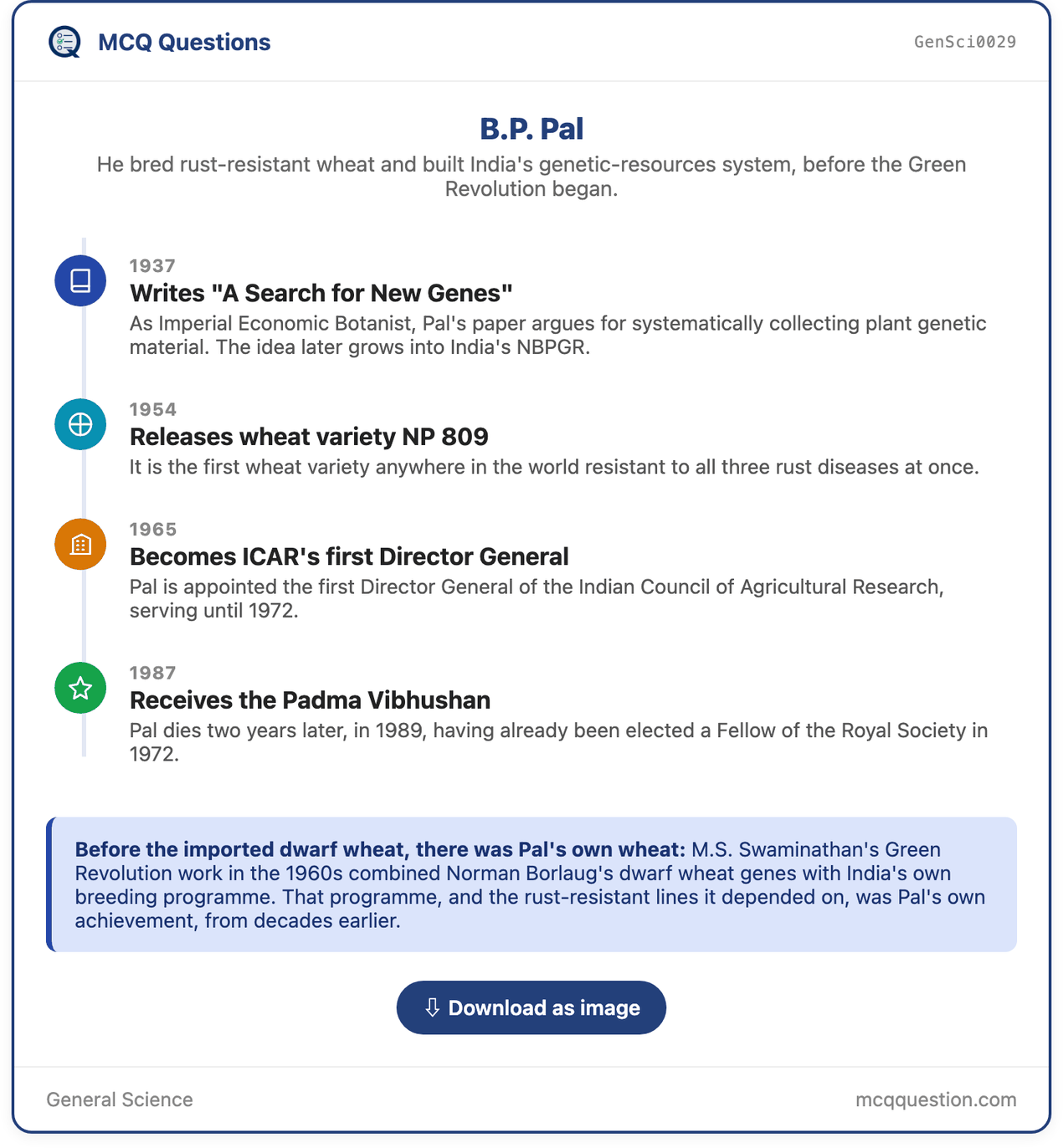
B.P. Pal
He bred rust-resistant wheat and built India’s genetic-resources system, before the Green Revolution began.
1937
Writes “A Search for New Genes”
As Imperial Economic Botanist, Pal’s paper argues for systematically collecting plant genetic material. The idea later grows into India’s NBPGR.
1954
Releases wheat variety NP 809
It is the first wheat variety anywhere in the world resistant to all three rust diseases at once.
1965
Becomes ICAR‘s first Director General
Pal is appointed the first Director General of the Indian Council of Agricultural Research, serving until 1972.
1987
Receives the Padma Vibhushan
Pal dies two years later, in 1989, having already been elected a Fellow of the Royal Society in 1972.
Before the imported dwarf wheat, there was Pal’s own wheat: M.S. Swaminathan‘s Green Revolution work in the 1960s combined Norman Borlaug’s dwarf wheat genes with India’s own breeding programme. That programme, and the rust-resistant lines it depended on, was Pal’s own achievement, from decades earlier.
General Sciencemcqquestion.com
Must Know
- Benjamin Peary Pal was born on 26 May 1906, in Mukandpur, Punjab.
- He earned a BSc and MSc in Botany from Rangoon University, then a PhD from Cambridge, studying wheat genetics.
- In 1937, he became Imperial Economic Botanist and published “A Search for New Genes,” calling for systematic collection of plant genetic material.
- In September 1950, he became the first Indian Director of the Indian Agricultural Research Institute (IARI), New Delhi.
- In 1954, his team released NP 809, the first wheat variety anywhere resistant to all three rust diseases at once.
- In 1965, he became the first Director General of the Indian Council of Agricultural Research (ICAR), serving until 1972.
- He died on 14 September 1989, aged 83.
Good to Know
- Pal’s 1937 push to collect and preserve plant genetic material grew, over decades, into what became the National Bureau of Plant Genetic Resources (NBPGR) in 1976-77.
- He also founded the Indian Society of Genetics and Plant Breeding, and served as editor of its journal.
- He founded the Rose Society of India and the Bougainvillea Society of India, reflecting a parallel interest in ornamental plant breeding.
- In 1972, he was elected a Fellow of the Royal Society (FRS).
- He received the Padma Shri in 1959, the Padma Bhushan in 1968, and the Padma Vibhushan in 1987.
- A rose garden at IARI’s library in New Delhi honours his legacy today.
Test Yourself

Great to Know
- Don’t confuse Pal’s era with the Green Revolution itself. Pal’s rust-resistant wheat breeding ran from the 1930s to the 1950s, well before M.S. Swaminathan’s own 1960s work with Borlaug’s imported dwarf wheat varieties.
- The two contributions were different, and complementary. Pal supplied disease-resistant genetics and institutional infrastructure, built over decades. Swaminathan then combined that base with the high-yield dwarf trait, to trigger the Green Revolution itself.
- Pal’s interest in genetics was not limited to food crops. He bred ornamental roses and bougainvillea too, and founded dedicated societies for both, alongside his wheat-breeding career.
Beyond the answer
Browse all general-science topics →
📚 Keep reading
IndEco0097 — Wheat Cultivation in IndiaUPSC CSP 2020 — General Studies Paper I (Full Question Paper)IntlRel0025 — PM Modi's Foreign VisitsUPSC CSP 2019 — General Studies Paper I (Full Question Paper)SciTech0070 — M.S. Swaminathan: Father of India's Green Revolution❓ Practice this topic
Besides livestock cloning, what is SCNT technology also being explored for?Roughly how many SCNT attempts did it take to produce Dolly the sheep as a live birth?Which animal was the first mammal successfully cloned via Somatic Cell Nuclear Transfer?In Somatic Cell Nuclear Transfer, what happens to the nucleus of the egg cell used?🎲 Take a General Science Quiz
Leave a Reply