AIIMS trains health staff, carries out research and treats patients. AIIMS New Delhi became a model for new AIIMS across India. Start with its founding law. Then ask how new AIIMS grow and when their wards open.
How did AIIMS begin?
A recommendation, a foundation stone and a law
The Health Survey and Development Committee is also called the Bhore Committee. Its 1946 report called for a health centre to train skilled teachers and research staff.
Rajkumari Amrit Kaur supported the project as India’s Health Minister. A New Zealand grant under the Colombo Plan helped fund the building work. The foundation stone was laid in 1952. The Colombo Plan had begun operations on 1 July 1951.
An Act of Parliament established AIIMS in 1956 as an autonomous institution of national importance. The Act is dated 2 June 1956. The stone was laid first. The law came four years later.
AIIMS New Delhi is located in Ansari Nagar. The grant did not make AIIMS a foreign college. An Indian law gave AIIMS its powers.
Sources: AIIMS history · AIIMS Act · UK Parliament record.
Why combine teaching, research and care?
AIIMS was meant to show other colleges how to teach medicine well. It would train doctors. It would also train teachers and build advanced courses for doctors.
The Act seeks to bring strong teaching resources into one place. Its work includes teaching, research, hospitals and nursing courses. It also trains teachers. Section 13 sets out the goals. Section 14 lists the work AIIMS can do.
Think of a ward where care and learning meet. Students learn from trained staff as they work with patients. Research asks how knowledge and treatment can improve. These three roles help each other. Each still needs staff, rooms and tools.
Sources: AIIMS Act · AIIMS teaching guide.
Check 1
The 1952 foundation stone and the 1956 Act refer to the same event.
How did the network expand?
PMSSY has two routes
The Pradhan Mantri Swasthya Suraksha Yojana (PMSSY) aims to close gaps in access to low-cost, trusted tertiary care. It also aims to improve training for doctors. Tertiary care means expert care for complex health needs. It goes beyond basic care.
Prime Minister Atal Bihari Vajpayee announced six AIIMS-like institutions on 15 August 2003. PMSSY was approved in March 2006. The speech came first. The scheme gained formal consent later.
The scheme builds new AIIMS. It also improves existing state-run medical colleges. A college does not become an AIIMS just because it gains new wards. Both routes seek better care. They fund two types of project.
The first six new AIIMS were in Bhopal, Bhubaneswar, Jodhpur, Patna, Raipur and Rishikesh. Their states are Madhya Pradesh, Odisha, Rajasthan, Bihar, Chhattisgarh and Uttarakhand, respectively.
Sources: Parliament reply · PMSSY objectives · 2022 AIIMS services.
Approved does not mean every service has opened
PMSSY covers 22 new AIIMS projects. AIIMS New Delhi came first. It is outside that new-project count. Adding Delhi gives 23 institutions, rather than 25.
Next ask what is open. A course, a clinic and a ward can open at different times. Outpatient care means a visit without an overnight stay. Inpatient care means care after admission to a bed.
Do not turn an approval count into a claim of 20 fully operational institutes. Nor does that count prove there are more than 2,250 MBBS seats each year. Bachelor of Medicine and Bachelor of Surgery (MBBS) seat totals need a list for the year of entry.
The first six AIIMS form a group within PMSSY. Later projects need their own status checks. Gujarat, Tamil Nadu and West Bengal have new AIIMS projects. A plan for Karnataka is not the same as a funded new AIIMS.
Sources: PMSSY status · PMSSY objectives · 2022 AIIMS services.
The diagram separates milestones. It is not a compulsory timetable for every campus. Some services overlap while building work continues.
Check 2
Upgrading a government medical college always creates another AIIMS.
Check 3
An outpatient clinic can operate before all campus construction is complete.
What does Bibinagar show?
Read the date and the unit together
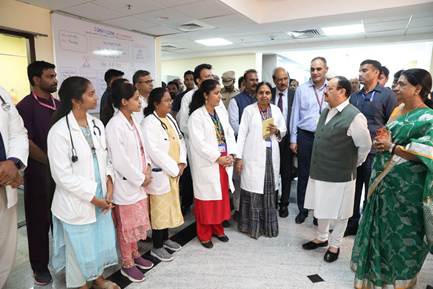
On 9 July 2026, Health Minister J. P. Nadda reviewed AIIMS Bibinagar’s progress. The review described approximately 87.4% construction completion. The whole-number figure is about 87%.
The institute served around 1,800 outpatients daily. It had 132 faculty members and 133 senior residents. Two MBBS batches had completed the course. These counts measure different parts of its work.
Research grants totalled ₹64 crore across 129 projects. The 1,156 figure counted research publications, not researcher applications. Six adopted villages and 547 mobile medical camps showed work in nearby communities.
The percentage shows how much building work was done. It cannot prove all work will end by December 2026. Visits, trained students and research papers count different things. Do not add them into one score.
Sources: Bibinagar review · 2022 AIIMS services.
Check 4
Bibinagar’s 1,156 figure counted researcher applications.
How much freedom does an AIIMS have?
Autonomy works within a legal framework
AIIMS New Delhi is an autonomous body under the Ministry of Health and Family Welfare. AIIMS has statutory autonomy. This means a law gives AIIMS powers to run its own affairs. AIIMS can make choices within those rules. It must still obey the law and account for public funds.
The Act sets up bodies to run AIIMS. It also sets rules for the use of funds. The original Act runs from section 1 to section 29 without formal chapter divisions. Read later changes with the first text.
New AIIMS can bring expert care and training closer to more people. A name alone cannot supply teachers, tools or staffed beds. To compare campuses, check what each can do. Do not judge by the name alone.
AIIMS and the Indian Institutes of Technology serve distinct fields. Both are public centres of advanced learning. AIIMS focuses on health. IITs focus on technology and related fields.
Sources: AIIMS Act · AIIMS history · AIIMS ministry status.
The students’ union case concerned admissions
In AIIMS Students’ Union v. AIIMS (2001), the Supreme Court examined institutional preference in postgraduate medical admissions. The case linked the pursuit of excellence with Fundamental Duties under Article 51A.
Fundamental Duties are not directly enforceable through a writ like Fundamental Rights. Courts can still use duties as a guide when they read the law. The judgment stressed two duties. Citizens should develop scientific temper and strive for excellence.
Duties do not always trump Fundamental Rights. They still have a role. A guide to reading the law is not the same as a right to seek a writ.
Sources: Supreme Court judgment · Constitution.
Check 5
Fundamental Duties have no role in constitutional interpretation.
Questions that connect the lesson
Why can a hospital open while construction continues?
A campus has many buildings. A clinic or ward may open before all blocks are ready. One count tracks building work. The other shows what patients can use.
Does a New Zealand grant explain AIIMS’s legal status?
The grant helped fund the project. An Indian law set up AIIMS and gave it powers. Who paid and who gave legal powers are two distinct questions.
Practice MCQ
Use these five questions to separate dates, funding, expansion and constitutional principles.
0 of 1 answered Question 1 of 1 0 of 1 answered Question 1 of 1 0 of 1 answered Question 1 of 1 0 of 1 answered Question 1 of 1 0 of 1 answered Question 1 of 1
Leave a Reply