The Taj Mahal wasn’t built beside the Yamuna by accident. Its still water was meant to double the monument, mirror and all.


 MCQ Questions
The Taj Mahal wasn’t built beside the Yamuna by accident. Its still water was meant to double the monument, mirror and all.
1. Source and Course
1.1 Where does the Yamuna begin, and where does it end?
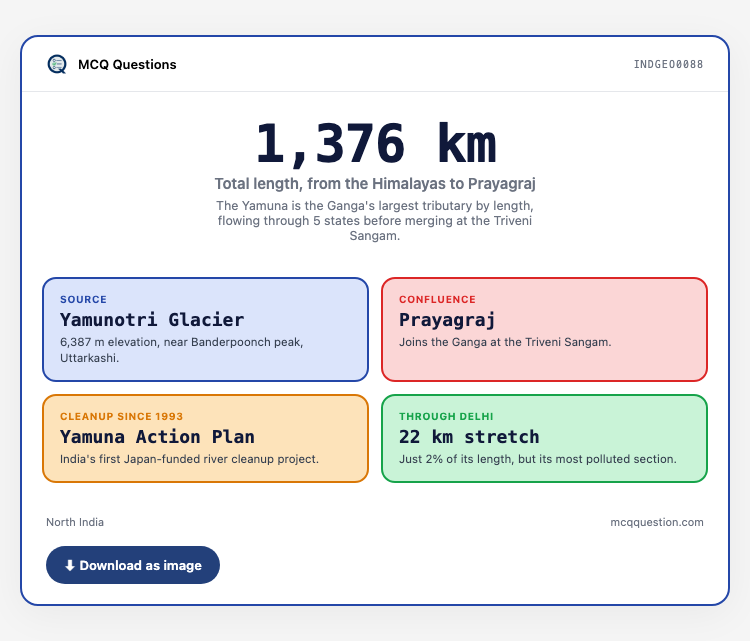
The Yamuna originates at the Yamunotri Glacier, near Banderpoonch peak in Uttarkashi, Uttarakhand. Its source sits at about 6,387 metres elevation.
- It’s the Ganga’s largest tributary, running about 1,376 km.
- The river drops rapidly from its glacial source before settling into a gentler course across the plains.
- It flows through Uttarakhand, Himachal Pradesh, Haryana, Delhi, and Uttar Pradesh.
- The river joins the Ganga at Prayagraj, at the Triveni Sangam.
- Tradition holds that the mythical Saraswati also meets the Ganga and Yamuna at this same confluence.
- The land between the Yamuna and the Ganga is called the Ganga-Yamuna Doab, a historically fertile region.
- This Doab has supported dense agriculture for centuries, thanks to fertile alluvial soil deposited by both rivers.
- The Doab has long been a densely populated political and cultural heartland of northern India.
True or False: The Yamuna originates at the Yamunotri Glacier and is the Ganga’s largest tributary by length.
Correct! It runs about 1,376 km before joining the Ganga at Prayagraj.
Not quite. The Yamuna does begin at the Yamunotri Glacier and is the Ganga’s largest tributary by length.
2. Tributaries and Cities
2.1 Which tributaries and cities matter most along the Yamuna?
Major tributaries include the Tons, its largest by water volume.
- Other major tributaries include the Chambal, Betwa, Ken, and Hindon.
- The Ken and Betwa are also central to India’s Ken-Betwa river-linking project, its first major interlinking scheme.
- That project aims to move surplus Ken water into the drought-prone Betwa basin, in Madhya Pradesh and Uttar Pradesh.
- The Yamuna flows past several historically major cities, including Delhi, Agra, and Mathura.
- Delhi itself draws a large share of its drinking water supply from the Yamuna.
- The Okhla Bird Sanctuary sits on the Yamuna, right where the river leaves Delhi for Uttar Pradesh.
- The Hathnikund Barrage, in Haryana, regulates the river’s flow before it reaches Delhi.
- The Western and Eastern Yamuna Canals, drawn from this barrage, irrigate large parts of Haryana and Uttar Pradesh.
- These canals date back to Mughal and colonial-era engineering, later expanded after independence.
3. The Taj Mahal and Mathura-Vrindavan
3.1 Why does the Yamuna matter to the Taj Mahal, and to Mathura-Vrindavan?
The Taj Mahal, in Agra, sits on the Yamuna’s southern bank, and its placement wasn’t accidental.
- The calm river water reflects the monument, adding to its “floating tomb” effect.
- In Mathura and Vrindavan, the Yamuna carries deep religious significance, tied to Krishna’s childhood in the Bhagavata Purana.
- Ghats like Vishram Ghat remain major pilgrimage sites today.
- Devotees also observe Yamuna Chhath, a festival specifically honouring the river as a goddess.
- In Hindu tradition, the Yamuna is personified as the goddess Yamuna, sister of Yama, the god of death.
- The Yamuna is counted among India’s seven sacred rivers, alongside the Ganga, Godavari, and others.
- Temple art often shows the Yamuna riding a tortoise, a visual motif distinct from the Ganga’s own iconography.
4. The Cleanup Effort
4.1 What has been done to clean up the Yamuna?
The Yamuna Action Plan (YAP), launched in 1993, was India’s first major river-cleanup project funded by Japan.
- Its first phase built 29 sewage treatment plants across Delhi, Haryana, and Uttar Pradesh, running until 2003.
- Despite decades of cleanup efforts, the roughly 22 km stretch through Delhi remains its most polluted section.
- That stretch is just a small fraction of the river’s total length.
- Recent efforts continue under the Namami Gange Programme, with nine projects worth over ₹1,951 crore sanctioned for Delhi alone.
- A large share of the pollution comes from untreated domestic sewage discharged directly into the river.
- Industrial effluents from towns along its course add further contamination, especially heavy metals.
- Chhath Puja and idol immersion during festivals also add seasonal pollution spikes each year.
- Toxic foam, caused by detergents and industrial phosphates, has become a visible, recurring symbol of the river’s pollution near Delhi.
Exam Practice: PYQ Pattern
Common traps in this topic:
- Questions test which basin each of the Yamuna’s neighbouring rivers actually belongs to.
- How to prepare: fix the anchor facts — Yamunotri Glacier, 1,376 km, Triveni Sangam at Prayagraj.
A Basin-Matching Trap. UPSC asked which basin each of four rivers, Sutlej, Kosi, Teesta, and Chambal, actually belongs to.
Answer: (c) Sutlej-Indus, Kosi-Ganga, Teesta-Brahmaputra, Chambal-Yamuna. Chambal is a Yamuna tributary, not part of any other river’s basin.
Quick recall: The Chambal river, a Yamuna tributary, is particularly well known for what?
Deep ravines and heavily eroded badland terrain.
5. A River That’s Both Sacred and Polluted
5.1 What’s the real paradox behind the Yamuna’s story?
The Yamuna shows a real paradox in Indian river management.
- It’s simultaneously one of India’s most sacred rivers and one of its most polluted, worshipped and fouled along the same stretch through Delhi.
- Its Mughal-era role went beyond religious symbolism into deliberate architecture.
- Riverside siting, seen at both Agra Fort and the Taj Mahal, used the Yamuna’s still water as a design element, not just a water source.
- The gap between the Yamuna’s small footprint through Delhi and its outsized pollution burden illustrates a wider pattern.
- A river’s worst-affected stretch is often exactly where it passes through its largest city, not where it’s longest or widest.
- Examiners often test this contrast: a river’s cultural stature and its actual water quality can move in opposite directions.
- The Ganga itself shows a similar pattern, most polluted where it passes through its largest cities.
- Unlike a river’s natural geography, this pollution pattern is entirely a product of human infrastructure choices.
6. Current Affairs
6.1 What did Parliament’s 2026 review find?
On 7 August 2026, the Rajya Sabha’s Standing Committee on Science, Technology, Environment, Forests and Climate Change tabled its 413th Report. (Source: PIB)
- This report reviewed the government’s action on the Committee’s earlier 402nd Report on Water Pollution in Delhi NCR.
- The 402nd Report had flagged severe water-quality degradation in the Yamuna’s stretch between Palla, Wazirabad, and the Shahdara Drain. (Source: PRS India)
- It recommended more frequent monitoring, and adding Chemical Oxygen Demand as a tracked contamination parameter.
MCQ on The Yamuna River
Try 7 practice questions on The Yamuna River.
Question 1 of 1
Question 1 of 1
Question 1 of 1
Question 1 of 1
Question 1 of 1
Question 1 of 1
Question 1 of 1
Leave a Reply